1. Search Result
Search Result
Results for "

ZnPc

" in MedChemExpress (MCE) Product Catalog:

4

Inhibitors & Agonists

1

Fluorescent Dye

Cat. No. Product Name Target Research Areas Chemical Structure
  • HY-19204

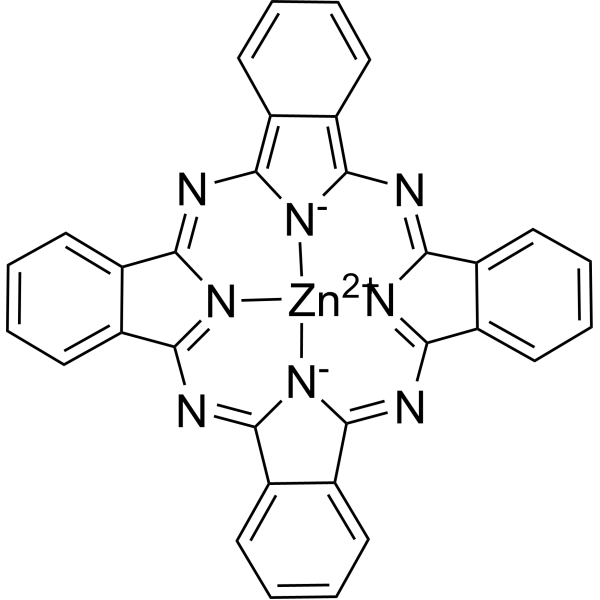
    ZnPc

    Ligands for Target Protein for PROTAC Reactive Oxygen Species (ROS) Apoptosis Caspase Cancer
    Zinc phthalocyanine (ZnPc) is commonly applied in industry (catalysts, photoconductors) and biomedical (photodynamic therapy, PDT). Zinc phthalocyanine can be used to photooxidise cyclohexane and is promising for research of solar-cell applications .
    Zinc phthalocyanine
  • HY-176724

    Epigenetic Reader Domain Reactive Oxygen Species (ROS) HIF/HIF Prolyl-Hydroxylase Cancer
    ZnPc-O3-JQ1 is a light-triggered BRD4 degrader. Under illumination, ZnPc-O3-JQ1 generates reactive oxygen species (ROS) that degrades BRD4. The degradation of BRD4 results in downregulation of HIF-1α, thereby counteracting the photodynamic therapy (PDT) resistance induced by tumor hypoxia. ZnPc-O3-JQ1 exhibits both Type I and Type II PDT mechanisms. The structure of ZnPc-O3-JQ1 consists of three parts: BRD4 ligand (HY-78695); Linker (HY-W040165); Photosensitizer (HY-176725) .
    ZnPc-O3-JQ1
  • HY-176726

    Reactive Oxygen Species (ROS) Cancer
    ZnPc-amide-PEG3-C2-NH2 is a photosensitizer-linker conjugate which consists of ZnPcPs (HY-176725) and a linker (HY-W040165). ZnPc-amide-PEG3-C2-NH2 can be used to synthesize the photo-activated BRD4 degrader pZnPc-O3-JQ1 (HY-176724) .
    ZnPc-amide-PEG3-C2-NH2
  • HY-181906

    PROTACs Reactive Oxygen Species (ROS) CDK Cancer
    ZnPc-PEG2-VH032 is a VHL-pathway-dependent photodegradation targeting chimera (PDTAC) and cytotoxic agent. ZnPc-PEG2-VH032 (HY-120217) binds to the VHL ligand domain, and then specifically degrades VHL under light irradiation, a process independent of non-specific ROS-mediated protein damage. ZnPc-PEG2-VH032 uses Zinc phthalocyanine (HY-19204) as a photosensitizer, and generates ROS via type I and type II photodynamic pathways under 680 nm LED irradiation. On one hand, it targets and degrades the bound VHL protein through ROS; on the other hand, it exerts direct photodynamic cytotoxicity. Meanwhile, the degradation of VHL downregulates the phosphorylation level of CDK2/4, induces cell cycle arrest in tumor cells, further enhances the sensitivity of tumor cells to oxidative damage caused by ROS, and achieves a synergistic anti-tumor effect. ZnPc-PEG2-VH032 exerts significant in vivo efficacy in an orthotopic mouse model of non-muscle invasive bladder cancer (NMIBC) .
    ZnPc-PEG2-VH032

Inquiry Online

Your information is safe with us. * Required Fields.

Salutation


Country or Region *

Applicant Name *


Organization Name *

Department *


Email Address *


Product Name *

Cat. No.


Requested quantity *

Phone Number *


Remarks

Inquiry Online

Inquiry Information

Product Name:
Cat. No.:
Quantity:
MCE Japan Authorized Agent:

