1. Search Result
Search Result
Results for "

acyl chain substrate

" in MedChemExpress (MCE) Product Catalog:

8

Inhibitors & Agonists

1

Biochemical Assay Reagents

1

Natural
Products

1

Isotope-Labeled Compounds

Cat. No. Product Name Target Research Areas Chemical Structure
  • HY-134421

    HMG-CoA Reductase (HMGCR) Metabolic Disease
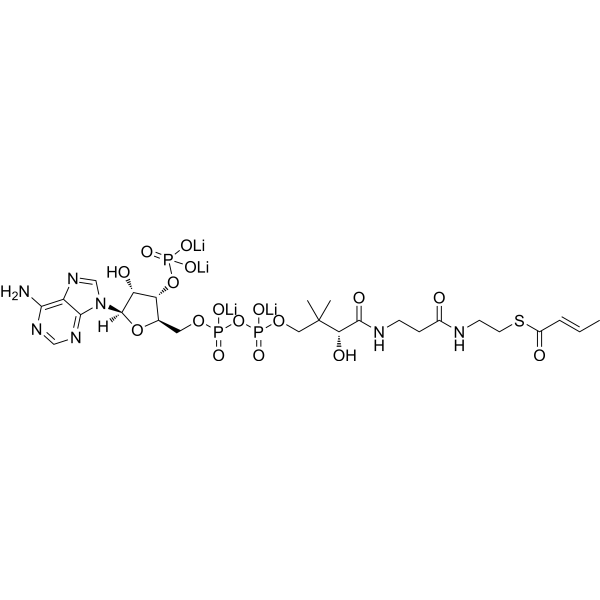
    2-Butenoyl coenzyme A lithium is an inactivator and a substrate of Plasmodium falciparum enoyl-β-hydroxyacyl-acyl carrier protein (ACP) reductase and other enoyl-CoA reductases, and it is also the lithium salt of trans-2-methyl-2-butenoyl coenzyme A. 2-Butenoyl coenzyme A lithium acts on short-chain and medium-chain coenzyme A dehydrogenases as well as glutaryl-CoA dehydrogenase, and shows no activity against wild-type isovaleryl-CoA dehydrogenase. 2-Butenoyl coenzyme A lithium functions as a metabolite in the L-isoleucine catabolic pathway, and can serve as a substrate in the activity assay of 3-ketothiolase. 2-Butenoyl coenzyme A lithium is applicable to research related to 3-ketothiolase deficiency .
    2-Butenoyl coenzyme A lithium
  • HY-B0399S
    L-Carnitine-d9
    1 Publications Verification

    (R)-Carnitine-d9; Levocarnitine-d9

    Isotope-Labeled Compounds Endogenous Metabolite Neurological Disease Metabolic Disease
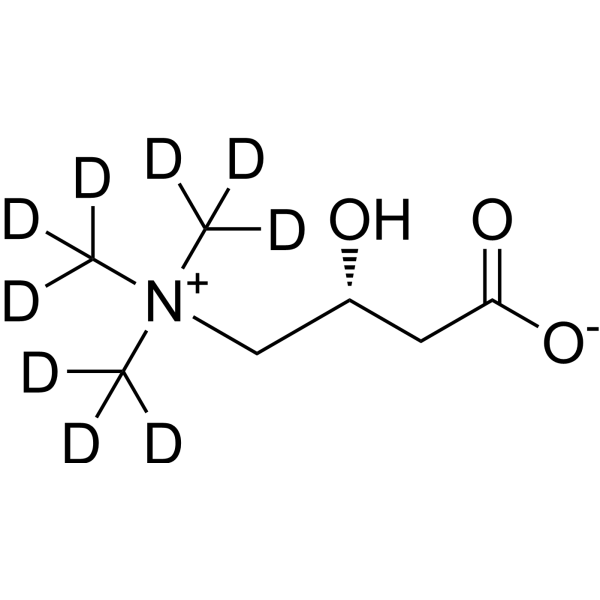
    L-Carnitine-d9 is the deuterium labeled L-Carnitine. L-Carnitine (Levocarnitine) is an endogenous molecule involved in fatty acid metabolism, biosynthesized within the human body using amino acids: L-lysine and L-methionine, as substrates. L-Carnitine functions to transport long chain fatty acyl-CoAs into the mitochondria for degradation by β-oxidation. L-carnitine can ameliorate metabolic imbalances in many inborn errors of metabolism .
    L-Carnitine-d9
  • HY-126720

    Endogenous Metabolite Metabolic Disease
    N-Lignoceroyl Taurine is an arachidonoyl amino acid and taurine conjugate with a fatty acid that can be isolated from bovine brain. N-Lignoceroyl Taurine is one of several novel taurine-conjugated fatty acids discovered during mass spectrometry lipidomic analysis of the brain and spinal cord of wild-type and fatty acid amide hydrolase (FAAH) knockout mice. N-Lignoceroyl Taurine levels were 23-26-fold higher in FAAH -/- mice compared to wild-type mice, suggesting that FAAH utilizes N-Lignoceroyl Taurine as a substrate. However, in vitro experiments with purified FAAH showed that N-Lignoceroyl Taurine was hydrolyzed 2,000-fold slower in FAAH compared to oleoylethanolamide. N-Acyl Taurines with polyunsaturated acyl chains can activate members of the transient receptor potential (TRP) calcium channel family, including TRPV1 and TRPV4.
    N-Lignoceroyl Taurine
  • HY-W284557

    2-Hydroxydecane; Methyl octyl carbinol

    Biochemical Assay Reagents Others
    2-Decanol can be used to develop a miniature catalytic reactor for the oxidation of alcohols with oxygen in supercritical carbon dioxide. 2-Decanol can be used in research on the substrate spectrum of phytanoyl-CoA hydroxylase with regard to the length of both the acyl chain and the branch at position .
    2-Decanol
  • HY-E70246

    Pelargonoyl-CoA; S-Nonanoate coenzyme A; Nonanoyl-coenzyme A

    Biochemical Assay Reagents Metabolic Disease
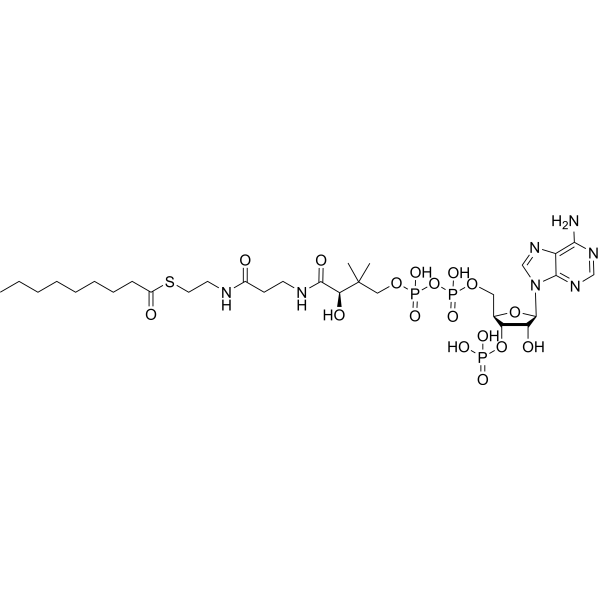
    Nonanoyl-CoA (Pelargonoyl-CoA) is a medium-chain fatty acyl-CoA that can be used as substrate for the medium-chain hydrolase .
    Nonanoyl-CoA
  • HY-148869A

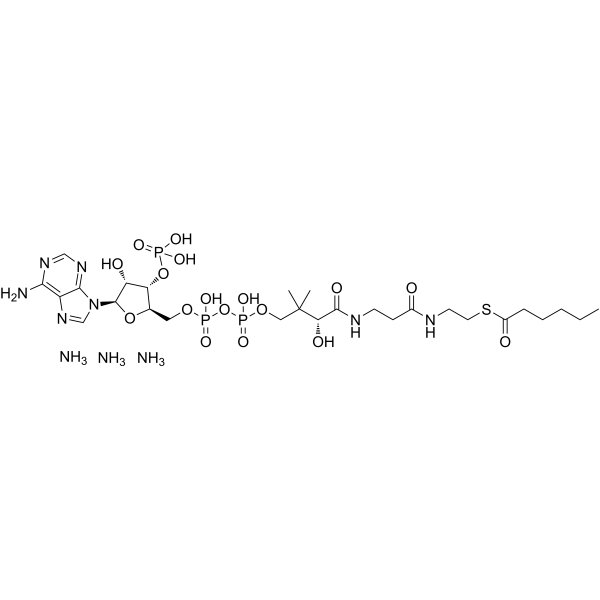
    06:0 Coenzyme A triammonium

    Biochemical Assay Reagents Metabolic Disease
    Hexanoyl-Coenzyme A triammonium (06:0 Coenzyme A) is a medium-chain fatty acyl CoA that is an acyl donor substrate for ghrelin O-acyltransferase (GOAT) .
    Hexanoyl-coenzyme A triammonium
  • HY-E70276

    Endogenous Metabolite Metabolic Disease
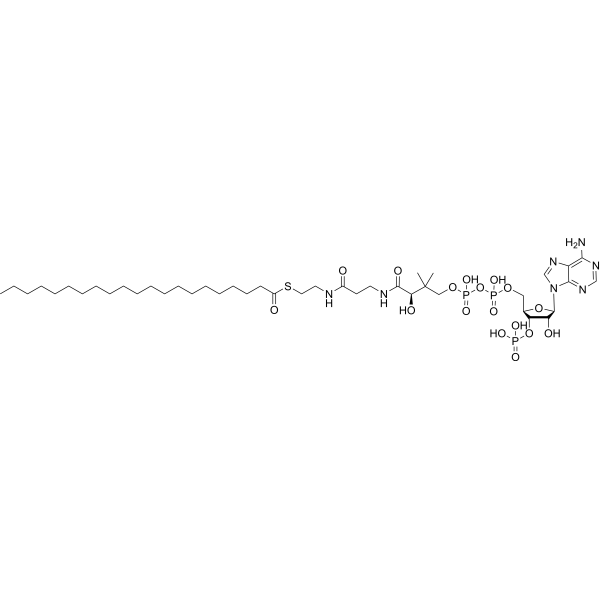
    Heneicosanoyl-CoA is a substrate of Very long-chain acyl-CoA dehydrogenase (VLCAD) in the anaerobic electron transfer flavoprotein (ETF) assay .
    Heneicosanoyl-CoA
  • HY-186236

    Bacterial Infection
    N42FTA is a non-covalent, non-suicidal inhibitor of FabA from Pseudomonas aeruginosa and Escherichia coli, with IC50 values of 3.27 μM and 2.31 μM, respectively. As a natural substrate mimetic, N42FTA blocks the cross-linking between acyl carrier protein and FabA in Escherichia coli. N42FTA shows no significant antibacterial activity due to poor permeability. N42FTA can be used in studies related to Pseudomonas aeruginosa and Escherichia coli infections .
    N42FTA

Inquiry Online

Your information is safe with us. * Required Fields.

Salutation


Country or Region *

Applicant Name *


Organization Name *

Department *


Email Address *


Product Name *

Cat. No.


Requested quantity *

Phone Number *


Remarks

Inquiry Online

Inquiry Information

Product Name:
Cat. No.:
Quantity:
MCE Japan Authorized Agent:

