6 Results for "

aqueous medium

" in MedChemExpress (MCE) Product Catalog:
Products (6)

6 Results for "aqueous medium" in MCE Product Catalog:

Cat. No.: HY-160113E
Sodium phosphate buffer 0.1M, pH 8.0 is an aqueous sodium phosphate buffer with a concentration of 0.1M and a pH value of 8.0. Sodium phosphate buffer 0.1M, pH 8.0 can be used for the preparation of hydrated micellar membranes, the construction of pH-sensitive nanocarriers, and the maintenance of stable environmental conditions for pH-cleavable PEG-Hz-PE micelles. Sodium phosphate buffer 0.1M, pH 8.0 can also serve as a universal solvent, reaction medium and eluent, and is widely applied in experimental processes such as antibody thiolation, nanoparticle purification and cross-linking reactions .
loading...
    loading...
Cat. No.: HY-B1610K
Sodium Citrate Buffer, 0.5M, pH 5.5 is a metal chelator and buffering agent. Sodium Citrate Buffer, 0.5M, pH 5.5 requires oxygen to participate in the oxidation process to reduce pink defects in cooked ground turkey, and it does not function via heme iron chelation or iron complex interaction. When mixed with 50% (by vol.) 1,3-dimethylimidazolium methyl sulfate, Sodium Citrate Buffer, 0.5M, pH 5.5 can serve as an aqueous buffering medium to maintain the catalytic efficiency of the hyperthermophilic β-glycosidase CelB for lactose hydrolysis at 80°C, while also acting as a reaction medium for CelB-catalyzed lactose hydrolysis and galactosyltransferase assays .
loading...
    loading...
Cat. No.: HY-D1470
CAS No.: 210832-86-3
Target:  

Fluorescent Dye

Research Areas:  

Others

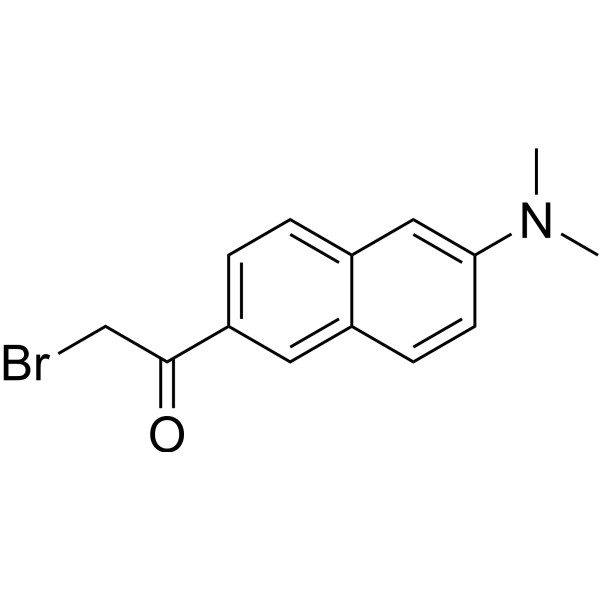
BADAN is a thiol-reactive, environment-sensitive fluorescent probe used for site-specific labeling of protein cysteine residues to detect protein topology, local polarity, protein-lipid interactions, and conformational changes. The bromoacetyl group of BADAN covalently binds to cysteine thiols, and its fluorescence originates from the intramolecular charge transfer (ICT) excited state. The emission peak position varies with the polarity of the surrounding medium: it blue-shifts to approximately 488 nm in nonpolar environments (such as the hydrophobic core of lipid bilayers) and red-shifts to approximately 496-507 nm in polar environments (such as aqueous phases), independent of enzymes, pH, or membrane potential. Ex = 380-402 nm; Em = 400-600 nm .
loading...
    loading...
Cat. No.: HY-125749
CAS No.: 41044-12-6
Coumarin-30 is a coumarin-based fluorescent dye and environment-sensitive fluorescent probe (in aqueous medium, λex = 430 nm, λem = 495 nm). Coumarin-30 serves as a dopant for organic light-emitting diodes .
loading...
    loading...
Cat. No.: HY-124886
CAS No.: 738-75-0
Synonyms: N-Phenylacetylphenylalanine
Research Areas:  

Others

N-(Phenylacetyl)-L-phenylalanine (N-Phenylacetylphenylalanine) is an amino acid analog. N-(Phenylacetyl)-L-phenylalanine is produced via the enantioselective acylation of L-phenylalanine catalyzed by penicillin G acylase from Alcaligenes faecalis. N-(Phenylacetyl)-L-phenylalanine undergoes hydrolysis in aqueous media .
loading...
    loading...
Cat. No.: HY-181553A
Research Areas:  

Cancer

PROTAC BRD4 Degrader-45 is a PROTAC degrader targeting BRD4, with a DC50 of 43 nM. PROTAC BRD4 Degrader-45 is applicable to studies on membrane-permeable PROTACs .
loading...
    loading...

