5 Results for "

catecholamine release and uptake

" in MedChemExpress (MCE) Product Catalog:
Products (5)

5 Results for "catecholamine release and uptake" in MCE Product Catalog:

Cat. No.: HY-B1231
CAS No.: 543-15-7
Synonyms: RP-2831 hydrochloride
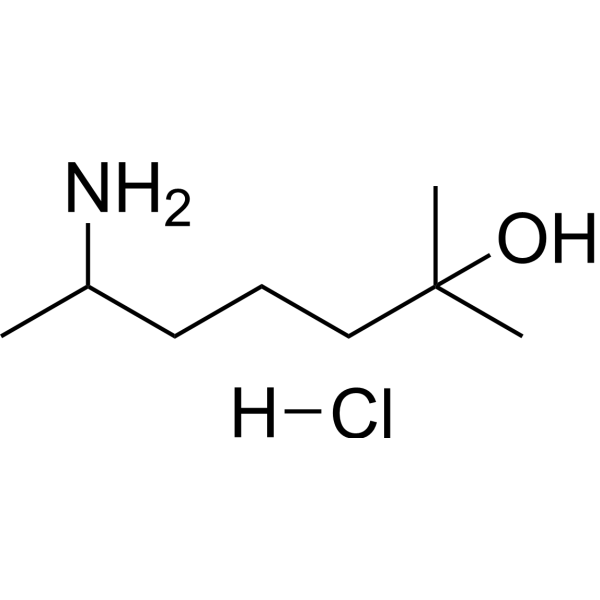
Heptaminol (RP-2831) hydrochloride is a vasoconstrictor used in the study of hypotension, especially orthostatic hypotension. Heptaminol is also a skin cancer proliferation inhibitor that inhibits immune inflammation induced by the tumor promoting factor 12-O-tetradecanoylphorbol-13-acetate (TPA) in an NO-dependent manner. Heptaminol also acts as a sympathomimetic amine, exerting indirect sympathetic effects. Heptaminol is also an antagonist of catecholamine release and uptake and can increase intracellular free calcium levels .
loading...
    loading...
Cat. No.: HY-W685943
CAS No.: 372-66-7
Heptaminol is a fatty amine with pressor properties and a potential antihypotension agent. Heptaminol is also a competitive inhibitor of norepinephrine uptake and an inhibitor of nicotine-induced catecholamine release (IC50: 650 μM). Heptaminol does not inhibit norepinephrine release induced by 59 mM K + but rather inhibits high-affinity Na +-dependent norepinephrine uptake .
loading...
    loading...
Cat. No.: HY-B1231R
CAS No.: 543-15-7
Synonyms: RP-2831 hydrochloride (Standard)
Heptaminol (hydrochloride) (Standard) is the analytical standard of Heptaminol (hydrochloride). This product is intended for research and analytical applications. Heptaminol (RP-2831) hydrochloride is a vasoconstrictor used in the study of hypotension, especially orthostatic hypotension. Heptaminol is also a skin cancer proliferation inhibitor that inhibits immune inflammation induced by the tumor promoting factor 12-O-tetradecanoylphorbol-13-acetate (TPA) in an NO-dependent manner. Heptaminol also acts as a sympathomimetic amine, exerting indirect sympathetic effects. Heptaminol is also an antagonist of catecholamine release and uptake and can increase intracellular free calcium levels .
loading...
    loading...
Cat. No.: HY-P11313
Synonyms: Rat chromogranin A367–387
Target:  

nAChR Akt

Research Areas:  

Cardiovascular Disease

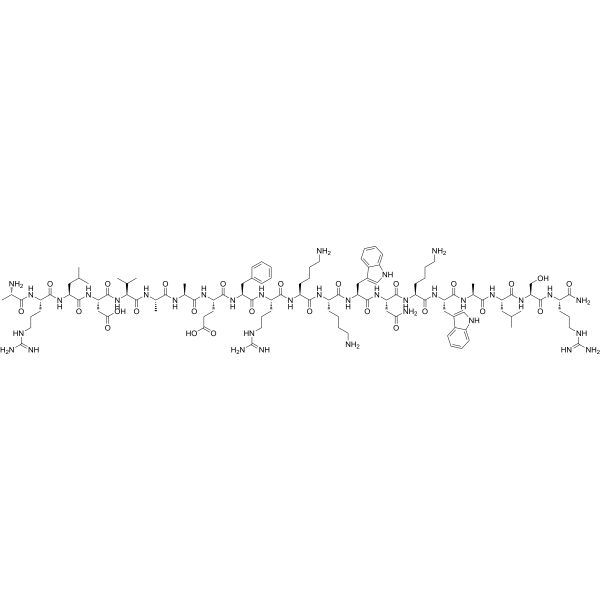
Catestatin (rat) (Rat chromogranin A367–387) is a potent, reversible, noncompetitive, and noncooperative nicotinic cholinergic antagonist derived from chromogranin A (A367-387). Catestatin (rat) inhibits norepinephrine release in rat PC12 pheochromocytoma cells (IC50 = 1.2 μM), and blocks desensitization of norepinephrine release (IC50 = 0.62 μM). Catestatin (rat) exerts antiadrenergic effects through the endothelial PI3K-AKT-eNOS pathway in rat papillary muscles and isolated cardiomyocytes. Catestatin (rat) maintains mitochondrial membrane potential in I/R cardiomyocytes and increases phosphorylation of AKT at S473, GSK3β at S9, PLB at T17, and eNOS at S1179. Catestatin (rat) reverses desensitization of 22Na + uptake. Catestatin (rat) can be used for the study of nicotinic cholinergic receptor regulation and catecholamine release control mechanisms .
loading...
    loading...
Cat. No.: HY-P5876
CAS No.: 154095-31-5
Synonyms: ProADM N20(bovine, porcine); PAMP-20(bovine, porcine)
Target:  

nAChR

Research Areas:  

Neurological Disease

Proadrenomedullin (N-20) (ProADM N20) (bovine, porcine) is a potent and noncompetitive hypotensive and catecholamine release-inhibitory peptide released from chromaffin cells. Proadrenomedullin (N-20) (bovine, porcine) inhibits catecholamine secretion with an IC50 of 350 nM in PC12 pheochromocytoma cells. Proadrenomedullin (N-20) (bovine, porcine) also blocks (EC50≈270 nM) nicotinic cholinergic agonist desensitization of catecholamine release, as well as desensitization of nicotinic signal transduction ( 22Na + uptake) .
loading...
    loading...

