8 Results for "

loam soil

" in MedChemExpress (MCE) Product Catalog:
Products (8)

8 Results for "loam soil" in MCE Product Catalog:

Cat. No.: HY-W019334
CAS No.: 202842-98-6
Synonyms: 3,4-DMPP
Target:  

Bacterial

Research Areas:  

Others

3,4-Dimethylpyrazole phosphate (3,4-DMPP) is a nitrification inhibitor and microbial community regulator, whose activity is dose- and soil pH-dependent. 3,4-Dimethylpyrazole phosphate inhibits ammonia monooxygenase, ammonia-oxidizing bacteria, as well as ammonia-oxidizing archaea and nitrite-oxidizing bacteria. 3,4-Dimethylpyrazole phosphate alters the community composition of prokaryotes, fungi and ammonia-oxidizing bacteria. 3,4-Dimethylpyrazole phosphate reduces nitrate leaching, nitrous oxide emission and soil nitrate accumulation, and enhances nitrogen use efficiency and crop yield in agricultural production. 3,4-Dimethylpyrazole phosphate is applicable to agriculture-related research .
loading...
    loading...
Cat. No.: HY-41465
CAS No.: 74-11-3
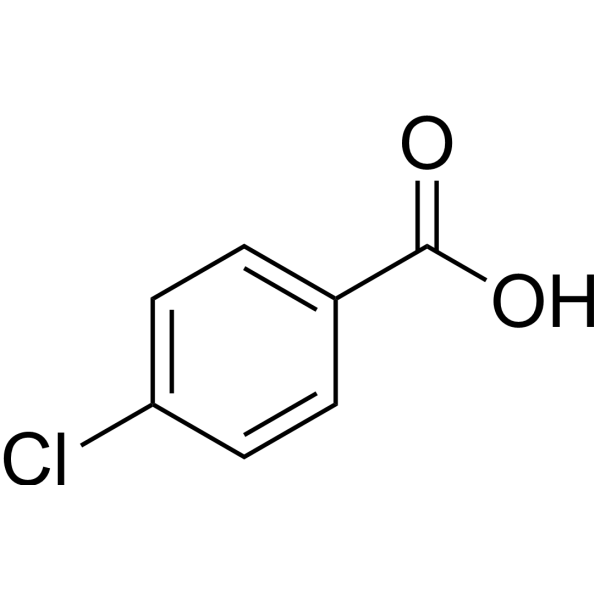
4-Chlorobenzoic acid is a halogenated aromatic compound that can be used as an industrial chemical and an intermediate in drug synthesis. 4-Chlorobenzoic acid is a persistent organic micropollutant and can be biodegraded through a direct dehalogenation pathway .
loading...
    loading...
Cat. No.: HY-B1871
CAS No.: 51218-45-2
Research Areas:  

Others

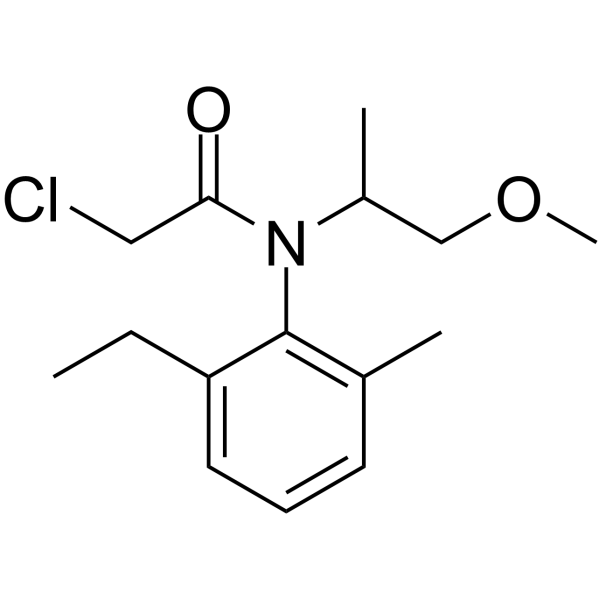
Metolachlor is a crop-selective chloroacetamide pre-emergence Herbicide. Microbial biodegradation serves as the primary dissipation pathway of Metolachlor in soil environments. Metolachlor can be used in studies related to farmland weed control .
loading...
    loading...
Cat. No.: HY-B1849
CAS No.: 51235-04-2
Research Areas:  

Others

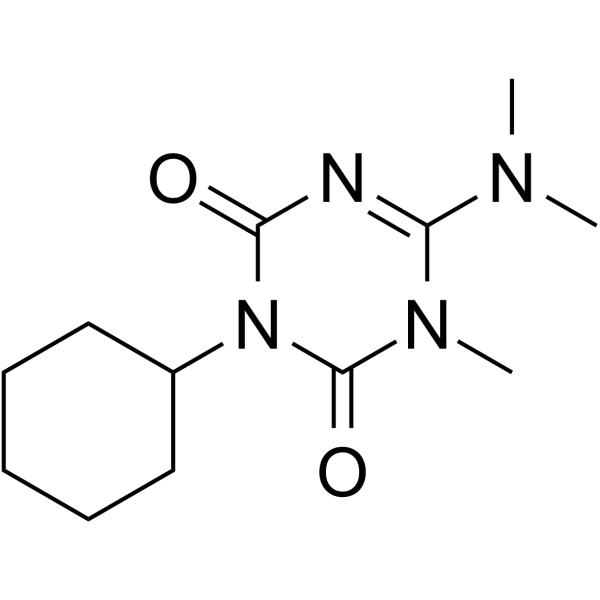
Hexazinone is a triazinone herbicide with high mobility and persistence in soil. Hexazinone is mainly degraded by soil microorganisms, and its degradation and mineralization processes are significantly affected by soil texture (faster in clay loam) and application method (mixed application can improve its bioavailability and mineralization rate). Hexazinone exhibits mild to moderate acute oral toxicity and has significant eye irritation .
loading...
    loading...
Cat. No.: HY-B1849R
CAS No.: 51235-04-2
Hexazinone (Standard) is the analytical standard of Hexazinone. This product is intended for research and analytical applications. Hexazinone is a triazinone herbicide with high mobility and persistence in soil. Hexazinone is mainly degraded by soil microorganisms, and its degradation and mineralization processes are significantly affected by soil texture (faster in clay loam) and application method (mixed application can improve its bioavailability and mineralization rate). Hexazinone exhibits mild to moderate acute oral toxicity and has significant eye irritation .
loading...
    loading...
Cat. No.: HY-B1849S
CAS No.: 1219804-22-4
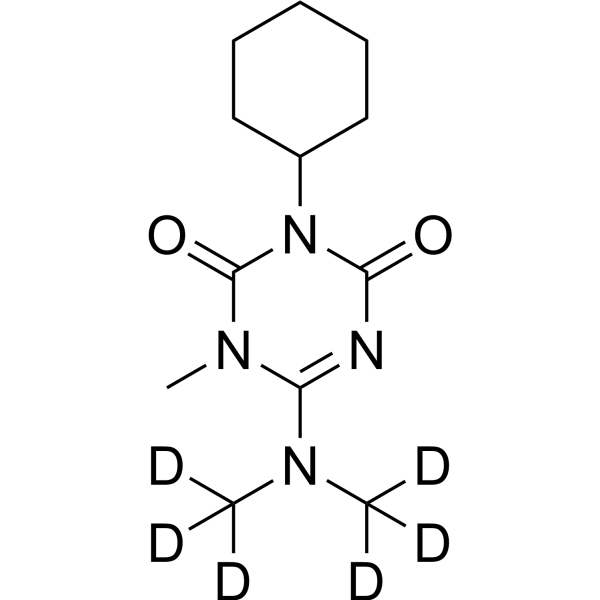
Hexazinone-d6 is the deuterium labeled Hexazinone. Hexazinone is a triazinone herbicide with high mobility and persistence in soil. Hexazinone is mainly degraded by soil microorganisms, and its degradation and mineralization processes are significantly affected by soil texture (faster in clay loam) and application method (mixed application can improve its bioavailability and mineralization rate). Hexazinone exhibits mild to moderate acute oral toxicity and has significant eye irritation .
loading...
    loading...
Cat. No.: HY-W588214
CAS No.: 2588-04-7
Research Areas:  

Infection

Phorate sulfone, Phorate metabolite, is an insecticide. Phorate sulfone shows inhibitory activity aainst acetylcholinesterase with an IC50 of 40 μM, leading to acetylcholine accumulation at cellular and subcellular levels. Phorate sulfone can be used for the research of severe phorate poisoning .
loading...
    loading...
Cat. No.: HY-W727532
CAS No.: 1992017-55-6
Target:  

HPPD Herbicide

Research Areas:  

Others

Fenpyrazone is a 4-hydroxyphenylpyruvate dioxygenase (HPPD) inhibitor as well as a post-emergence herbicide. By inhibiting the activity of HPPD, Fenpyrazone indirectly blocks carotenoid biosynthesis in plants, causing bleaching of new tissues in sensitive plants, followed by necrosis and eventual death. Fenpyrazone is used in studies on controlling annual monocotyledonous and dicotyledonous weeds in summer maize fields .
loading...
    loading...

