5 Results for "

mitochondrial DNA G-quadruplex

" in MedChemExpress (MCE) Product Catalog:
Products (5)

5 Results for "mitochondrial DNA G-quadruplex" in MCE Product Catalog:

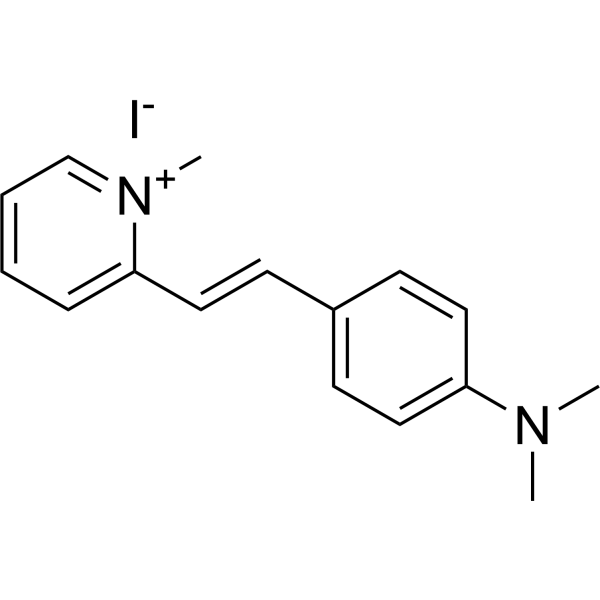
Cat. No.: HY-135009
CAS No.: 2156-29-8
Purity:  99.97%
Synonyms: DASPI
2-Di-1-ASP (DASPI; Compound 18a) is a mono-stryryl dye, and widely used as mitochondrial stain and groove-binding fluorescent probes for double-stranded DNA. 2-Di-1-ASP is selective for G-quadruplex (G4) and double-stranded DNA .
loading...
    loading...
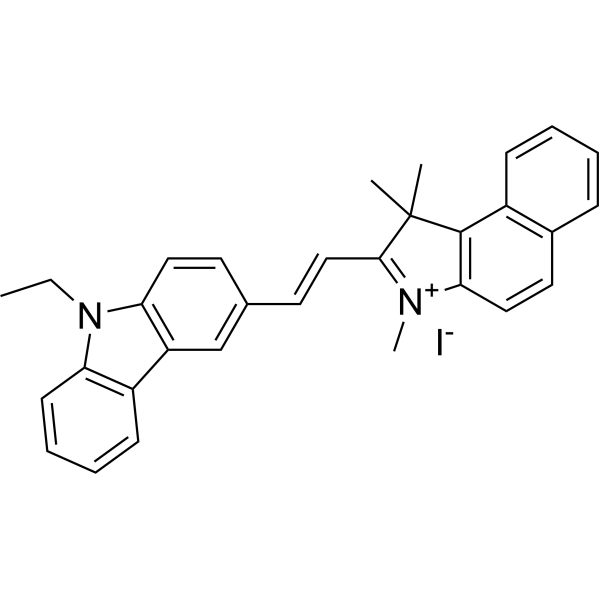
Cat. No.: HY-162084
CAS No.: 1607831-82-2
Target:  

Autophagy Apoptosis

Research Areas:  

Cancer

BKN-1 is a bifunctional ligand that can not only track the formation of mtG4s (G-quadruplexes, four-stranded DNA structures containing Hoogsteen bonds) through far-red emission, but can also induce mitochondrial dysfunction. BKN-1 has anti-tumor activity and may cause mtDNA loss, damage mitochondrial integrity, reduce ATP levels, and trigger ROS imbalance, leading to apoptosis and autophagy .
loading...
    loading...
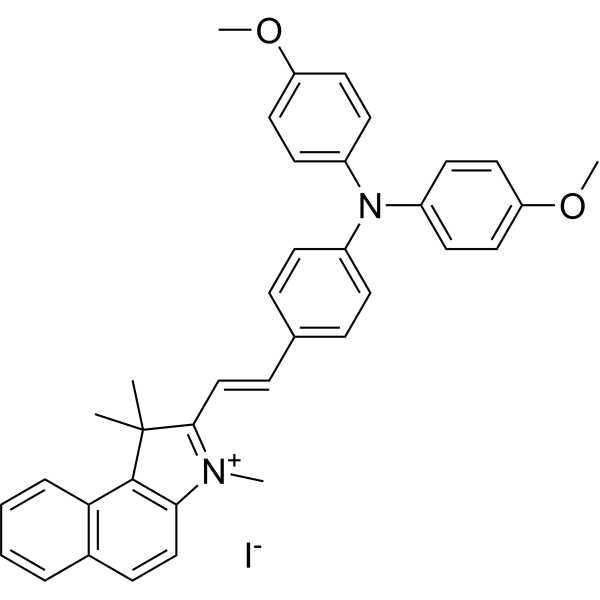
Cat. No.: HY-158126
Target:  

DNA/RNA Synthesis

Research Areas:  

Cancer

G-quadruplex ligand 2 (compound A3) is a triphenylamine-based ligand that targets mitochondrial DNA G4s. G-quadruplex ligand 2 activates the cGAS-STING pathway. G-quadruplex ligand 2 inhibits tumor growth and metastasis via regulation of TME .
loading...
    loading...
Cat. No.: HY-162688
Research Areas:  

Others

Anticancer agent 239 (Compound 5) is a ligand of hTERT promoter G-quadruplex DNA structures (hTERT G4) (Kd = 1.1 μM), and downregulates hTERT expression. Anticancer agent 239 decreases telomerase activity, shortens telomere length, and induces DNA damage, acute cellular senescence, and apoptosis. Anticancer agent 239 causes mitochondrial dysfunction, disrupts iron metabolism and activates ferroptosis in cancer cells. Anticancer agent 239 inhibits tumor growth in MDA-MB-231 xenograft mouse model .
loading...
    loading...
Cat. No.: HY-181599
XAN-5 is a mitochondrial DNA G-quadruplex (mtG4) ligand with a Kd of 3.8 μM. XAN-5 selectively binds and stabilizes mtG4 structures, disrupting mitochondrial gene transcription and DNA replication. XAN-5 triggers mitochondrial dysfunction, ROS overproduction, G0 phase arrest and caspase-dependent apoptosis. XAN-5 inhibits autophagy and induces immunogenic cell death. XAN-5 inhibits tumor growth in a mouse liver cancer model while enhancing tumor-infiltrating CD4 + and CD8 + T cells. XAN-5 targets two cancer resistance mechanisms simultaneously. XAN-5 can be used for the research of liver cancer .
loading...
    loading...

