1. Search Result
Search Result
Pathways Recommended: Cell Cycle/DNA Damage
Results for "

phase change cycles

" in MedChemExpress (MCE) Product Catalog:

5

Inhibitors & Agonists

1

Fluorescent Dyes

Cat. No. Product Name Target Research Areas Chemical Structure
  • HY-15558
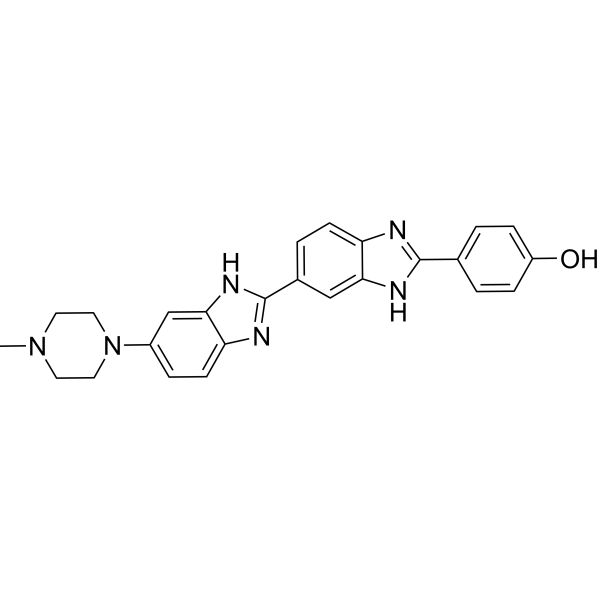
    Hoechst 33258
    20+ Cited Publications

    bisBenzimide H 33258; H 33258

    Fluorescent Dye DNA Stain DNA Alkylator/Crosslinker Others
    Hoechst 33258 is a blue to blue-green fluorescent live cell dye that can label DNA. Hoechst 33258 can specifically bind to the minor groove of DNA (and tends to bind to A/T-rich DNA), resulting in a significant increase in fluorescence intensity. Hoechst 33258 can cross the cell membrane and cause changes in DNA structure, such as G2/M phase arrest. Hoechst 33258 can bind to live or fixed cells, and the fluorescence intensity increases with increasing solution pH. As a DNA-specific probe, Hoechst 33258 can be used to detect DNA content, analyze cell cycle, etc. The excitation wavelength of Hoechst 33258 is 350-365 nm, and the emission wavelength is 460-490 nm .
    Hoechst 33258
  • HY-W094846

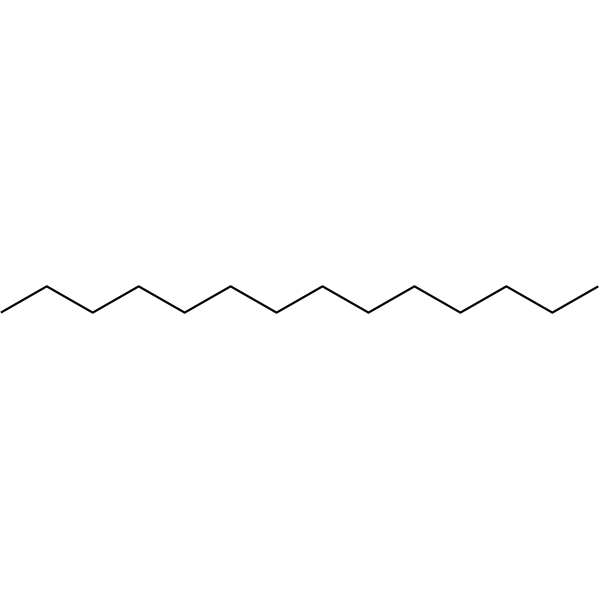
    n-Tetradecane

    Environmental Pollutants Biochemical Assay Reagents Others
    Tetradecane (n-Tetradecane) is a low-temperature phase change material with a phase change temperature of 5°C and a latent heat of phase change of 220 J/g. Tetradecane undergoes solid-liquid phase transition around 5°C, and achieves temperature regulation by absorbing or releasing latent heat .
    Tetradecane
  • HY-W747572

    (R)-(+)-Perillyl alcohol

    Ras Cancer
    (+)-Perillyl alcohol is the enantiomer of S-(-)-Perillyl alcohol (HY-116514). (+)-Perillyl alcohol can inhibit the growth of polypeptides and block the cell cycle in the G0/G1 phase. (+)-Perillyl alcohol induces cell signaling that is associated with changes in cytoskeletal actin organization and reduced protein expression of growth regulatory proteins such as Ras and CDC2 kinase .
    (+)-Perillyl alcohol
  • HY-168072

    Interleukin Related Apoptosis Autophagy Cancer
    GP130-IN-1 (compound 49) is a potent GP130 inhibitor with significant in vitro antitumor activity and higher selectivity than Bazedoxifene (HY-A0031). GP130-IN-1 induces ultrastructural changes in cells, causing cell cycle arrest in the G0/G1 phase in a time-dependent manner and triggering apoptosis and autophagy. GP130-IN-1 can be used in the study of triple-negative breast cancer .
    GP130-IN-1
  • HY-W094110

    Environmental Pollutants Biochemical Assay Reagents Others
    Iron (III) sulfate is a stable rhombohedral NASICON compound. Iron (III) sulfate can serve as a sodium ion intercalation host, enabling sodium ion intercalation and deintercalation via a single-phase mechanism relying on the Fe 2+/Fe 3+ redox couple. Iron (III) sulfate exhibits reversible electrochemical behavior and moderate polarization in cyclic voltammetry tests, and its charge transfer resistance changes during charge-discharge cycles. Iron (III) sulfate possesses a high redox potential, excellent rate capability, and long-cycle stability .
    Iron(III) sulfate

Inquiry Online

Your information is safe with us. * Required Fields.

Salutation


Country or Region *

Applicant Name *


Organization Name *

Department *


Email Address *


Product Name *

Cat. No.


Requested quantity *

Phone Number *


Remarks

Inquiry Online

Inquiry Information

Product Name:
Cat. No.:
Quantity:
MCE Japan Authorized Agent:

