
6 Results for "

total tau

" in MedChemExpress (MCE) Product Catalog:
Products (6)

6 Results for "total tau" in MCE Product Catalog:

Cat. No.: HY-138820
CAS No.: 1010820-68-4
Purity:  98.3%
Target:  

HSP

Research Areas:  

Neurological Disease

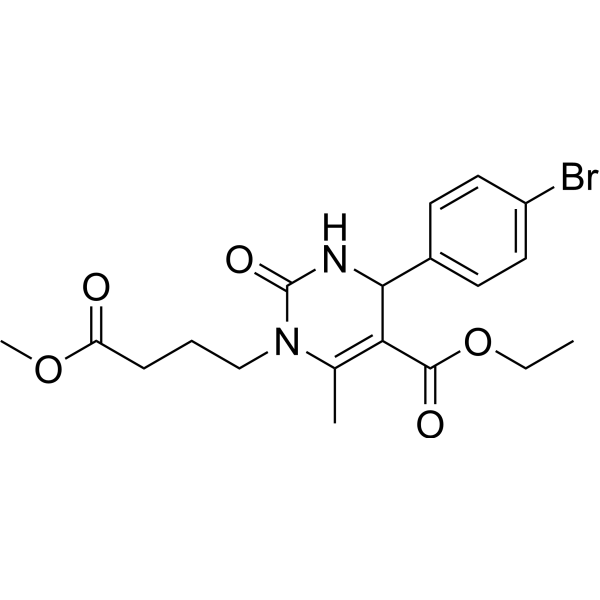
SW02 is a potent activator of ATPase activity of Hsp70, with an EC50 of 150 μM. SW02 leads to accumulation of both total tau and phosphorylated tau (pTau) .
loading...
    loading...
Cat. No.: HY-P9995
CAS No.: 2517973-04-3
Synonyms: JNJ-63733657

Target:  

Tau Protein

Research Areas:  

Neurological Disease

Posdinemab (JNJ-63733657) is a humanized IgG1/κ monoclonal antibody that selectively targets phosphorylated tau (pT217). Posdinemab specifically binds to the pT217+tau epitope rich in the proline domain, blocks tau protein aggregation and seed propagation, and promotes the clearance of extracellular tau species. Posdinemab reduces the levels of free and total p217+tau in cerebrospinal fluid, thereby inhibiting the pathological propagation of tau protein and the formation of neurofibrillary tangles. Posdinemab can be used for the study of progressive supranuclear palsy syndrome and Alzheimer's disease (AD), especially for prodromal or mild AD disease .
loading...
    loading...
Cat. No.: HY-102086
CAS No.: 261717-23-1
Research Areas:  

Neurological Disease

MSX3 is an orally active, selective A2a adenosine receptor antagonist and a prodrug of MSX2 (HY-117184). MSX3 reduces hyperphosphorylation of Tau at specific epitopes in mice without altering total Tau levels, Tau fragments, or Tau aggregation in these animals. MSX3 enhances spatial memory. MSX3 regulates effort-related decision-making behaviors. MSX3 reverses D2 antagonist-induced suppression of lever pressing, increased Chow feed intake, reduced selection of high-barrier arms, and prolonged response latency, and also slightly attenuates effects induced by D1 antagonists. MSX3 can be used in the research of Tauopathies (Alzheimer's disease-related), depression, and Parkinsonism .
loading...
    loading...
Cat. No.: HY-123320S
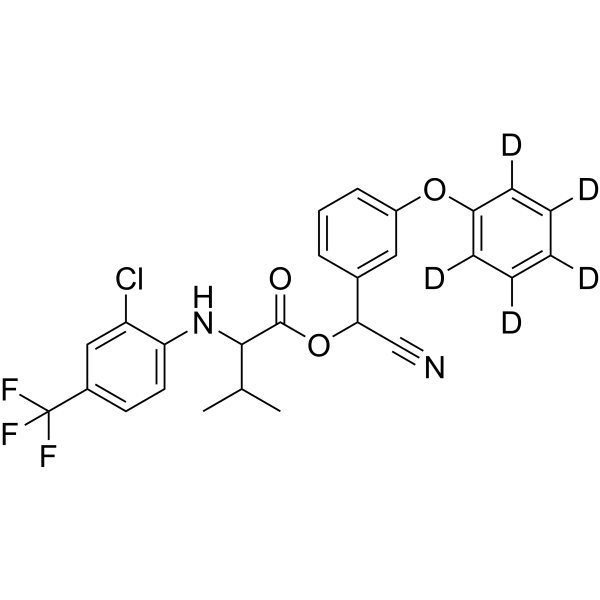
Fluvalinate-d5 is the deuterated-labeled Fluvalinate (HY-123320). Fluvalinate is an orally active acaricide classified as a sodium channel inhibitor. Fluvalinate delays sodium channel closure, prolongs cell membrane depolarization, inhibits the excitability of honeybee brain neurons, and exerts a central nervous system inhibitory effect. Fluvalinate negatively affects the learning ability, memory ability, sucrose responsiveness, and survival of honeybees. Fluvalinate potentiates pentobarbital-induced hypnosis, reduces spontaneous activity in mice, and decreases the total white blood cell count and absolute lymphocyte count in mice. Fluvalinate induces acute toxic symptoms in rats, acts as a cholinergic stimulant, and induces the production of hepatic enzymes in rats. Fluvalinate causes the death of Varroa jacobsoni sensitive to τ-Fluvalinate (HY-B2021). Fluvalinate can be used in studies related to mite pest control .
loading...
    loading...
Cat. No.: HY-P99648A
CAS No.: 1788032-39-2
Synonyms: BMS-986168 (powder); IPN007 (powder); BIIB092 (powder)

Target:  

Tau Protein

Research Areas:  

Neurological Disease

Gosuranemab (BMS-986168; IPN007; BIIB092) (powder) is a humanised IgG4 anti-tau monoclonal antibody. Gosuranemab (powder) neutralizes the extracellular tau protein, inhibiting the spread and aggregation of pathological tau protein. Gosuranemab (powder) can be used for the research of progressive supranuclear palsy and early Alzheimer’s disease .
loading...
    loading...
Cat. No.: HY-123320
CAS No.: 69409-94-5
Research Areas:  

Infection Neurological Disease

Fluvalinate is an orally active acaricide classified as a sodium channel inhibitor. Fluvalinate delays sodium channel closure, prolongs cell membrane depolarization, inhibits the excitability of honeybee brain neurons, and exerts a central nervous system inhibitory effect. Fluvalinate negatively affects the learning ability, memory ability, sucrose responsiveness, and survival of honeybees. Fluvalinate potentiates pentobarbital-induced hypnosis, reduces spontaneous activity in mice, and decreases the total white blood cell count and absolute lymphocyte count in mice. Fluvalinate induces acute toxic symptoms in rats, acts as a cholinergic stimulant, and induces the production of hepatic enzymes in rats. Fluvalinate causes the death of Varroa jacobsoni sensitive to τ-Fluvalinate (HY-B2021). Fluvalinate can be used in studies related to mite pest control .
loading...
    loading...

