



6-Keto-PGE1
Based on 1 publication(s) in Google Scholar
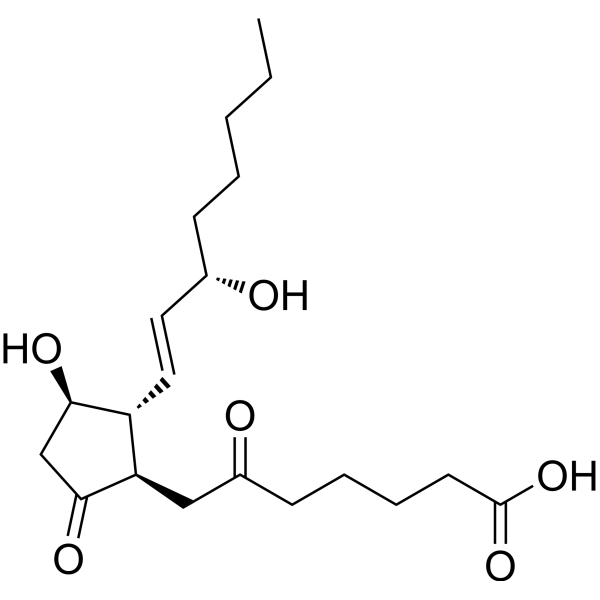
6-Keto-PGE1 (6-keto-Prostaglandin E1) is a biologically active derivative of PGE1. 6-Keto-PGE1 inhibits adenosine diphosphate-induced platelet aggregation. 6-Keto-PGE1 reduces cardiac afterload, decreases the accumulation of plasma myocardial depressant factor (MDF), lowers arterial blood pressure, dilates vascular beds, inhibits the vasoconstrictive response of vascular smooth muscle, and increases pulmonary compliance. 6-Keto-PGE1 directly stabilizes isolated cat liver lysosomes and significantly reduces the release of β-glucuronidase and cathepsin D. 6-Keto-PGE1 prolongs the survival time of traumatized rats and exerts protective effects through hemodynamic and cytoprotective actions. 6-Keto-PGE1 reduces central airway resistance. 6-Keto-PGE1 can be used in studies related to traumatic shock.
For research use only. We do not sell to patients.
- Purity : 99.0%
- CAS No.: 67786-53-2
- Formula: C20H32O6
- Molecular Weight:368.46
-
Storage:
Solution, -20°C, 2 years

To place orders, for customer services and technical support, please contact: MedChemExpress USA
Tel: 609-228-6898 E-mail: [email protected] [email protected]


-
 Biological Activity
-
Chemical Information
- Purity & Documentation
- References
-
 Help & FAQs


-

HY-165067
14,15-EE-8(Z)-EVasodilator Agonist -

HY-165078
(±)11(12)-EpETEComponent of PUFAs -
HY-129293
AFP-07 free acidProstacyclin Receptor Agonist -

HY-N12970
14S(15R)-EET -
HY-116704
11-Deoxyprostaglandin F2αTREK-2 Activator -
HY-137024
15-Keto-PGA1Vasoconstrictor -
HY-114751
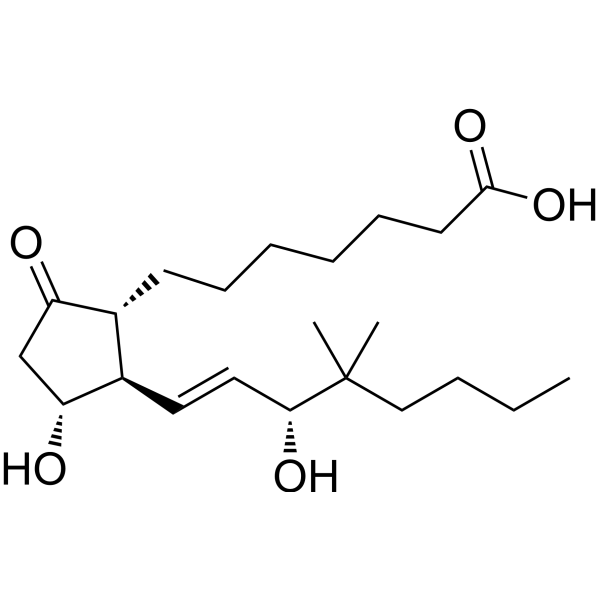
16,16-Dimethylprostaglandin E1Bronchoconstrictor
Publications Citing Use of MedChemExpress (MCE) 6-Keto-PGE1
More

Biological Activity
Description
IC50 & Target
|
Human Endogenous Metabolite |
In Vitro
6-Keto-PGE1 (1 μg/mL; 30 min) directly stabilizes isolated cat liver lysosomes, significantly reducing the release of β-glucuronidase and cathepsin D[1].
MedChemExpress (MCE) has not independently confirmed the accuracy of these methods. They are for reference only. .
In Vivo
6-Keto-PGE1 (250 ng/kg/min; i.v.; continuous infusion; 5 hours) produces a modest, sustained decrease in mean arterial blood pressure (23 mmHg total reduction at 5 hours) without altering heart rate in healthy sham-operated rats[1].
6-Keto-PGE1 (1 μg/min; i.a.; infusion) significantly reduces mesenteric perfusion pressure by ~27-31% and reversibly inhibits vasoconstrictor responses to sympathetic nerve stimulation, norepinephrine, and angiotensin II in the feline mesenteric vascular bed[2].
6-Keto-PGE1 (0.3-10 μg; i.v.; rapid injection) acts as a potent bronchodilator in 5-HT-induced bronchoconstricted cats, reducing central airway resistance 3-10 times more potently than PGI2, with minimal pulmonary vasomotor activity, and its effects are independent of cyclooxygenase pathway stimulation[3].
MedChemExpress (MCE) has not independently confirmed the accuracy of these methods. They are for reference only.
-
Animal Model:Sprague-Dawley (male, 210-250 g, traumatic shock induced by Noble-Collip drum trauma under sodium pentobarbital anesthesia)[1]
-
Dosage:250 ng/kg/min
-
Administration:i.v.; continuous infusion; starting 15 min after trauma for experiment duration
-
Result:Prolonged mean survival time to 2.6 hours.
Inhibited trauma-induced increase in plasma cathepsin D activity, reducing it from ~14 units/mg protein to ~9 units/mg protein.
Reduced plasma MDF activity from ~58 units to ~30 units.
Increased mean arterial blood pressure to 108 mmHg at 0.5 hours and maintained this level for 2 hours in 7 out of 10 treated rats.
-
Animal Model:Sprague-Dawley (male, 210-250 g, sham-operated, no trauma)[1]
-
Dosage:250 ng/kg/min
-
Administration:i.v.; continuous infusion; 5 hours
-
Result:Decreased mean arterial blood pressure by 15 mmHg 5 minutes after infusion start, followed by a 10 mmHg increase by 15 minutes.
Maintained a mean arterial blood pressure of 117 mmHg at 5 hours, down from an initial 140 mmHg.
Caused no significant changes in heart rate.
-
Animal Model:Domestic cats (adult, either sex, 1.9 to 4.3 kg)[2]
-
Dosage:1 μg/min
-
Administration:i.a.; infusion
-
Result:Reduced mesenteric arterial perfusion pressure from a control of 105 mmHg to 76 mmHg at 1 minute, 73 mmHg at 3 minutes, 72 mmHg at 5 minutes, 77 mmHg at 10 minutes, and 76 mmHg at 30 minutes.
Returned perfusion pressure to baseline (105 mmHg) 30 minutes after infusion cessation.
Reduced vasoconstrictor responses to all tested doses of norepinephrine (0.3, 1, 3 μg i.a.), all tested frequencies of sympathetic nerve stimulation (1, 3, 10 cycles/sec), and all tested doses of angiotensin II (0.3, 1 μg i.a.) during infusion.
Restored all suppressed vasoconstrictor responses to control levels 30 minutes after infusion termination.
-
Animal Model:Mongrel cats (either sex, 2.0-4.5 kg)[3]
-
Dosage:0.3 μg; 1.0 μg; 3.0 μg; 10.0 μg
-
Administration:i.v.; rapid injection
-
Result:Produced statistically significant reductions in central airway resistance (RL) and increases in dynamic lung compliance (Cdyn) and semi-static compliance (C'stat') compared to 5-HT-elevated tone controls.
Decreased RL from 38 cm H2O/L/sec to 35 cm H2O/L/sec, increased Cdyn from 4.0 mL/cm H2O to 4.5 mL/cm H2O, increased C'stat' from 3.2 mL/cm H2O to 3.5 mL/cm H2O, and caused no significant change in pulmonary arterial pressure (PPA) at 0.3 μg.
Decreased RL from 38 cm H2O/L/sec to 32 cm H2O/L/sec, increased Cdyn from 4.4 mL/cm H2O to 4.9 mL/cm H2O, increased C'stat' from 3.4 mL/cm H2O to 3.9 mL/cm H2O, and caused no significant change in PPA at 1.0 μg.
Decreased RL from 34 cm H2O/L/sec to 27 cm H2O/L/sec, increased Cdyn from 4.4 mL/cm H2O to 5.2 mL/cm H2O, increased C'stat' from 3.5 mL/cm H2O to 4.5 mL/cm H2O, and decreased PPA significantly from 25 mm Hg to 23 mm Hg at 3.0 μg.
Decreased RL from 32 cm H2O/L/sec to 22 cm H2O/L/sec (a 32% reduction from elevated tone, representing a 50% return to pre-5-HT control values), increased Cdyn from 5.3 mL/cm H2O to 6.2 mL/cm H2O, increased C'stat' from 4.1 mL/cm H2O to 5.1 mL/cm H2O, and caused no significant change in PPA at 10.0 μg.
Was 3-10 times more potent than PGI2 at reducing RL, and more potent than PGI2 at increasing Cdyn at lower doses.
Had a time to maximum response (tmax) ranging from 30 seconds to 42 seconds, which was significantly shorter than tmax for PGI2 at comparable potency doses.
Had a duration of response (t1/2) ranging from 52 seconds to 103 seconds, with no consistent difference compared to PGI2.
Showed airway and vascular responses unaltered by pretreatment with sodium meclofenamate.


Chemical Information
-
CAS No. 67786-53-2
-
Appearance Liquid
-
Molecular Weight 368.46
-
Formula C20H32O6
-
Color Colorless to light yellow
-
SMILES
OC(CCCCC(C[C@@H]1[C@H]([C@@H](CC1=O)O)/C=C/[C@@H](O)CCCCC)=O)=O
-
Synonyms
6-keto-Prostaglandin E1
-
Shipping
Room temperature in continental US; may vary elsewhere.
-
Storage
Solution, -20°C, 2 years


Publications (1)
-
Journal Impact Factor
-
Most Recent


Purity & Documentation
-
Data Sheet (282 KB)
-
SDS (479 KB)
- English - EN (479 KB)
- Français - FR (479 KB)
- Deutsch - DE (479 KB)
- Norwegian - NO (479 KB)
- Español - ES (479 KB)
- Swedish - SV (479 KB)
- Italian - IT (479 KB)
- Korean - KR (479 KB)
- Portuguese - PT (479 KB)
-
Handling Instructions (2659 KB)
References
[1]. Araki H, et al. Protective action of 6-keto-prostaglandin E1 in traumatic shock. Prostaglandins Med. 1979;2(4):277-284. [Content Brief]
[2]. Lippton HL, et al. Inhibition of vasoconstrictor responses by 6-keto-PGE1 in the feline mesenteric vascular bed. Prostaglandins. 1980;19(2):299-310. [Content Brief]
[3]. van der Meer JW, et al. Abstract!. Neth J Med. 2002;60(11):418. [Content Brief]

Calculators
Concentration (start) × Volume (start) = Concentration (final) × Volume (final)


6-Keto-PGE1 Related Classifications
HY-114986 Related Classifications
 Powered by Bioz