



L-Thyroxine sodium xhydrate
Based on 11 publication(s) in Google Scholar
L-Thyroxine sodium xhydrate (Levothyroxine; T4) is a synthetic hormone in the treatment of hypothyroidism. DIO enzymes convert biologically active hormone (Triiodothyronine,T3) from L-Thyroxine (T4).
For research use only. We do not sell to patients.
- Purity : 98.94%
- CAS No.: 25416-65-3
- Formula: C15H11I4NO4·xH2O·Na
- Molecular Weight:776.87 (free acid)
-
Storage:
4°C, sealed storage, away from moisture
* In solvent : -80°C, 6 months; -20°C, 1 month (sealed storage, away from moisture)


To place orders, for customer services and technical support, please contact: MedChemExpress USA
Tel: 609-228-6898 E-mail: [email protected] [email protected]


-
 Biological Activity
-
Chemical Information
-
Solvent & Solubility
- Protocols
- Purity & Documentation
- References
-
 Help & FAQs


-
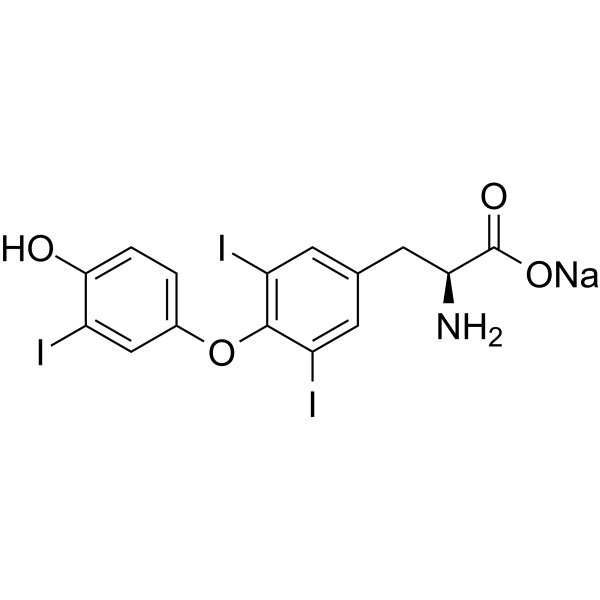
HY-A0070
Liothyronine sodiumTRα/TRβ Agonist -

HY-A0070R
Liothyronine sodium (Standard)TRα/TRβ Agonist -
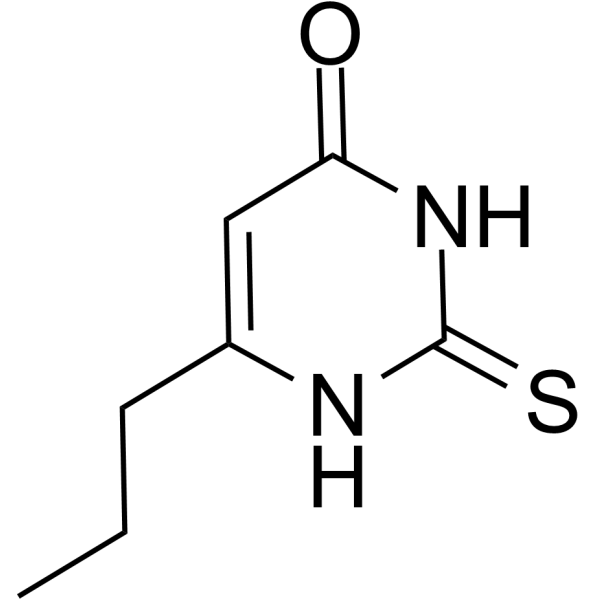
HY-B0346
PropylthiouracilAntithyroid Agent -

HY-W010669R
L-Thyroxine sodium xhydrate (Standard) -
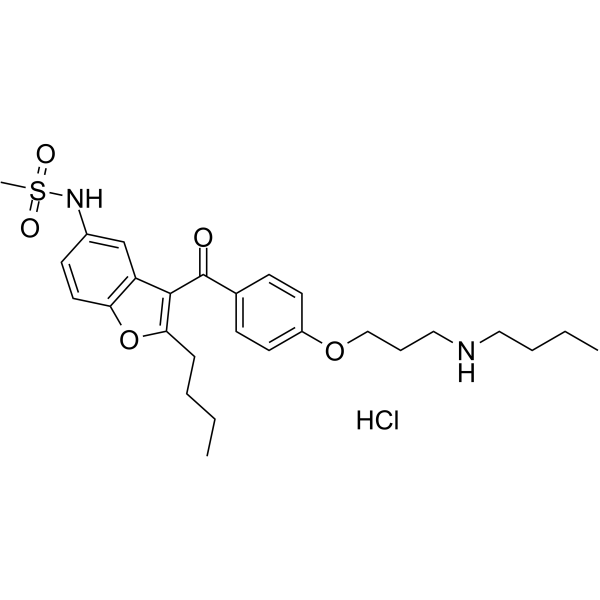
HY-12753A
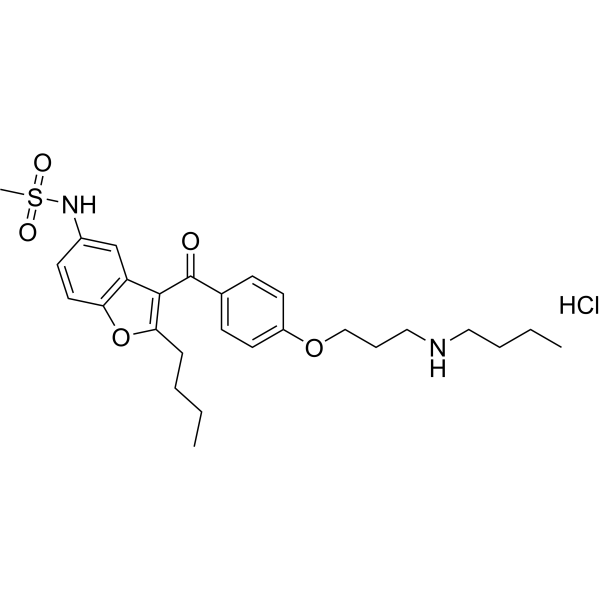
Debutyldronedarone hydrochlorideCytochrome P450 Enzyme/Thyroid Hormone Receptor Inhibitor -
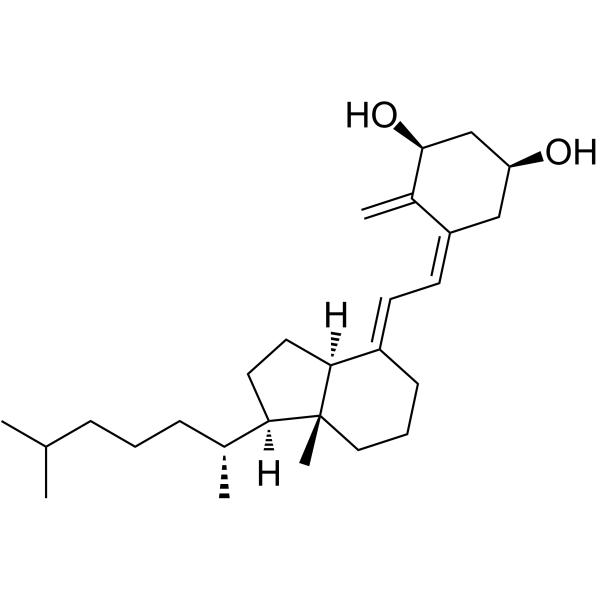
HY-10003A
1α-Hydroxy-3-epi-vitamin D3PTH Secretion Suppressor -

HY-B0346R
Propylthiouracil (Standard)Antithyroid Agent -
HY-115434
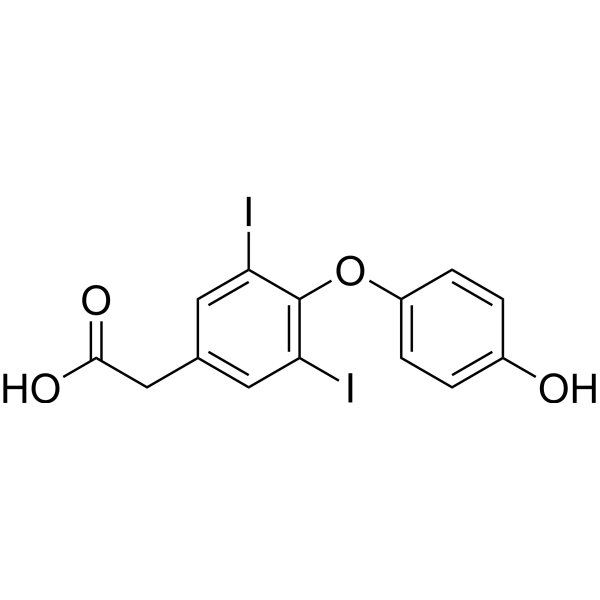
3,5-Diiodothyroacetic acidThyroid Hormone Analog -
HY-12753AR
Debutyldronedarone hydrochloride (Standard)Reference Standard -

HY-10003AR
1α-Hydroxy-3-epi-vitamin D3 (Standard)PTH Secretion Suppressor
Publications Citing Use of MedChemExpress (MCE) L-Thyroxine sodium xhydrate
More- Cell. 2026 Apr 2;189(7):2007-2023.e20. [Abstract]
- Nat Immunol. 2024 Apr;25(4):659-670. [Abstract]
- Cell Rep Med. 2023 Jun 20;4(6):101061. [Abstract]
- Europace. 2026 Mar 30;28(4):euag047. [Abstract]
- EMBO J. 2024 Aug;43(15):3090-3115. [Abstract]
- Sci Rep. 2022 Jul 4;12(1):11259. [Abstract]
- Stem Cell Rev Rep. 2021 Jun;17(3):999-1013. [Abstract]
- Clin Exp Med. 2025 Dec 20. [Abstract]
- Mol Brain. 2021 Jan 27;14(1):25. [Abstract]
- Dis Model Mech. 2024 Sep 1;17(9):dmm050748. [Abstract]
- Ther Deliv. 2025 Oct 30:1-15. [Abstract]
 Customer Validation & Images

-
In Vivo Efficacy Study
-
In Vivo Efficacy Study
-
Histological Imaging/Staining
-
In Vivo Imaging
-
In Vivo Efficacy Study


Biological Activity
Description
In Vivo
MedChemExpress (MCE) has not independently confirmed the accuracy of these methods. They are for reference only.


Chemical Information
-
CAS No. 25416-65-3
-
Appearance Solid
-
Molecular Weight 776.87 (free acid)
-
Formula C15H11I4NO4·xH2O·Na
-
Color Off-white to light yellow
-
SMILES
IC1=C(O)C(I)=CC(OC2=C(I)C=C(C[C@@](N)([H])C(O[Na])=O)C=C2I)=C1.[x].O
-
Synonyms
Sodium levothyroxine
-
Shipping
Room temperature in continental US; may vary elsewhere.
-
Storage
4°C, sealed storage, away from moisture
* In solvent : -80°C, 6 months; -20°C, 1 month (sealed storage, away from moisture)


Publications (11)
-
Journal Impact Factor
-
Most Recent
-
Cell
Restoring circadian rhythms in the hypothalamic paraventricular nucleus reverses aging biomarkers and extends lifespan in male mice. [Abstract]2026 Apr 2;189(7):2007-2023.e20. PMID: 41785851 -
Nat Immunol
2024 Apr;25(4):659-670. PMID: 38499799 -
Cell Rep Med
2023 Jun 20;4(6):101061. PMID: 37267943 -
Europace
Fto-mediated m6A demethylation of Lox drives atrial fibrosis and promotes atrial fibrillation in a murine model of hyperthyroidism. [Abstract]2026 Mar 30;28(4):euag047. PMID: 41812233 -
EMBO J
Whole-body replacement of larval myofibers generates permanent adult myofibers in zebrafish. [Abstract]2024 Aug;43(15):3090-3115. PMID: 38839992
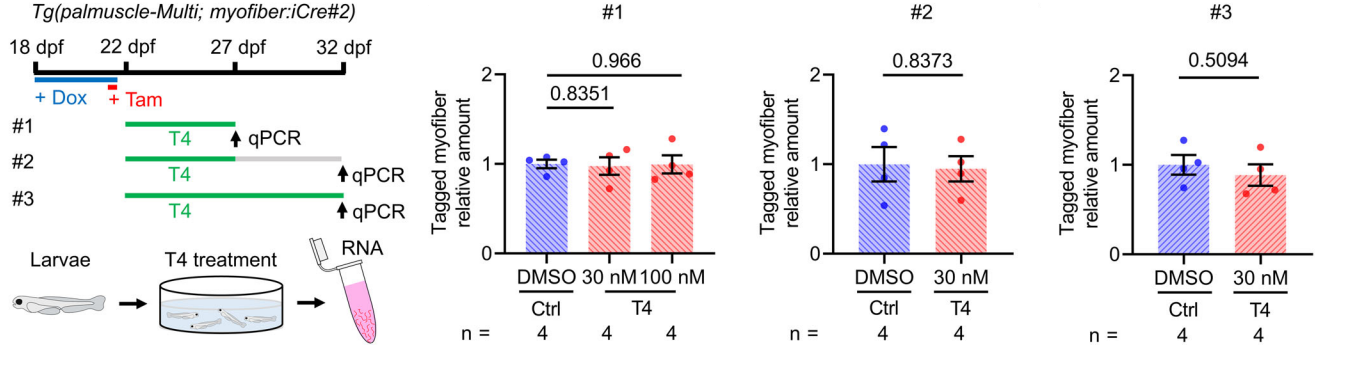
L-Thyroxine sodium xhydrate purchased from MedChemExpress. Usage Cited in: EMBO J. 2024 Aug;43(15):3090-3115. [Abstract]
Timeline and three different Thyroxine hormone (T4) treatment schemes. RT-qPCR analysis of the whole-animal myofiber loss for each of the schemes.
-
Sci Rep
The iodide transporter Slc26a7 impacts thyroid function more strongly than Slc26a4 in mice. [Abstract]2022 Jul 4;12(1):11259. PMID: 35788623
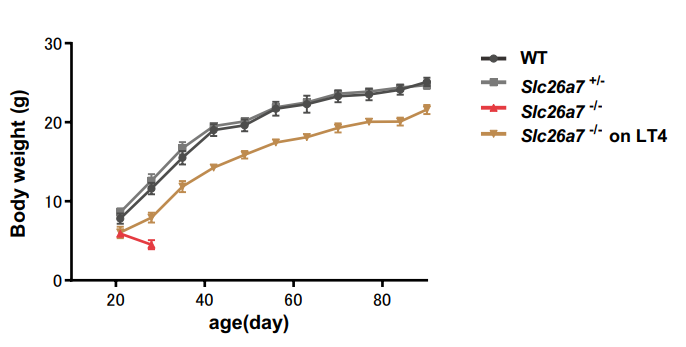
L-Thyroxine sodium xhydrate purchased from MedChemExpress. Usage Cited in: Sci Rep. 2022 Jul 4;12(1):11259. [Abstract]
Growth curve of male wild type (WT), Slc26a7+/−, Slc26a7−/−, and Slc26a7-/− mice receiving L-Thyroxine (drinking water containing 0.39 mg/L L-Thyroxine) replacement from day 21 with a low iodine diet. Note that Slc26a7−/− mice without thyroid hormone replacement did not survive.
-
Stem Cell Rev Rep
2021 Jun;17(3):999-1013. PMID: 33389681 -
Clin Exp Med
2025 Dec 20. PMID: 41420729 -
Mol Brain
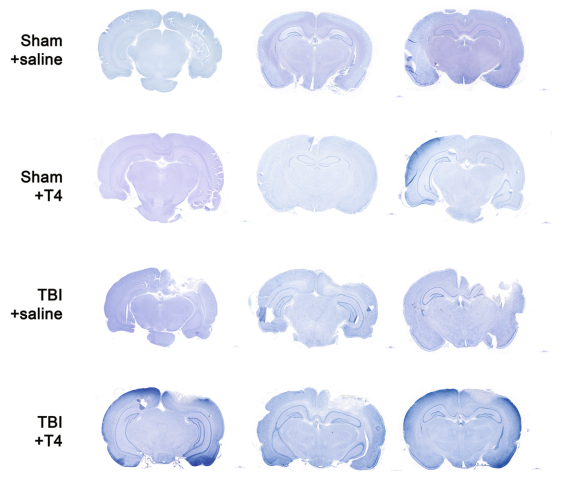
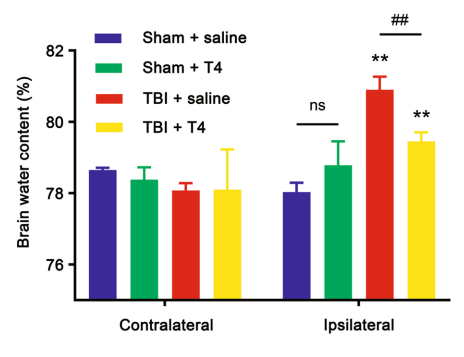
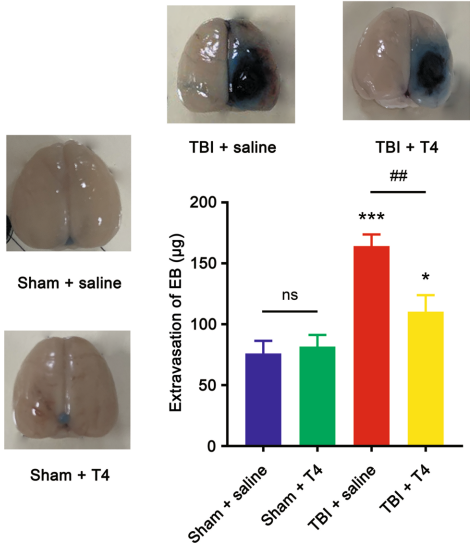
iTRAQ-based proteomic profiling reveals protein alterations after traumatic brain injury and supports thyroxine as a potential treatment. [Abstract]2021 Jan 27;14(1):25. PMID: 33504361
L-Thyroxine sodium xhydrate purchased from MedChemExpress. Usage Cited in: Mol Brain. 2021 Jan 27;14(1):25. [Abstract]
Effects of L-Thyroxine on histopathology post-TBI. a Brain sections stained with cresyl violet were shown on the left. Lesion volume was calculated from the sections.
L-Thyroxine sodium xhydrate purchased from MedChemExpress. Usage Cited in: Mol Brain. 2021 Jan 27;14(1):25. [Abstract]
Brain water content of traumatized hemisphere increased 1 day post-TBI, whereas L-Thyroxine alleviates edema.
L-Thyroxine sodium xhydrate purchased from MedChemExpress. Usage Cited in: Mol Brain. 2021 Jan 27;14(1):25. [Abstract]
BBB integrity was reflected by detecting the extravasation of EB dye (n = 3 per group).
-
Dis Model Mech
2024 Sep 1;17(9):dmm050748. PMID: 39139065 -
Ther Deliv
Excipient adjusting rheological properties of silica-based injectable hydrogel composites for controlled drug delivery. [Abstract]2025 Oct 30:1-15. PMID: 41168137


Solvent & Solubility
In Vitro:
DMSO : 50 mg/mL (Need ultrasonic; Hygroscopic DMSO has a significant impact on the solubility of product, please use newly opened DMSO)
0.01 M NaOH : 2 mg/mL (ultrasonic and warming and adjust pH to 12 with NaOH and heat to 60°C)
In Vivo:
Select the appropriate dissolution method based on your experimental animal and administration route.
- For the following dissolution methods, please ensure to first prepare a clear stock solution using an In Vitro approach and then sequentially add co-solvents:
- To ensure reliable experimental results, the clarified stock solution can be appropriately stored based on storage conditions. As for the working solution for In Vivo experiments, it is recommended to prepare freshly and use it on the same day.
- The percentages shown for the solvents indicate their volumetric ratio in the final prepared solution. If precipitation or phase separation occurs during preparation, heat and/or sonication can be used to aid dissolution.
Add each solvent one by one: 10% DMSO 40% PEG300 5% Tween-80 45% Saline
Solubility: ≥ 5 mg/mL; Clear solution
This protocol yields a clear solution of ≥ 5 mg/mL (saturation unknown).
Taking 1 mL working solution as an example, add 100 μL DMSO stock solution (50.0 mg/mL) to 400 μL PEG300, and mix evenly; then add 50 μL Tween-80 and mix evenly; then add 450 μL Saline to adjust the volume to 1 mL.
Preparation of Saline: Dissolve 0.9 g sodium chloride in ddH₂O and dilute to 100 mL to obtain a clear Saline solution.
In Vivo Dissolution Calculator
Please enter the basic information of animal experiments:
-
-
-
-
Recommended: Prepare an additional quantity of animals to account for potential losses during experiments.
Please enter your animal formula composition:
-
%DMSO +
Recommended: Keep the proportion of DMSO in working solution below 2% if your animal is weak.
-
%+
-
+%Tween-80 + +
-
%Saline +
The co-solvents required include: DMSO, . All of co-solvents are available by MedChemExpress (MCE). , Tween 80. All of co-solvents are available by MedChemExpress (MCE).
Working solution concentration: 0.22 mg/mL
Method for preparing stock solution: mg drug dissolved in μL DMSO. Stock solution concentration: mg/mL. * In solvent : -80°C, 6 months; -20°C, 1 month (sealed storage, away from moisture)
1. Take μL DMSO stock solution;
2. Add μL .
μL , mix evenly;
3. Then add μL Tween 80, mix evenly;
4. Then add μL
Please ensure that the stock solution in the first step is dissolved to a clear state, and add co-solvents in sequence. You can use ultrasonic heating (ultrasonic cleaner, recommended frequency 20-40 kHz), vortexing, etc. to assist dissolution.

Protocols
-
Research Protocol for Endocrine Diseases
Endocrine diseases often arise from disrupted hormone production, hormone signaling, or target-tissue responsiveness; for diabetes-focused endocrine disease models, insulin signaling regulates glucose uptake, hepatic glucose output, lipid metabolism, and β-cell compensation. Type 2 diabetes develops through interacting defects in insulin resistance, β-cell dysfunction, adipose inflammation, hepatic glucose overproduction, altered incretin signaling, and ectopic lipid metabolism. A major unresolved question is whether endocrine dysfunction is driven primarily by target-tissue insulin resistance, intrinsic β-cell failure, immune/inflammatory stress, or combined multi-organ failure that differs by disease stage.


Purity & Documentation
-
Data Sheet (283 KB)
-
SDS (394 KB)
- English - EN (394 KB)
- Français - FR (394 KB)
- Deutsch - DE (394 KB)
- Norwegian - NO (394 KB)
- Español - ES (394 KB)
- Swedish - SV (394 KB)
- Italian - IT (394 KB)
- Korean - KR (394 KB)
- Portuguese - PT (394 KB)
-
Handling Instructions (2659 KB)
References
[1]. Arici M, et al. Association between genetic polymorphism and levothyroxine bioavailability in hypothyroid patients. Endocr J. 2018 Jan 11. [Content Brief]
[2]. Corriveau S, et al. Levothyroxine treatment generates an abnormal uterine contractility patterns in an in vitro animalmodel. J Clin Transl Endocrinol. 2015 Sep 9;2(4):144-149. [Content Brief]

Calculators
Concentration (start) × Volume (start) = Concentration (final) × Volume (final)


L-Thyroxine sodium xhydrate Related Classifications
HY-W010669 Related Classifications
 Powered by Bioz