



N-type calcium channel blocker-1
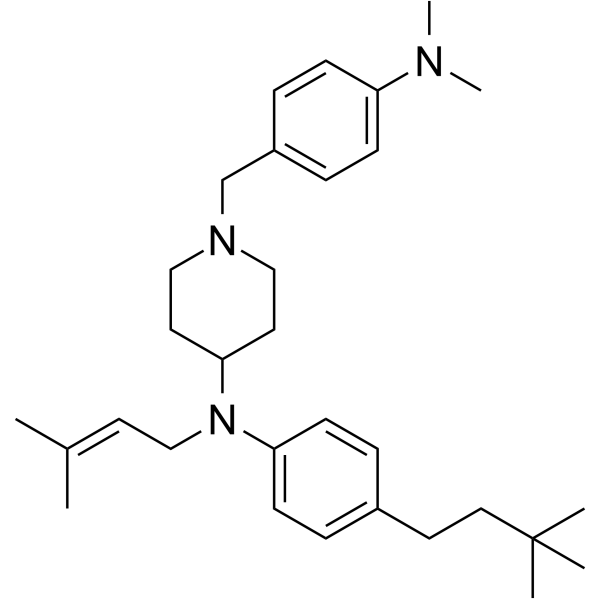
N-type calcium channel blocker-1 is an orally active compound which shows high affinity to functionally block N-type calcium channels with an IC50 of 0.7 μM in the IMR32 assay.
Nos produits utilisent uniquement pour la recherche. Nous ne vendons pas aux patients.
- CAS No.: 241499-17-2
- Formule: C31H47N3
- Masse moléculaire:461.73
-
Stockage:
Please store the product under the recommended conditions in the Certificate of Analysis.

To place orders, for customer services and technical support, please contact: MedChemExpress USA
Tel: 609-228-6898 E-mail: [email protected] [email protected]


-
 Activité biologique
-
Chemical Information
- Protocole
- Pureté et documentation
- Références
-
 Help & FAQs


Voir tous les produits spécifiques à Isoform Calcium Channel
More

Activité biologique
Description
IC50 & Target
IC50: 0.7 μM (N-type calcium channels)[1]
In Vitro
N-type calcium channel blocker-1 shows good activities in the IMR32 assay (IC50=0.7 μM). N-type calcium channel blocker-1 is the most orally active N-type calcium channel blocker for analgesia found in a series of compounds[1].
MedChemExpress (MCE) has not independently confirmed the accuracy of these methods. They are for reference only.
In Vivo
MedChemExpress (MCE) has not independently confirmed the accuracy of these methods. They are for reference only.


Chemical Information
-
CAS No. 241499-17-2
-
Masse moléculaire 461.73
-
Formule C31H47N3
-
SMILES
C/C(C)=C\CN(C1=CC=C(CCC(C)(C)C)C=C1)C2CCN(CC3=CC=C(N(C)C)C=C3)CC2
-
Livraison
Room temperature in continental US; may vary elsewhere.
-
Stockage
Please store the product under the recommended conditions in the Certificate of Analysis.

Protocole
Kinase Assay[1]
N-type calcium channel blocker-1 is dissolved and diluted in DMSO. Different concentrations of the test compounds (N-type calcium channel blocker-1, et al.) are added to assay buffer containing approximately 3×10⁶ loaded cells with 5 mM nitrendipine added to block l-type calcium channels. Samples are incubated for 10 min for then emission signals at 400 and 490 nm are acquired from each cuvette at 30°C for 50 s. At 20 s after the start of reading, cells are depolarized by the addition of a high K+ solution. Drug effects are expressed as a percentage of the amplitude of the K+- evoked change in intracellular calcium in drug treated compared to control experiments. PD-15130714 is run in parallel as a standard in each assay to compare the relative potencies determined. IC50 values of test compounds are calculated by fitting a four-parameter logistic function to the data using the least squares method[1].
MedChemExpress (MCE) has not independently confirmed the accuracy of these methods. They are for reference only.
Animal Administration[1]
Rats[1]
Three Wistar rats receive a 5 mg/kg bolus intravenous dose of each compound (N-type calcium channel blocker-1, et al.) as a solution and serial plasma samples are collected at various times up to 24 hr postdose. Plasma samples are analyzed using direct protein precipitation with acetonitrile and the compound is quantitated by SciexLC/MS/MS system. A Betasil phenyl column (2.1 mm 12 cm) is used with a mobile phase of acetonitrile:0.1% acetic acid (70:30, v/v)[1].
Mice[1]
Male, CF-1 mice (26 and 30 g) are given a single, intraperitoneal injection of 0.6% acetic acid. This injection evoked abdominal constrictions, defined as discrete episodes of torso and hind limb stretching with or without neck arching, are counted and recorded for 5 min, beginning 7 min after acetic acid injection. The mice are individually housed in Nalgene cages and allowed to move freely during the experimental period (12 min). Animals are sacrificed by CO2 asphyxiation immediately after the 5-min observation period. Test compounds (N-type calcium channel blocker-1, et al.) are administered by intravenous or oral routes approximately 10 min prior to administering the acetic acid. The dose response relationship for antinociceptive effects during the acetic acid writhing test are assessed by plotting the incidence of abdominal constrictions against dose of the test compound. ED50 values are calculated using a four parameter logistic function[1].
MedChemExpress (MCE) has not independently confirmed the accuracy of these methods. They are for reference only.


Pureté et documentation
Références

Calculators
Concentration (start) × Volume (start) = Concentration (final) × Volume (final)


N-type calcium channel blocker-1 Related Classifications
HY-100310 Related Classifications
 Powered by Bioz