



CA VA
CA VA (CAVA/CA5A) is a mitochondrial carbonic anhydrase that catalyzes CO2 hydration to supply HCO3- for mitochondrial metabolism[1]. Mechanistically, CA VA supports ureagenesis, gluconeogenesis, and lipogenesis by providing bicarbonate to liver metabolic enzymes[1][2]. In disease models, CA5A mutations reduce CAVA activity or thermal stability and cause early-onset metabolic crisis with hyperammonemia, hyperlactatemia, ketonuria, metabolic acidosis, and hypoglycemia[3][4]. Compared with CA VB, CA VA has the predominant liver role in ammonia detoxification, while CA VB contributes more clearly when CA VA is absent[1][2]. For experimental applications, recombinant CAVA expression and purification support biochemical studies, and selective mitochondrial CA VA/VB inhibitors provide tools to study metabolism-linked pathways[5][6].
References:
- [1]. Aspatwar A, et al. Mitochondrial carbonic anhydrase VA and VB: properties and roles in health and disease. J Physiol. 2023 Jan;601(2):257-274. [Content Brief]
- [2]. Shah GN, et al. Targeted mutagenesis of mitochondrial carbonic anhydrases VA and VB implicates both enzymes in ammonia detoxification and glucose metabolism. Proc Natl Acad Sci U S A. 2013 Apr 30;110(18):7423-8. [Content Brief]
- [3]. Diez-Fernandez C, et al. Defective hepatic bicarbonate production due to carbonic anhydrase VA deficiency leads to early-onset life-threatening metabolic crisis. Genet Med. 2016 Oct;18(10):991-1000. [Content Brief]
- [4]. van Karnebeek CD, et al. Mitochondrial carbonic anhydrase VA deficiency resulting from CA5A alterations presents with hyperammonemia in early childhood. Am J Hum Genet. 2014 Mar 6;94(3):453-61. [Content Brief]
- [5]. Davis RA, et al. Carbonic anhydrase inhibitors. Identification of selective inhibitors of the human mitochondrial isozymes VA and VB over the cytosolic isozymes I and II from a natural product-based phenolic library. Bioorg Med Chem. 2010 Jan 1;18(1):14-8. [Content Brief]
- [6]. Idrees D, et al. Cloning, expression, purification and characterization of human mitochondrial carbonic anhydrase VA. 3 Biotech. 2016 Jun;6(1):16. [Content Brief]
All Product Categories
-
CA VA Related Products (2)
Related Products (2)

-
Elsulfavirine
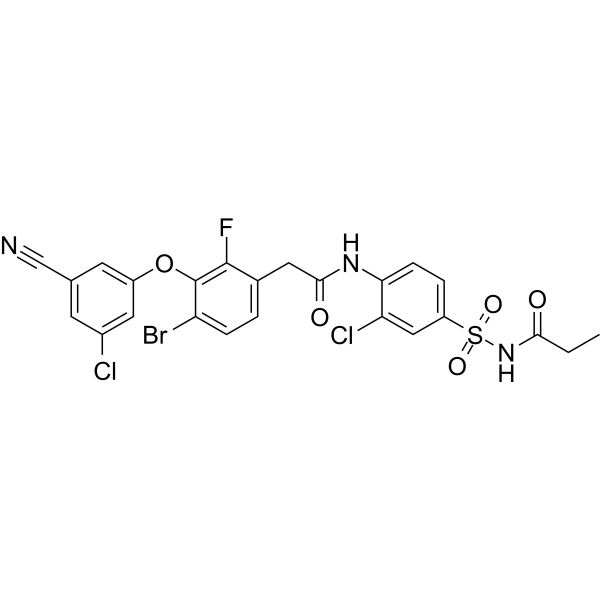 0 ImagesSynonyms: R-1206Elsulfavirine (R-1206) is an orally active human carbonic anhydrase (carbonic anhydrase, CA) inhibitor and an allosteric inhibitor of HIV-1 non-nucleoside reverse transcriptase (NNRT). Elsulfavirine also targets and blocks the interaction between adenylosuccinate lyase (ADSL) and insulin-induced gene proteins INSIG1/2, blocks SREBP-1-mediated de novo lipid synthesis, and inhibits the proliferation of liver cancer cells. The combination of Elsulfavirine and Lenvatinib (HY-10981) produces a synergistic anti-tumor effect. Elsulfavirine is converted into the active metabolite VM1500A in vivo, blocks the DNA polymerase activity of reverse transcriptase, and inhibits HIV-1 replication. Elsulfavirine exhibits a Ki of 1960 nM-52400 nM against human carbonic anhydrase isoforms including I, VII, VI, VA, VB, IX, XIII, XIV. Elsulfavirine is used in studies related to HIV-1 infection and liver cancer.
-
Elsulfavirine sodium
 0 ImagesCat. No.: HY-109056ACAS No.: 867365-40-0Synonyms: R-1206 sodiumElsulfavirine sodium (R-1206) is an orally active human carbonic anhydrase (carbonic anhydrase, CA) inhibitor and an allosteric inhibitor of HIV-1 non-nucleoside reverse transcriptase (NNRT). Elsulfavirine sodium also targets and blocks the interaction between adenylosuccinate lyase (ADSL) and insulin-induced gene proteins INSIG1/2, blocks SREBP-1-mediated de novo lipid synthesis, and inhibits the proliferation of liver cancer cells. The combination of Elsulfavirine sodium and Lenvatinib (HY-10981) produces a synergistic anti-tumor effect. Elsulfavirine sodium is converted into the active metabolite VM1500A in vivo, blocks the DNA polymerase activity of reverse transcriptase, and inhibits HIV-1 replication. Elsulfavirine sodium exhibits a Ki of 1960 nM-52400 nM against human carbonic anhydrase isoforms including I, VII, VI, VA, VB, IX, XIII, XIV. Elsulfavirine sodium is used in studies related to HIV-1 infection and liver cancer.



