



MST4
Hippo (MST) MST4 is a serine/threonine kinase of the germinal center kinase III family that regulates cell growth, apoptosis, polarity, migration, and transformation-related signaling programs[1][2]. Unlike the canonical Hippo kinases MST1 and MST2, which function as core upstream components of the Hippo tumor-suppressor cascade, MST4 primarily acts through distinct signaling modules including ERK-dependent pathways and Golgi-associated regulatory networks, highlighting functional divergence within the MST kinase family[3][4]. Mechanistically, MST4 localizes to the Golgi apparatus, where interaction with the Golgi matrix protein GM130 contributes to the control of cell polarity and migration. Through modulation of ERK signaling, MST4 promotes cellular proliferation and transformation-related phenotypes in experimental systems[2][5]. In disease models, elevated MST4 expression has been associated with aggressive behavior in multiple cancers, including prostate cancer and hepatocellular carcinoma, where MST4 enhances proliferation, invasion, epithelial-mesenchymal transition, and metastatic potential[5][6]. Beyond tumor biology, MST4 also participates in innate immune regulation by phosphorylating TRAF6 and suppressing excessive Toll-like receptor-mediated inflammatory responses, indicating broader functions in tissue homeostasis and host defense[7]. Compared with related isoforms MST1 and MST2, which are central Hippo pathway regulators, MST4 is more strongly linked to Golgi-associated signaling, ERK activation, and context-dependent regulation of cancer progression and inflammation[3][7]. Small-molecule MST4 inhibitors have been reported as experimental tools for mechanistic studies and therapeutic target validation in disease models[8].
Références:
- [1]. Lee MJ, et al. Time to HIV rebound after infusion of long-acting broadly neutralising antibodies 3BNC117-LS and 10-1074-LS and analytical treatment interruption (the RIO trial): a double-blind, randomised, placebo-controlled trial. Lancet HIV. 2026 May 27:S2352-3018(26)00059-7. [Content Brief]
- [2]. Bosc DG, et al. HER2/Neu-mediated activation of the ETS transcription factor ER81 and its target gene MMP-1. Oncogene. 2001 Sep 27;20(43):6215-24. [Content Brief]
- [3]. Wrighton KH. Cell migration: EMT promotes contact inhibition of locomotion. Nat Rev Mol Cell Biol. 2015 Sep;16(9):518. doi: 10.1038/nrm4045. Epub 2015 Aug 12. PMID: 26265408. et al. Cell migration: EMT promotes contact inhibition of locomotion. Nat Rev Mol Cell Biol. 2015 Sep;16(9):518. [Content Brief]
- [4]. Shadel GS, et al. Mitochondrial ROS signaling in organismal homeostasis. Cell. 2015 Oct 22;163(3):560-9. [Content Brief]
- [5]. Villemure JF, et al. MSH2-deficient human cells exhibit a defect in the accurate repair of plasmid DNA double-strand breaks by homologous recombination. Cancer Res. 2003;63(12):3334-9. [Content Brief]
- [6]. Lin ZH, et al. MST4 promotes hepatocellular carcinoma epithelial-mesenchymal transition and metastasis via activation of the p-ERK pathway. Int J Oncol. 2014 Aug;45(2):629-40. [Content Brief]
- [7]. Shi Z, et al. MST kinases in innate immune signaling. Cell Stress. 2018;2(1):4-13.
- [8]. Ali SR, et al. Nerve Density and Neuronal Biomarkers in Cancer. Cancers (Basel). 2022 Oct 1;14(19):4817. [Content Brief]
All Product Categories
-
MST4 Produits associés (3)
Produits associés (3)

-
IHMT-MST1-39
 0 ImagesIHMT-MST1-39 is an orally active inhibitor for MST kinase, with IC50 of 42, 109, 286, 159 nM for MST1, MST2, MST3, MST4. IHMT-MST1-39 activates the AMPK signaling pathway in liver cells, reduces apoptosis of pancreatic β-cells. IHMT-MST1-39 can be used for the studies of type 1 diabetes (T1D) and type 2 diabetes (T2D).
-
MR24 TFA
 0 ImagesCat. No.: HY-157932APureté: 99.13%MR24 TFA, a G-5555 (HY-19635) derivative, is a mammalian STE20-like (MST) kinase inhibitor. MR24 TFA shows selectively to MST3/4 over MST1/2, with EC50 values of 57 and 583 nM, respectively. MR24 TFA induces G1 phase cell cycle arrest. MR24 TFA can be used for cancer research, such as breast, liver and lung cancers.
-
MR24
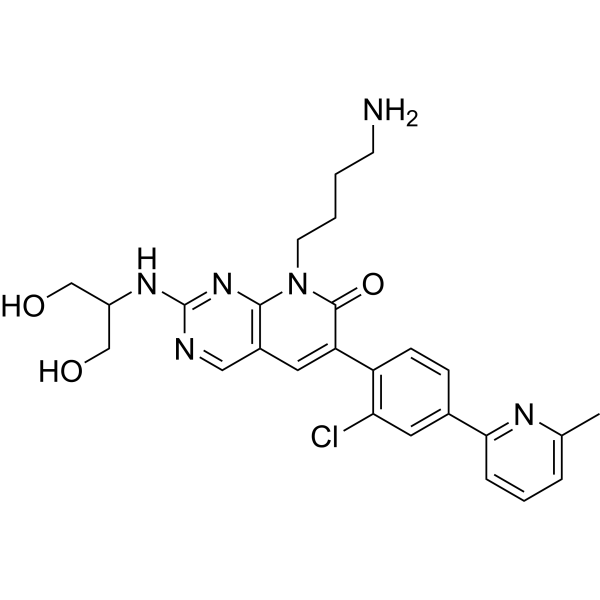 0 ImagesCat. No.: HY-157932CAS No.: 3056814-89-9MR24, a G-5555 (HY-19635) derivative, is a mammalian STE20-like (MST) kinase inhibitor. MR24 shows selectively to MST3/4 over MST1/2, with EC50 values of 57 and 583 nM, respectively. MR24 induces G1 phase cell cycle arrest. MR24 can be used for cancer research, such as breast, liver and lung cancers.



