PI4KII
PI4KII comprises type II phosphatidylinositol 4-kinases that generate PI(4)P, a lipid signal central to cell signaling, membrane traffic, and vesicle trafficking[1]. Mechanistically, PI4KIIα acts at endosomes and the trans-Golgi network, where AP-3-dependent sorting requires both its AP-3 sorting motif and kinase-active site[2]. In lysosomal trafficking, PI4KIIα controls post-Golgi delivery of the LIMP-2/GBA complex, linking PI4P metabolism to Gaucher disease enzyme targeting and sphingolipid homeostasis[3]. In cancer models, PI4KIIα regulates tumor growth through angiogenesis, HIF-1α expression, and HER-2/PI3K/ERK signaling[4]. Compared with PI4KIIα, PI4KIIβ is cytosolic and peripheral membrane-associated, recruits to plasma membrane ruffles through Rac, and stimulates PI(4,5)P2 synthesis at the plasma membrane[5]. Distinctly, PI4KIIβ suppresses invasive behavior by maintaining MT1-MMP traffic in the degradative pathway and reducing invadopodia formation[6]. For experimental applications, PI-273 is a substrate-competitive, subtype-specific PI4KIIα inhibitor that reduces PI4P content, AKT signaling, breast cancer cell viability, and MCF-7 tumor growth[7].
References:
- [1]. Clayton EL, et al. Mammalian phosphatidylinositol 4-kinases as modulators of membrane trafficking and lipid signaling networks. Prog Lipid Res. 2013 Jul;52(3):294-304. [Content Brief]
- [2]. Craige B, et al. Phosphatidylinositol-4-kinase type II alpha contains an AP-3-sorting motif and a kinase domain that are both required for endosome traffic. Mol Biol Cell. 2008 Apr;19(4):1415-26. [Content Brief]
- [3]. Jović M, et al. Two phosphatidylinositol 4-kinases control lysosomal delivery of the Gaucher disease enzyme, β-glucocerebrosidase. Mol Biol Cell. 2012 Apr;23(8):1533-45. [Content Brief]
- [4]. Li J, et al. PI4KIIalpha is a novel regulator of tumor growth by its action on angiogenesis and HIF-1alpha regulation. Oncogene. 2010 Apr 29;29(17):2550-9. [Content Brief]
- [5]. Ookawa K, et al. Transcriptional activation of the MUC2 gene by p53. J Biol Chem. 2002 Dec 13;277(50):48270-5. [Content Brief]
- [6]. Alli-Balogun GO, et al. Phosphatidylinositol 4-kinase IIβ negatively regulates invadopodia formation and suppresses an invasive cellular phenotype. Mol Biol Cell. 2016 Dec 15;27(25):4033-4042. [Content Brief]
- [7]. Li J, et al. PI-273, a Substrate-Competitive, Specific Small-Molecule Inhibitor of PI4KIIα, Inhibits the Growth of Breast Cancer Cells. Cancer Res. 2017 Nov 15;77(22):6253-6266. [Content Brief]
All Product Categories
-
PI4KII Related Products (2)
Related Products (2)

-
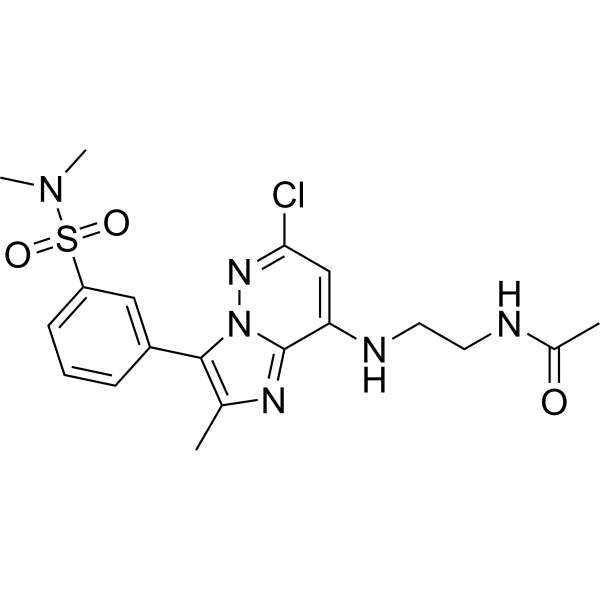
NC03
 0 ImagesNC03 is a PI4K2A inhibitor and reducing agent. NC03 inhibits the activity of PI4K2A, thereby reducing the production of PI4P in the cellular compartments where PI4K2A functions. NC03 rapidly induces a decrease in PI4P pools in the Golgi and endosomal compartments. NC03 reduces PI4P production in Rab7-positive late endosomes.