



ROS Kinase
The transmembrane proto-oncogene receptor tyrosine kinase (RTK) ROS is one of the last two remaining orphan receptor tyrosine kinases. Its normal expression pattern is tightly spatiotemporally restricted during development. The ectopic expression, as well as the production of variable mutant forms of ROS kinase, has been reported in a number of cancers, such as glioblastoma multiforme, and non-small cell lung cancer, suggesting a role for ROS kinase in deriving such tumors. It is thought also that the c-ROS gene may have a role in some cardiovascular diseases, and the fact that homozygous male mice targeted against the c-ROS gene are healthy but infertile has inspired researchers to think about ROS inhibition as a method for the development of new male contraceptives.
ROS1 is a transmembrane receptor tyrosine kinase proto-oncogene that has been shown to have rearrangements with several genes in glioblastoma, non-small-cell lung cancer (NSCLC), and other neoplasms, including intrachromosomal fusion with GOPC due to microdeletions at 6q22.1. ROS1 fusion events are important findings in these tumors, as they are potentially targetable alterations with newer tyrosine kinase inhibitors.
All Product Categories
-
ROS Kinase Related Products (101)
Related Products (101)

-
Antibodies (3)
-
ROS1-IN-2
 0 ImagesCat. No.: HY-161975CAS No.: 2120337-16-6ROS1-IN-2 (Compound 3) is a ROS1 inhibitor. ROS1-IN-2 can be used in the study of cancer.
-
Higenamine-d4-1 hydrochloride
 0 ImagesCat. No.: HY-N2037AS1Synonyms: Norcoclaurine-d4-1 hydrochloride; Demethyl-Coclaurine-d4-1 hydrochlorideHigenamine-d4-1 (Norcoclaurine-d4-1) hydrochloride is deuterium labeled Higenamine (hydrochloride). Higenamine hydrochloride is a selective LSD1 inhibitor (IC50=1.47 μM) that can be isolated from aconite. Higenamine hydrochloride has anti-inflammatory and antibacterial activity. Higenamine (Norcoclaurine) can attenuate IL-1β-induced Apoptosis through ROS-mediated PI3K/Akt signaling pathway. Higenamine hydrochloride protects brain cells from oxygen deprivation. Higenamine can promote bone formation in osteoporosis through the SMAD2/3 pathway. Higenamine hydrochloride can be used to study cancer, inflammation, cardiorenal syndrome and other diseases.
-
Mefloquine (Standard)
 0 ImagesSynonyms: Mefloquin (Standard)Mefloquine (Standard) is the analytical standard of Mefloquine. This product is intended for research and analytical applications. Mefloquine (Mefloquin), an orally active and potent quinoline antimalarial agent, is an anti-SARS-CoV-2 entry inhibitor. Mefloquine is also a K+ channel (KvQT1/minK) antagonist with an IC50 of ~1 μM. Mefloquine can be used for malaria, systemic lupus erythematosus and cancer research.
-
Repotrectinib (Standard)
 0 ImagesCat. No.: HY-103022RCAS No.: 1802220-02-5Synonyms: TPX-0005 (Standard)Repotrectinib (Standard) is the analytical standard of Repotrectinib (HY-103022). This product is intended for research and analytical applications. Repotrectinib (TPX-0005) is a potent ROS1 (IC50=0.07 nM) and TRK (IC50=0.83/0.05/0.1 nM for TRKA/B/C) inhibitor. Repotrectinib potently inhibits WT ALK (IC50=1.01 nM). Repotrectinib has anti-cancer activity.
-
Tyrosine ethyl ester
 0 ImagesCat. No.: HY-W415231CAS No.: 34081-17-9Tyrosine ethyl ester exhibits antioxidant activity.
-
Phosphocreatine disodium (Standard)
 0 ImagesCat. No.: HY-D0885BRCAS No.: 922-32-7Synonyms: Disodium creatine phosphate (Standard)Phosphocreatine (disodium) (Standard) is the analytical standard of Phosphocreatine (disodium). This product is intended for research and analytical applications. Phosphocreatine (disodium) is an organic compound found in vertebrate skeletal muscles. Phosphocreatine (disodium) enhances antioxidant activity, and activates the TAK1 pathway to protect the heart. Phosphocreatine (disodium) normalizing mitochondrial function and reducing oxidative stress via Akt mediated Nrf2/HO-1 pathway. Phosphocreatine (disodium) provides renal protection by suppressing Apoptosis and ROS (Reactive Oxygen Species) generation through ERK mediated mediated Nrf-2/HO-1 pathway..
-
Higenamine hydrochloride (Standard)
 0 ImagesSynonyms: Norcoclaurine hydrochloride (Standard)Higenamine (hydrochloride) (Standard) is the analytical standard of Higenamine (hydrochloride). This product is intended for research and analytical applications. Higenamine hydrochloride is a selective LSD1 inhibitor (IC50=1.47 μM) that can be isolated from aconite. Higenamine hydrochloride has anti-inflammatory and antibacterial activity. Higenamine (Norcoclaurine) can attenuate IL-1β-induced Apoptosis through ROS-mediated PI3K/Akt signaling pathway. Higenamine hydrochloride protects brain cells from oxygen deprivation. Higenamine can promote bone formation in osteoporosis through the SMAD2/3 pathway. Higenamine hydrochloride can be used to study cancer, inflammation, cardiorenal syndrome and other diseases.
-
Kukoamine B mesylate
 0 ImagesCat. No.: HY-N2393ACAS No.: 1375179-86-4Kukoamine B, a spermine alkaloid, is a potent dual LPS and CpG DNA inhibitor with Kd values of 1.23 µM and 0.66 µM, respectively. Kukoamine B exerts anti-inflammatory, anti-diabetic, anti-oxidant, anti-osteoporotic and neuroprotective effects. Kukoamine B has the potential for the study of sepsis. .
-
ALK/ROS1-IN-4 hydrate
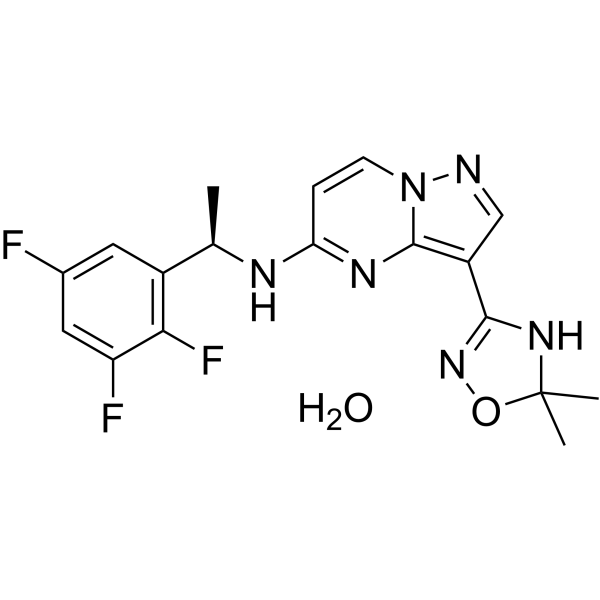 0 ImagesCat. No.: HY-160172AALK/ROS1-IN-4 (hydrate) (example 13) is a dual inhibitor of ALK and ROS1 kinase.
-
Crizotinib-d8
 0 ImagesCat. No.: HY-50878S1CAS No.: 1523579-82-9Synonyms: PF-02341066-d8Crizotinib-d8 (PF-02341066-d8) is deuterium labeled Crizotinib. Crizotinib (PF-02341066) is an orally bioavailable, ATP-competitive ALK and c-Met inhibitor with IC50s of 20 and 8 nM, respectively. Crizotinib inhibits tyrosine phosphorylation of NPM-ALK and tyrosine phosphorylation of c-Met with IC50s of 24 and 11 nM in cell-based assays, respectively. Crizotinib is also a ROS1 inhibitor. Crizotinib has effective tumor growth inhibition.
-
Higenamine (Standard)
 0 ImagesSynonyms: Norcoclaurine (Standard); Demethyl-Coclaurine (Standard)Higenamine (Norcoclaurine), a β2-AR agonist with antioxidant capability, is a key component of the Chinese herb aconite root that prescribes for treating symptoms of heart failure in the oriental Asian countries. Higenamine is also a α1-adrenergic receptor antagonist with hypotensive effect. is a selective LSD1 inhibitor (IC50=1.47 μM) that can be isolated from aconite. Higenamine hydrochloride has anti-inflammatory and antibacterial activity. Higenamine protects myocyte Apoptosis and ischemia/reperfusion (I/R) injury through selective activation of beta2-adrenergic receptor (β2-AR). Higenamine also reduces I/R-induced myocardial infarction in mice. Higenamine can attenuate IL-1β-induced Apoptosis through ROS-mediated PI3K/Akt signaling pathway. Higenamine protects brain cells from oxygen deprivation. Higenamine can promote bone formation in osteoporosis through the SMAD2/3 pathway. Higenamine can be used to study cancer, inflammation, cardiorenal syndrome and other diseases.
-
Salvigenin (Standard)
 0 ImagesCat. No.: HY-N1318RCAS No.: 19103-54-9Synonyms: Psathyrotin (Standard)Salvigenin is a natural polyphenolic compound, with neuroprotective effect. Salvigenin has antitumor cytotoxic and immunomodulatory properties. Salvigenin inhibits H2O2-induced cell apoptosis.
-
Mefloquine hydrochloride (Standard)
 0 ImagesSynonyms: Mefloquin hydrochloride (Standard)Mefloquine (hydrochloride) (Standard) is the analytical standard of Mefloquine (hydrochloride). This product is intended for research and analytical applications. Mefloquine hydrochloride (Mefloquin hydrochloride), a quinoline antimalarial agent, is an anti-SARS-CoV-2 entry inhibitor. Mefloquine hydrochloride is also a K+ channel (KvQT1/minK) antagonist with an IC50 of ~1 μM. Mefloquine hydrochloride can be used for malaria, systemic lupus erythematosus and cancer research.
-
ALK/ROS1-IN-4
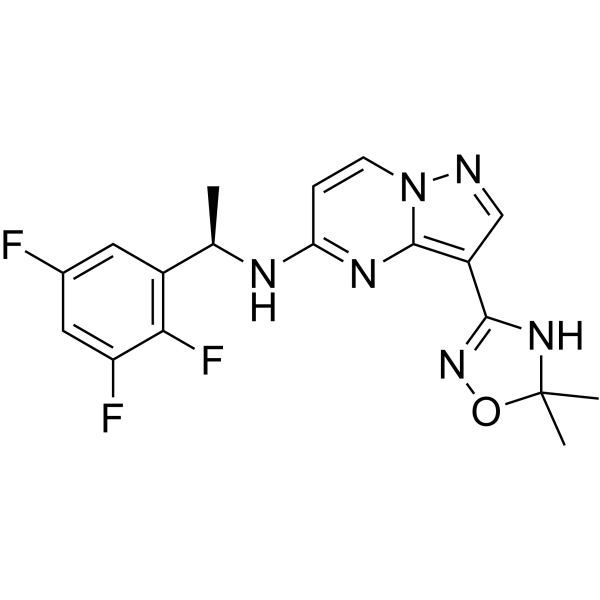 0 ImagesCat. No.: HY-160172CAS No.: 2649878-59-9ALK/ROS1-IN-4 (example 13) is a dual inhibitor of ALK and ROS1 kinase.
-
Phosphocreatine dipotassium
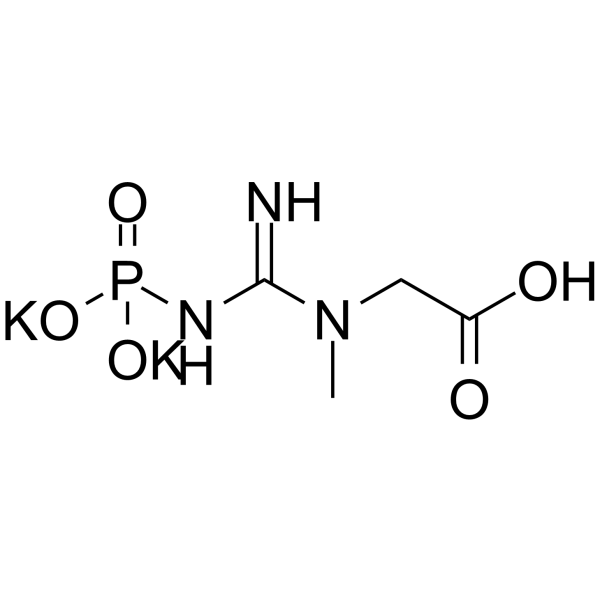 0 ImagesCat. No.: HY-D0885CCAS No.: 18838-38-5Synonyms: Creatine phosphate dipotassium; Creatinephosphoric acid dipotassiumPhosphocreatine (creatine phosphate) is an organic compound found in vertebrate skeletal muscles. Phosphocreatine enhances antioxidant activity, and activates the TAK1 pathway to protect the heart. Phosphocreatine normalizing mitochondrial function and reducing oxidative stress via Akt mediated Nrf2/HO-1 pathway. Phosphocreatine provides renal protection by suppressing Apoptosis and ROS (Reactive Oxygen Species) generation through ERK mediated mediated Nrf-2/HO-1 pathway..
-
Uniconazole (Standard)
 0 ImagesUniconazole (Standard) is the analytical standard of Uniconazole. This product is intended for research and analytical applications. Uniconazole, a plant growth retardant, is a potent inhibitor of abscisic acid (ABA) catabolism with an IC50 of 68 nM against ABA 8’-hydroxylase. Uniconazole is a potent competitive inhibitor of CYP707A3 activity with a Ki of 8 nM. Uniconazole evidently inhibits gibberellin biosynthesis, and brassinosteroid biosynthesis is also inhibited to some extent.
-
Crizotinib (Standard)
 0 ImagesSynonyms: PF-02341066 (Standard)Crizotinib (Standard) is the analytical standard of Crizotinib. This product is intended for research and analytical applications. Crizotinib (PF-02341066) is an orally bioavailable, ATP-competitive ALK and c-Met inhibitor with IC50s of 20 and 8 nM, respectively. Crizotinib inhibits tyrosine phosphorylation of NPM-ALK and tyrosine phosphorylation of c-Met with IC50s of 24 and 11 nM in cell-based assays, respectively. Crizotinib is also a ROS1 inhibitor. Crizotinib has effective tumor growth inhibition.
-
BRD5459
 0 ImagesCat. No.: HY-123815CAS No.: 612037-58-8BRD5459 is a ROS chemical probe. BRD5459 can increase ROS, a marker of oxidative stress in cells, without causing cell death.




