



CD1b
CD1b is a group 1 CD1 antigen-presenting molecule that displays self and microbial lipid antigens to αβ and γδ T cells, thereby extending immune surveillance beyond peptide-based antigen recognition systems[1][2]. Mechanistically, CD1b contains the largest antigen-binding groove within the CD1 family, including interconnected A′, C′, F′, and T′ pockets that accommodate lipids with long alkyl chains and support presentation of structurally diverse mycobacterial and endogenous lipids[3][4]. Following intracellular trafficking through endosomal and lysosomal compartments, CD1b loads lipid antigens and forms complexes that activate CD1b-restricted T-cell responses[5][6]. In disease-relevant settings, CD1b participates in immune recognition of microbial lipids, particularly those derived from Mycobacterium tuberculosis, and also presents self phospholipids and gangliosides that have been linked to autoreactive T-cell responses[3][4]. Compared with related isoforms, CD1a and CD1c more closely reflect the overall cellular lipidome, whereas CD1b shows preferential association with sphingolipids and possesses a substantially larger antigen-binding cleft that enables presentation of longer lipid antigens[3][4]. This structural specialization distinguishes CD1b from CD1a, CD1c, and CD1d and supports its role in studying lipid antigen presentation, host-pathogen interactions, and CD1-restricted T-cell biology[1][3][6].
References:
- [1]. Chancellor A, et al. The versatility of the CD1 lipid antigen presentation pathway. Immunology. 2018 Jun;154(2):196-203. [Content Brief]
- [2]. Van Rhijn I. Do antigen-presenting CD1a, et al. 2023 Oct;44(10):757-759. doi: 10.1016/j.it.2023.08.010. Epub 2023 Sep 18. PMID: 37730500. [Content Brief]
- [3]. Van Kaer L, et al. Mechanisms and Consequences of Antigen Presentation by CD1. Trends Immunol. 2016 Nov;37(11):738-754. doi: 10.1016/j.it.2016.08.011. Epub 2016 Sep 9. PMID: 27623113; PMCID: PMC5159200. [Content Brief]
- [4]. Szoke-Kovacs R, et al. Insights into the CD1 lipidome. Front Immunol. 2024;15:1462209.
- [5]. Pereira CS, et al. Lipid Antigen Presentation by CD1b and CD1d in Lysosomal Storage Disease Patients. Front Immunol. 2019 Jun 4;10:1264. [Content Brief]
- [6]. Kim S, et al. CD1-mediated immune responses in mucosal tissues: molecular mechanisms underlying lipid antigen presentation system. Exp Mol Med. 2023;55:1858-1871.
-
CD1b Related Products (3)
Related Products (3)

-
DPPE-PEG350
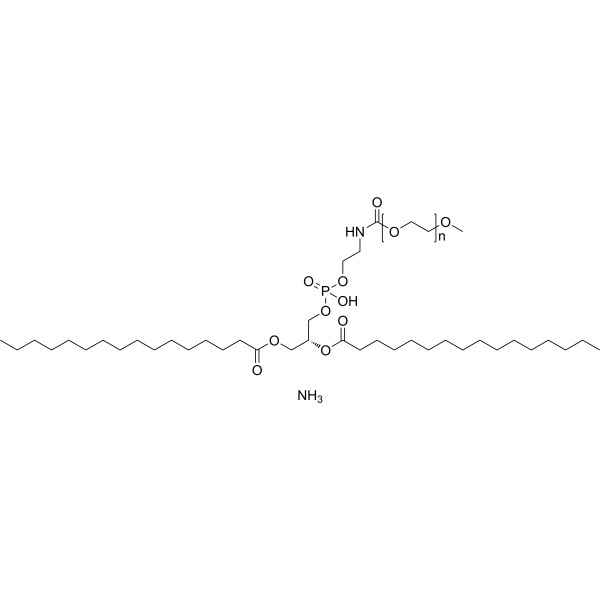 0 ImagesSynonyms: 16:0 PEG350 PE; 1,2-Dipalmitoyl-sn-glycero-3-phosphoethanolamine-N-[methoxy(polyethylene glycol)-350] ammoniumDPPE-PEG350 is a CD1d-dependent lipid antagonist thus blocking the ERK phosphorylation pathway in iNKT cells. DPPE-PEG350 is a PEG lipid functional end group used in the synthesis of liposomes (LPs) for the design of conjugated polymer nanoparticles.

-
Diacylglyceride
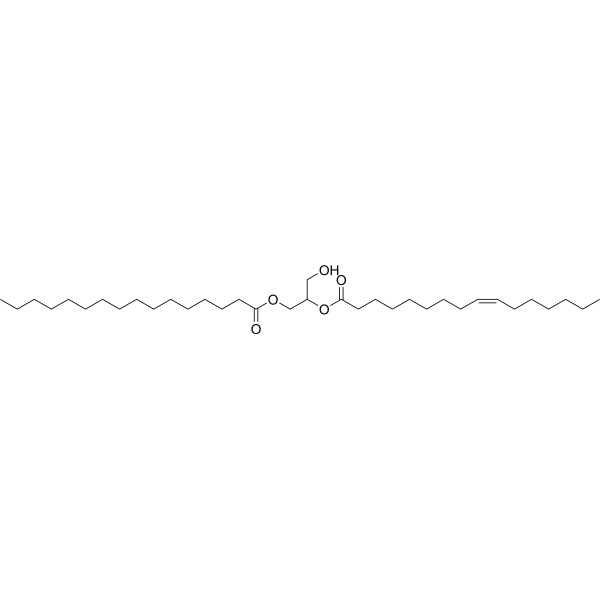 0 ImagesCat. No.: HY-157193CAS No.: 73566-74-2Diacylglyceride, a natural scaffolding lipid, is a hapten that binds to CD1b. Diacylglyceride can be combined with carrier proteins and used in the design of antigens.



