



OPA1 Antibody (YA256)
(Synonyms: Optic atrophy protein 1 homolog)Based on 2 publication(s) in Google Scholar
OPA1 Antibody (YA256) is a Rabbit-derived and non-conjugated IgG monoclonal antibody, targeting to OPA1.
-
Host:
Rabbit
-
Isotype:
IgG
-
Application:
WB, IHC-P, FC
-
Reactivity :
Human, Mouse, Rat
-
Formulation:
Supplied in 1*TBS (pH7.4), 0.05% BSA and 40% Glycerol. Preservative: 0.05% Sodium Azide.
-
Conjugation:
Non-conjugated


To place orders, for customer services and technical support, please contact: MedChemExpress USA
Tel: 609-228-6898 E-mail: [email protected] [email protected]



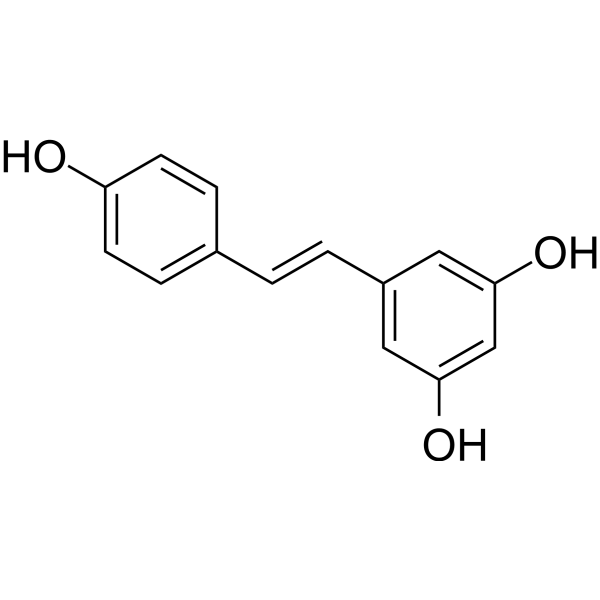
Publications Citing Use of MedChemExpress (MCE) OPA1 Antibody (YA256)
More

Applications
| Application |
WB

WB: Western Blot
|
IHC-P
IHC-P: Immunohistochemistry-Paraffin
|
FC
FC: Flow Cytometry
|
|---|---|---|---|
| Dilution Ratio | 1:500-1:1000 | 1:50-1:200 | 1:50-1:100 |


Product Details
OPA1 Antibody (YA256) is a Rabbit-derived and non-conjugated IgG monoclonal antibody, targeting to OPA1.
-
Host Rabbit

-
Clonality Recombinant,Monoclonal

-
Species ReactivityHuman, Mouse, Rat
-
Observed Molecular WeightObserved band size: 85-120kDa
Note: Due to possible protein modifications or aggregation, the molecular weight should be confirmed by actual measurement, and the predicted value is for reference only.

-
Calculated Molecular Weight Predicted band size: 112 kDa

Entrez Gene: 4976 Human ; 74143 Mouse ; 171116 Rat
SwissProt: O60313 Human ; P58281 Mouse ; Q2TA68 Rat
OMIM: 165500 Human
Synthetic peptide corresponding to Human OPA1.AA range:896-945.
Endogenous
Protein A affinity purified.
Non-conjugated
Unmodified
IgG


Product Properties
-
Appearance
Solution
-
Formulation
Supplied in 1*TBS (pH7.4), 0.05% BSA and 40% Glycerol. Preservative: 0.05% Sodium Azide.
-
Concentration
Batch-dependent, Please check the COA for the concentration of each lot. Check Lot Concentration
-
Storage & Stability
Stored at -20°C for 1 year. Avoid repeated freeze / thaw cycles.
-
Shipping
Shipping with blue ice.


Publications (2)
-
Journal Impact Factor
-
Most Recent


Verification Images
-
 Western blot analysis of extracts from PANC-1 (lane 2, 20ug), HEK293T (lane 3, 20ug), C6 (lane 4, 20ug) and C2C12 (lane 5, 20ug) using OPA1 Antibody (HY-P80255). Proteins were transferred to a PVDF membrane and blocked with 5% non-fat milk in TBST at 4°C overnight. The primary antibody (1/500) and Loading control antibody (Beta Actin, HY-P80993, 1/10,000) was used in 5% non-fat milk in TBST for 2 hour at room temperature. Goat Anti-Rabbit IgG-HRP Secondary Antibody (HY-P8001, 1/10,000) was used for 1 hour at room temperature.
 -
 Immunohistochemical analysis of paraffin-embedded Mouse brain tissue using OPA1 Antibody. The section was pre-treated using heat mediated antigen retrieval with Tris-EDTA buffer (pH 8.0) for 8 minutes. The tissues were blocked in QuickBlock for 20 minutes at room temperature, washed with ddH2O and PBS, and then probed with the primary antibody (HY-P80255, 1/100) in 4℃ overnight. The detection was performed using an HRP conjugated compact polymer system. DAB was used as the chromogen. Tissues were counterstained with hematoxylin and mounted with DPX.
 -
 Immunohistochemical analysis of paraffin-embedded Mouse brain tissue using OPA1 Antibody. The section was pre-treated using heat mediated antigen retrieval with Tris-EDTA buffer (pH 8.0) for 8 minutes. The tissues were blocked in QuickBlock for 20 minutes at room temperature, washed with ddH2O and PBS, and then probed with the primary antibody (HY-P80255, 1/100) in 4℃ overnight. The detection was performed using an HRP conjugated compact polymer system. DAB was used as the chromogen. Tissues were counterstained with hematoxylin and mounted with DPX.
 -
 Flow cytometric analysis of 1X10⁶ NIH-3T3 cells labeling OPA1 Antibody(HY-P80255, red). Cells were fixed with 4% paraformaldehyde and permeabilised with 90% methanol. Then stained with the primary antibody at 1/100 dilution for an hour at 4℃. AF488-conjugated Goat Anti-Rabbit IgG H&L (HY-P8002) was used as the secondary antibody at 1/1,000 dilution for 30 minutes at 4℃. Rabbit IgG Isotype Control (HY-P80879, blue) was used as the isotype control, cells without incubation with primary antibody were used as the unlabeled control (black).
 -
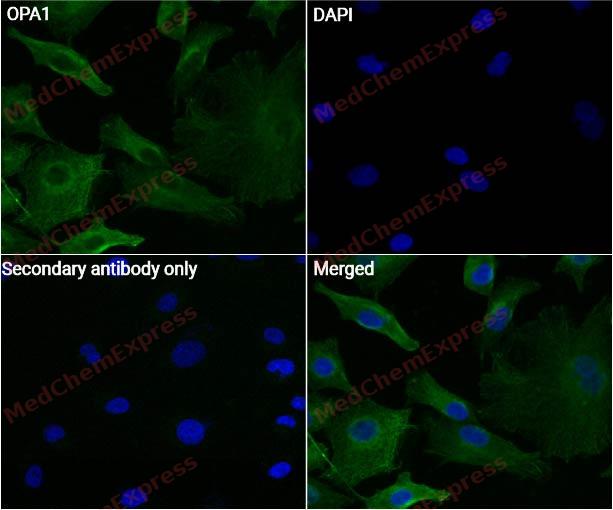 Immunocytochemistry analysis of A549 cells labeling OPA1 with OPA1 Antibody (HY-P80255) at 1/50 dilution. Cells were fixed in 4% paraformaldehyde for 15 minutes at room temperature, permeabilized with 0.1% Triton X-100 for 10 minutes at room temperature, then blocked with QuickBlock™ Blocking Buffer for Immunol Staining for 10 min at room temperature. Cells were then incubated with OPA1 Antibody (HY-P80255) at 1/50 dilution in QuickBlock™ Blocking Buffer for Immunol Staining at 4 ℃. Alexa Fluor® 488-conjugated AffiniPure Goat Anti-Rabbit IgG H&L(HY-P8002, Green) was used as the secondary antibody at 1/1,000 dilution. PBS instead of the primary antibody was used as the secondary antibody only control. The Nuclear counterstain was DAPI (Blue).
 -
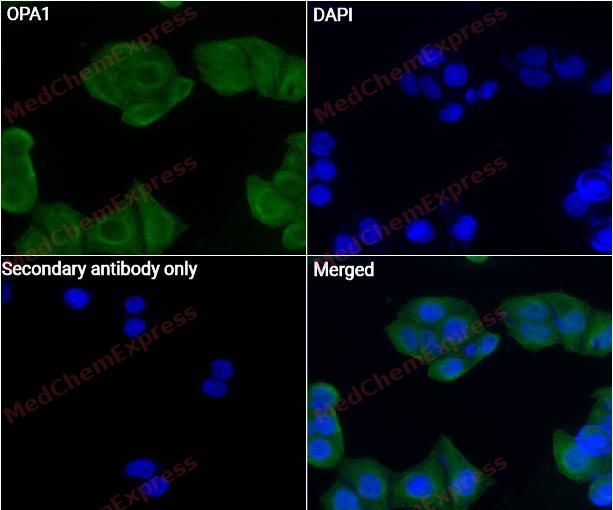 Immunocytochemistry analysis of HeLa cells labeling OPA1 with OPA1 Antibody (HY-P80255)at 1/50 dilution. Cells were fixed in 4% paraformaldehyde for 15 minutes at room temperature, permeabilized with 0.1% Triton X-100 for 10 minutes at room temperature, then blocked with QuickBlock™ Blocking Buffer for Immunol Staining for 10 min at room temperature. Cells were then incubated with OPA1 Antibody (HY-P80255) at 1/50 dilution in QuickBlock™ Blocking Buffer for Immunol Staining at 4 ℃. Alexa Fluor® 488-conjugated AffiniPure Goat Anti-Rabbit IgG H&L(HY-P8002, Green) was used as the secondary antibody at 1/1,000 dilution. PBS instead of the primary antibody was used as the secondary antibody only control. The Nuclear counterstain was DAPI (Blue).


Background
-
Function
OPA1 is a Dynamin-related GTPase that is essential for normal mitochondrial morphology by mediating fusion of the mitochondrial inner membranes, regulating cristae morphology and maintaining respiratory chain function. Exists in two forms: the transmembrane, long form (Dynamin-like GTPase OPA1, long form; L-OPA1), which is tethered to the inner mitochondrial membrane, and the short soluble form (Dynamin-like GTPase OPA1, short form; S-OPA1), which results from proteolytic cleavage and localizes in the intermembrane space. Both forms (L-OPA1 and S-OPA1) cooperate to catalyze the fusion of the mitochondrial inner membrane. The equilibrium between L-OPA1 and S-OPA1 is essential: excess levels of S-OPA1, produced by cleavage by OMA1 following loss of mitochondrial membrane potential, lead to an impaired equilibrium between L-OPA1 and S-OPA1, inhibiting mitochondrial fusion. The balance between L-OPA1 and S-OPA1 also influences cristae shape and morphology. Involved in remodeling cristae and the release of cytochrome c during apoptosis. Proteolytic processing by PARL in response to intrinsic apoptotic signals may lead to disassembly of OPA1 oligomers and release of the caspase activator cytochrome C (CYCS) into the mitochondrial intermembrane space. Acts as a regulator of T-helper Th17 cells, which are characterized by cells with fused mitochondria with tight cristae, by mediating mitochondrial membrane remodeling: OPA1 is required for interleukin-17 (IL-17) production. Its role in mitochondrial morphology is required for mitochondrial genome maintenance; Constitutes the transmembrane long form (L-OPA1) that plays a central role in mitochondrial inner membrane fusion and cristae morphology. L-OPA1 and the soluble short form (S-OPA1) form higher-order helical assemblies that coordinate the fusion of mitochondrial inner membranes. Inner membrane-anchored L-OPA1 molecules initiate membrane remodeling by recruiting soluble S-OPA1 to rapidly polymerize into a flexible cylindrical scaffold encaging the mitochondrial inner membrane. Once at the membrane surface, the formation of S-OPA1 helices induce bilayer curvature. OPA1 dimerization through the paddle region, which inserts into cardiolipin-containing membrane, promotes GTP hydrolysis and the helical assembly of a flexible OPA1 lattice on the membrane, which drives membrane curvature and mitochondrial fusion. Plays a role in the maintenance and remodeling of mitochondrial cristae, some invaginations of the mitochondrial inner membrane that provide an increase in the surface area. Probably acts by forming helical filaments at the inside of inner membrane tubes with the shape and dimensions of crista junctions. The equilibrium between L-OPA1 and S-OPA1 influences cristae shape and morphology: increased L-OPA1 levels promote cristae stacking and elongated mitochondria, while increased S-OPA1 levels correlated with irregular cristae packing and round mitochondria shape; Constitutes the soluble short form (S-OPA1) generated by cleavage by OMA1, which plays a central role in mitochondrial inner membrane fusion and cristae morphology. The transmembrane long form (L-OPA1) and the S-OPA1 form higher-order helical assemblies that coordinate the fusion of mitochondrial inner membranes. Inner membrane-anchored L-OPA1 molecules initiate membrane remodeling by recruiting soluble S-OPA1 to rapidly polymerize into a flexible cylindrical scaffold encaging the mitochondrial inner membrane. Once at the membrane surface, the formation of S-OPA1 helices induce bilayer curvature. OPA1 dimerization through the paddle region, which inserts into cardiolipin-containing membrane, promotes GTP hydrolysis and the helical assembly of a flexible OPA1 lattice on the membrane, which drives membrane curvature and mitochondrial fusion. Excess levels of S-OPA1 produced by cleavage by OMA1 following stress conditions that induce loss of mitochondrial membrane potential, lead to an impaired equilibrium between L-OPA1 and S-OPA1, thereby inhibiting mitochondrial fusion. Involved in mitochondrial safeguard in response to transient mitochondrial membrane depolarization by mediating flickering: cleavage by OMA1 leads to excess production of S-OPA1, preventing mitochondrial hyperfusion. Plays a role in the maintenance and remodeling of mitochondrial cristae, some invaginations of the mitochondrial inner membrane that provide an increase in the surface area. Probably acts by forming helical filaments at the inside of inner membrane tubes with the shape and dimensions of crista junctions. The equilibrium between L-OPA1 and S-OPA1 influences cristae shape and morphology: increased L-OPA1 levels promote cristae stacking and elongated mitochondria, while increased S-OPA1 levels correlated with irregular cristae packing and round mitochondria shape; Coexpression of isoform 1 with shorter alternative products is required for optimal activity in promoting mitochondrial fusion; Isoforms that contain the alternative exon 4b are required for mitochondrial genome maintenance, possibly by anchoring the mitochondrial nucleoids to the inner mitochondrial membrane; Isoforms that contain the alternative exon 4b are required for mitochondrial genome maintenance, possibly by anchoring the mitochondrial nucleoids to the inner mitochondrial membrane[1][2][3][4][5][6][7][8][9][10][11][12][13][14][15][16][17].
-
Subcellular Localization
Mitochondrion inner membrane; Single-pass membrane protein; Mitochondrion intermembrane space
-
Expression
Tissue_specificity:High expression in the retina (PubMed:11017079, PubMed:11017080, PubMed:11810270) . Also expressed in the brain, testes, heart, and skeletal muscle (PubMed:11810270) . All isotypes are expressed at low levels in multiple tissues (PubMed:11810270) ; expressed in the retina, skeletal muscle, heart, lung, ovary, colon, thyroid, leukocytes, and fetal brain. All isotypes are expressed at low levels in multiple tissues; isotype 2 is expressed in the colon, liver, kidney, thyroid, and leukocytes. -
Subunit
Oligomeric complex consisting of membrane-bound and soluble forms of OPA1 (PubMed:20185555, PubMed:37612504, PubMed:37612506). Interacts with RCC1L; RCC1L acts as a guanine nucleotide exchange factor (GEF) for OPA1 by exchanging bound GDP for free GTP (PubMed:28746876). Interacts with CHCHD3 and IMMT; these interactions occur preferentially with soluble OPA1 forms (PubMed:21081504). Interacts with PRELID1 (PubMed:21364629)
-
SwissProt ID
-
Synonyms
Optic atrophy protein 1 homolog
-
Research Field
Neuroscience
Documentation
-
Data Sheet (234 KB)
-
SDS (251 KB)
- English - EN (251 KB)
- Français - FR (251 KB)
- Deutsch - DE (251 KB)
- Norwegian - NO (251 KB)
- Español - ES (251 KB)
- Swedish - SV (251 KB)
- Italian - IT (251 KB)
- Korean - KR (251 KB)
- Portuguese - PT (251 KB)
-
User Guide for Antibodies (1077 KB)

 Powered by Bioz
