



ARP
Based on 1 publication(s) in Google Scholar
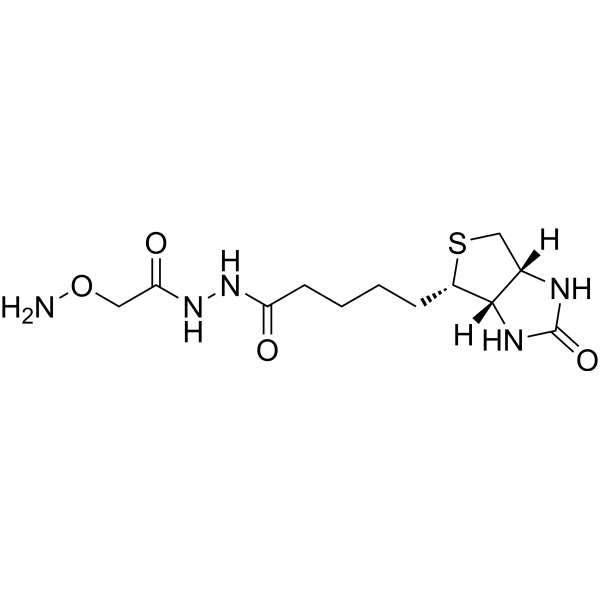
ARP (Aldehyde reactive probe) is an aldehyde-reactive probe. ARP specifically labels AP sites in DNA with biotin residues. ARP detects abasic sites induced by RNA oxidation. ARP is suitable for studies involving the quantification of AP sites, or the detection of other aldehyde-containing DNA damages and abasic sites induced by RNA oxidation.
For research use only. We do not sell to patients.
- Purity : 95.24%
- CAS No.: 139585-03-8
- Formula: C12H21N5O4S
- Molecular Weight:331.39
-
Storage:Powder -20°C, 3 years , 4°C, 2 years ; In solvent -80°C, 6 months , -20°C, 1 month

To place orders, for customer services and technical support, please contact: MedChemExpress USA
Tel: 609-228-6898 E-mail: [email protected] [email protected]


-
 Biological Activity
-
Chemical Information
-
Solvent & Solubility
- Purity & Documentation
- References
-
 Help & FAQs


Publications Citing Use of MedChemExpress (MCE) ARP
More

Biological Activity
Description
In Vitro
ARP (100 μL; 1 h at 37 °C) detects AP sites and related aldehyde-containing damages in DNA isolated from heat-inactivated, X-irradiated E. coli AB1157 cells, with signal intensity proportional to radiation dose[1].
ARP (100 μL; 1 h at 37 °C) detects AP sites formed in the DNA of MMS-treated E. coli AB1157 cells. Its signal is proportional to the concentration of MMS and decreases during the repair process after treatment[1].
ARP (2 mM; 1 h) specifically reacts with apurinic sites in acid-apurinized yeast tRNAPhe, and its reaction activity is directly proportional to the degree of apurinization[2].
ARP (0-10 mM; 1 h) specifically binds to abasic sites in chemically synthesized RNA, with a limit of detection of 10 fmoles of abasic sites[2].
The reactivity of ARP (0-10 mM; 0.5-2 h) with synthetic abasic RNA increases with elevated temperature, prolonged incubation time up to 1 h, acidic pH, and increased ARP concentration[2].
ARP (2 mM; 1 h) detects apurinic/apyrimidinic sites in in vitro synthesized RNA irradiated with γ-rays in a dose-dependent manner, and this effect occurs at doses ≥5 Gy[2].
ARP (2 mM; 1 h) detects apurinic/apyrimidinic (AP) sites in in vitro synthesized RNA oxidized by the Fenton reaction in a dose-dependent manner, and covalently binds to abasic glycosyl groups in Fenton reaction-oxidized RNA to form ribose-ARP adducts detectable by LC/MS[2].
ARP (2 mM; 1 h) detects apurinic/apyrimidinic sites in in vitro synthesized RNA oxidized by peroxynitrite in a dose-dependent manner[2].
ARP (2 mM; 1 h) detected an increase in the formation of abasic sites in the total RNA of HeLa cells treated with hydrogen peroxide or peroxynitrite[2].
MedChemExpress (MCE) has not independently confirmed the accuracy of these methods. They are for reference only.


Chemical Information
-
CAS No. 139585-03-8
-
Appearance Solid
-
Molecular Weight 331.39
-
Formula C12H21N5O4S
-
Color White to off-white
-
SMILES
NOCC(NNC(CCCC[C@H]1[C@]2([H])[C@](NC(N2)=O)([H])CS1)=O)=O
-
Synonyms
Aldehyde reactive probe
-
Shipping
Room temperature in continental US; may vary elsewhere.
-
Storage
Powder -20°C 3 years 4°C 2 years In solvent -80°C 6 months -20°C 1 month


Publications (1)
-
Journal Impact Factor
-
Most Recent
-
Biosens Bioelectron
2026 Nov 1:311:118940. PMID: 42322945


Solvent & Solubility
In Vitro:
DMSO : ≥ 100 mg/mL (301.76 mM; Hygroscopic DMSO has a significant impact on the solubility of product, please use newly opened DMSO)
* "≥" means soluble, but saturation unknown.
Please refer to the solubility information to select the appropriate solvent. Once prepared, please aliquot and store the solution to prevent product inactivation from repeated freeze-thaw cycles.
Storage method and period of stock solution: -80°C, 6 months; -20°C, 1 month. When stored at -80°C, please use it within 6 months. When stored at -20°C, please use it within 1 month.
Please refer to the solubility information to select the appropriate solvent. Once prepared, please aliquot and store the solution to prevent product inactivation from repeated freeze-thaw cycles.
Storage method and period of stock solution: -80°C, 6 months; -20°C, 1 month. When stored at -80°C, please use it within 6 months. When stored at -20°C, please use it within 1 month.
Concentration (start) × Volume (start) = Concentration (final) × Volume (final)


Purity & Documentation
-
Data Sheet (270 KB)
-
SDS (254 KB)
- English - EN (254 KB)
- Français - FR (254 KB)
- Deutsch - DE (254 KB)
- Norwegian - NO (254 KB)
- Español - ES (254 KB)
- Swedish - SV (254 KB)
- Italian - IT (254 KB)
- Korean - KR (254 KB)
- Portuguese - PT (254 KB)
-
Handling Instructions (2659 KB)
References
[1]. Kubo K, et al. A novel, sensitive, and specific assay for abasic sites, the most commonly produced DNA lesion. Biochemistry. 1992;31(14):3703-3708. [Content Brief]
[2]. Tanaka M, et al. An assay for RNA oxidation induced abasic sites using the Aldehyde Reactive Probe. Free Radic Res. 2011;45(2):237-247. [Content Brief]


Complete Stock Solution Preparation Table
Please refer to the solubility information to select the appropriate solvent. Once prepared, please aliquot and store the solution to prevent product inactivation from repeated freeze-thaw cycles.
Storage method and period of stock solution: -80°C, 6 months; -20°C, 1 month. When stored at -80°C, please use it within 6 months. When stored at -20°C, please use it within 1 month.
| Optional Solvent | Concentration Solvent Mass | 1 mg | 5 mg | 10 mg | 25 mg |
|---|---|---|---|---|---|
| DMSO | 1 mM | 3.0176 mL | 15.0880 mL | 30.1759 mL | 75.4398 mL |
| 5 mM | 0.6035 mL | 3.0176 mL | 6.0352 mL | 15.0880 mL | |
| 10 mM | 0.3018 mL | 1.5088 mL | 3.0176 mL | 7.5440 mL | |
| 15 mM | 0.2012 mL | 1.0059 mL | 2.0117 mL | 5.0293 mL | |
| 20 mM | 0.1509 mL | 0.7544 mL | 1.5088 mL | 3.7720 mL | |
| 25 mM | 0.1207 mL | 0.6035 mL | 1.2070 mL | 3.0176 mL | |
| 30 mM | 0.1006 mL | 0.5029 mL | 1.0059 mL | 2.5147 mL | |
| 40 mM | 0.0754 mL | 0.3772 mL | 0.7544 mL | 1.8860 mL | |
| 50 mM | 0.0604 mL | 0.3018 mL | 0.6035 mL | 1.5088 mL | |
| 60 mM | 0.0503 mL | 0.2515 mL | 0.5029 mL | 1.2573 mL | |
| 80 mM | 0.0377 mL | 0.1886 mL | 0.3772 mL | 0.9430 mL | |
| 100 mM | 0.0302 mL | 0.1509 mL | 0.3018 mL | 0.7544 mL |


ARP Related Classifications
HY-157916 Related Classifications
 Powered by Bioz