



Pressinoic Acid
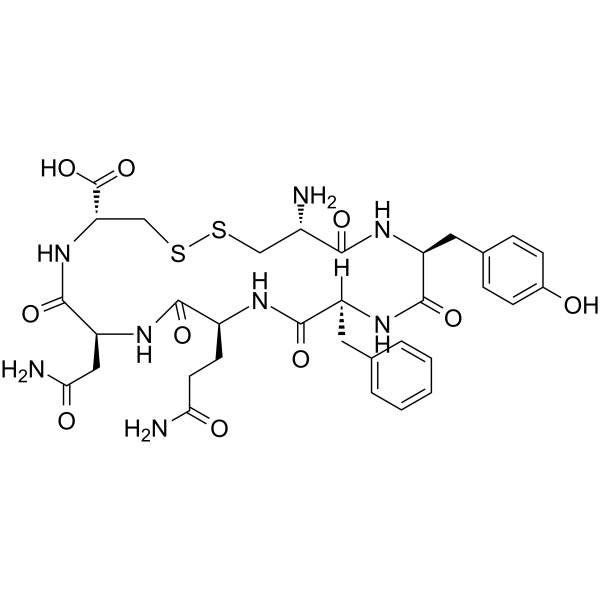
Pressinoic Acid is a synthetic hexapeptide with potent corticotrophin-releasing activity. Pressinoic Acid is also an oxytocin inhibitor; it induces maternal behavior.
Nur für Forschungszwecke. Wir verkaufen nicht an Patienten.
- CAS. Nr.: 35748-51-7
- Formel: C33H42N8O10S2
- Molecular Weight:774.86
-
Speicherung:
Please store the product under the recommended conditions in the Certificate of Analysis.

To place orders, for customer services and technical support, please contact: MedChemExpress USA
Tel: 609-228-6898 E-mail: [email protected] [email protected]


-
 Biologische Aktivität
-
Chemical Information
-
Lösungsmittel & Löslichkeit
- Protokoll
- Reinheit & Dokumentation
- Verweise
-
 Help & FAQs




Biologische Aktivität
Oxytocin[1]
Pressinoic acid, a synthetic hexapeptide that corresponds to the ring of vasopressin, exhibits corticotrophin-releasing activity in vitro in doses of 3 and 30 ng/mL[1].
MedChemExpress (MCE) has not independently confirmed the accuracy of these methods. They are for reference only.


Chemical Information
-
CAS. Nr. 35748-51-7
-
Molecular Weight 774.86
-
Formel C33H42N8O10S2
-
Sequence
Cys-Tyr-Phe-Gln-Asn-Cys (Disulfide bridge: Cys1-Cys6)
-
Sequence Shortening
CYFQNC (Disulfide bridge: Cys1-Cys6)
-
Versand
Room temperature in continental US; may vary elsewhere.
-
Speicherung
Please store the product under the recommended conditions in the Certificate of Analysis.


Lösungsmittel & Löslichkeit
H2O
Peptide Solubility and Storage Guidelines:
1. Calculate the length of the peptide.
2. Calculate the overall charge of the entire peptide according to the following table:
| Contents | Assign value | |
|---|---|---|
| Acidic amino acid | Asp (D), Glu (E), and the C-terminal -COOH. | -1 |
| Basic amino acid | Arg (R), Lys (K), His (H), and the N-terminal -NH2 | +1 |
| Neutral amino acid | Gly (G), Ala (A), Leu (L), Ile (I), Val (V), Cys (C), Met (M), Thr (T), Ser (S), Phe (F), Tyr (Y), Trp (W), Pro (P), Asn (N), Gln (Q) | 0 |
3. Recommended solution:
| Overall charge of peptide | Details |
|---|---|
| Negative (<0) |
1. Try to dissolve the peptide in water first. 2. If water fails, add NH4OH (<50 μL). 3. If the peptide still does not dissolve, add DMSO (50-100 μL) to solubilize the peptide. |
| Positive (>0) |
1. Try to dissolve the peptide in water first. 2. If water fails, try dissolving the peptide in a 10%-30% acetic acid solution. 3. If the peptide still does not dissolve, try dissolving the peptide in a small amount of DMSO. |
| Zero (=0) |
1. Try to dissolve the peptide in organic solvent (acetonitrile, methanol, etc.) first. 2. For very hydrophobic peptides, try dissolving the peptide in a small amount of DMSO, and then dilute the solution with water to the desired concentration. |

Protokoll
Single halved pituitary glands of female CFE rats weighing 100 to 150 g are preincubated for two hours in Krebs-Ringer-bicarbonate-glucose (2%) medium under 5% CO2 in O2, and then for one hour periods each with 300 ng. lysine vasopressin and the sample of vasopressin ring peptide Pressinoic Acid. The incubations are separated by a one hour ish period. The media from the pituitary incubations are added to rat adrenal quarters superfused for estimation of the steroidogenic response to the corticotrophin released. The steroidogenie effect of the unstimulated release of corticotrophin by the pituitary tissue and the possible steroidogenic effect of the peptide directly on the adrenal tissue are measured together by adding the peptide to the media from pituitary tissue incubated without peptide for one hour[1].
MedChemExpress (MCE) has not independently confirmed the accuracy of these methods. They are for reference only.


Reinheit & Dokumentation
Verweise
[1]. Saffran M, et al. Pressinoic acid: a peptide with potent corticotrophin-releasing activity. Biochem Biophys Res Commun. 1972 Nov 1;49(3):748-51. [Content Brief]
[2]. Langs DA, et al. Structure of pressinoic acid: the cyclic moiety of vasopressin. Science. 1986 Jun 6;232(4755):1240-2. [Content Brief]

Calculators
Konzentration (Stammlösung) × Volumen (Stammlösung) = Konzentration (Ziellösung) × Volumen (Ziellösung)


Pressinoic Acid Related Classifications
HY-P1487 Related Classifications
 Powered by Bioz