



Brenetafusp

Based on 1 Customer Validation
Brenetafusp is a TCR/anti-CD3 bispecific fusion protein, consisting of a TCR targeting the PRAME peptide and an anti-CD3 scFv effector domain. Brenetafusp redirects CD3+ T cells to kill PRAME+ tumor cells. Brenetafusp can be used in research related to cutaneous melanoma, non-small cell lung cancer, ovarian cancer, endometrial cancer, triple-negative breast cancer, and small cell lung cancer.
For research use only. We do not sell to patients.
- Purity : 99.70%
- CAS No.: 2736407-54-6
- Molecular Weight:76.98 kDa
-
Storage:
Please store the product under the recommended conditions in the Certificate of Analysis.


To place orders, for customer services and technical support, please contact: MedChemExpress USA
Tel: 609-228-6898 E-mail: [email protected] [email protected]


-
 Biological Activity
-
Chemical Information
- Protocols
- Purity & Documentation
- References
-
 Help & FAQs






Biological Activity
Description
Isotype
scFv-TR-Alpha_Beta-2
Species Reactivity
Human
IC50 & Target
CD3E & PRAME
In Vitro
Brenetafusp (10-13-10-8 M) potently activates T cells in a dose-dependent manner against HLA-A*02:01+ PRAME+ MEL624, MEWO, SKMEL5, and C32 melanoma cell lines, with EC50 values ranging from 12.4 to 98.0 pM[1].
Brenetafusp (10-14-10-9 M) potently mediates T cell-directed cytotoxicity against HLA-A*02:01+ PRAME+ MEL624, MEWO, and C32 melanoma cell lines, with EC50 values ranging from 2.99 to 20.4 pM[1].
Brenetafusp (10-13-10-8 M) potently activates T cells in a dose-dependent manner against HLA-A*02:01+ PRAME+ NCI-H1755 and NCI-H1703 NSCLC cell lines, with EC50 values of 17.9 and 76.9 pM, respectively[1].
Brenetafusp (10-14-10-9 M) potently mediates T cell-directed cytotoxicity against HLA-A*02:01+ PRAME+ NCI-H1755 and NCI-H1703 NSCLC cell lines, with EC50 values of 1.3 and 4.4 pM, respectively[1].
Brenetafusp (10-13-10-8 M) potently activates T cells in a dose-dependent manner against HLA-A*02:01+ PRAME+ OV56 and COV318 ovarian cancer cell lines, with EC50 values of 2.4 and 17.4 pM, respectively[1].
Brenetafusp (10-14-10-9 M) potently mediates T cell-directed cytotoxicity against HLA-A*02:01+ PRAME+ OV56 and COV318 ovarian cancer cell lines, with EC50 values of 1.6 and 10.5 pM, respectively[1].
Brenetafusp (10-1000 pM) effectively redirects T cells to induce dose-dependent apoptosis in HLA-A*02:01+ PRAME+ patient-derived tumor organoids[1].
Brenetafusp (10-13-10-8 M) mediated T cell activation is dependent on PRAME expression in MEL624 melanoma cells, with robust activity in parental cells, reduced activity in PRAME KO cells, and dose-dependent restored activity in PRAME-rescued KO cells[1].
Brenetafusp (10-100 pM; 80 hours) redirects PD-1+ exhausted TILs to kill PD-L1+ MEL624 melanoma cells, with impaired activity that is fully rescued by anti-PD-1 antibody[1].
Brenetafusp (up to 10 nM for bronchial epithelial cells; down to 1 nM for melanocytes) shows minimal reactivity against primary normal human bronchial epithelial cells and melanocytes, demonstrating specificity for PRAME+ tumor cells[1].
MedChemExpress (MCE) has not independently confirmed the accuracy of these methods. They are for reference only. Further protocols information, click here.
-
Cell Line:PD-1+ and PD-1- tumor-infiltrating lymphocytes (TILs) from melanoma biopsies, co-cultured with PD-L1+ or PD-L1- MEL624 melanoma cells
-
Concentration:10 pM, 100 pM
-
Incubation Time:80 hours
-
Result:Mediated cytotoxicity by PD-1+ TILs against PD-L1+ MEL624 cells that was 3-10-fold lower than against PD-L1- cells at 100 pM; co-incubation with anti-PD-1 antibody fully restored this cytotoxicity.
Gene ID
Accession
Conjugated
Unconjugated
Reconsititution
The product can be reconstituted/diluted with sterile PBS or saline.
Application
ELISA, FACS, Functional assay
Verified Bioactivity
-
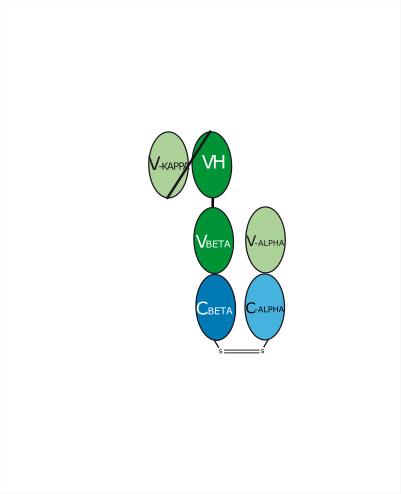 scFv-TR-Alpha_Beta-2
 -
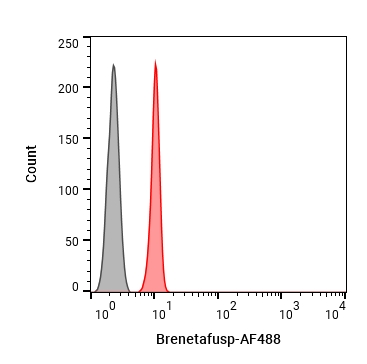 Flow cytometric analysis of 1X10⁶ Jurkat cells with Brenetafusp (HY-P990717, red). Cells were fixed with 4% paraformaldehyde and permeabilised with 90% methanol. Then stained with the primary antibody at 1/50 dilution for an hour at 4℃. Alexa Fluor 488-conjugated AffiniPure Goat Anti-Human IgG H&L (HY-P83776) was used as the secondary antibody at 1/1,000 dilution for 30 minutes at 4℃. Cells without incubation with primary antibody were used as the unlabeled control (black).
 -
 Flow cytometric analysis of 1X10⁶ THP-1 cells with Brenetafusp (HY-P990717, red). Cells were fixed with 4% paraformaldehyde and permeabilised with 90% methanol. Then stained with the primary antibody at 1/50 dilution for an hour at 4℃. Alexa Fluor 488-conjugated AffiniPure Goat Anti-Human IgG H&L (HY-P83776) was used as the secondary antibody at 1/1,000 dilution for 30 minutes at 4℃. Cells without incubation with primary antibody were used as the unlabeled control (black).


Chemical Information
-
CAS No. 2736407-54-6
-
Appearance Liquid
-
Molecular Weight 76.98 kDa
-
Color Colorless to light yellow
-
Synonyms
IMC-F106C
-
Shipping
Shipping with dry ice.
-
Formulation
Please refer to the lot-specific COA for specific buffer information.
-
Storage
Please store the product under the recommended conditions in the Certificate of Analysis.

Protocols
-
Breast Cancer Modeling
Breast cancer is a heterogeneous cancer, and it has been distinguished into four subtypes: luminal A, luminal B, HER2-positive and basal-like. Molecular mutations, epigenetic alterations, hormone exposure and immune microenvironment are related to the progression of breast cancer.


Purity & Documentation
-
Data Sheet (261 KB)
-
SDS (251 KB)
- English - EN (251 KB)
- Français - FR (251 KB)
- Deutsch - DE (251 KB)
- Norwegian - NO (251 KB)
- Español - ES (251 KB)
- Swedish - SV (251 KB)
- Italian - IT (251 KB)
- Korean - KR (251 KB)
- Portuguese - PT (251 KB)
-
Inhibitory Antibodies User Guide (603 KB)
References

Calculators
Concentration (start) × Volume (start) = Concentration (final) × Volume (final)


Brenetafusp Related Classifications
HY-P990717 Related Classifications
 Powered by Bioz