



Bispecific Antibodies
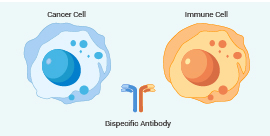
Bispecific antibodies are antibodies with two binding sites against two different antigens or two different epitopes on the same antigen. The core mechanism involves bridging immune cells (e.g., T cells) with target cells (e.g., cancer cells, by binding CD3 and tumor antigens) to enhance killing, or blocking two disease-associated pathways simultaneously.

- Molecular Weight: 54.09 kDa
Blinatumomab (Anatumomab) is a bispecific monoclonal antibody with two binding sites, one for CD3E on T cells and one for CD19 on B cells. Blinatumomab can be used in research for acute lymphoblastic leukemia.

- Molecular Weight: 105.07 kDa
Tarlatamab (AMG-757) is a bispecific T-cell engager (BiTE) antibody targeting delta-like ligand 3 (DLL3). DLL3 is a target that is selectively expressed in small-cell lung cancer (SCLC) tumors, but with minimal normal tissue expression. Tarlatamab has the KDs of 0.64 nM and 0.50 nM for human and nonhuman primate (NHP) DLL3, respectively. Tarlatamab has the KDs of 14.9 nM and 12 nM for human and NHP CD3, respectively. Tarlatamab is a first-in-class HLE BiTE immuno-oncology therapy targeting DLL3 and has the potential for SCLC research.

- Molecular Weight: 145.88 kDa
Amivantamab (JNJ-61186372) is a human EGFR-MET bispecific antibody with immune anticancer activity. Amivantamab inhibits ligand binding, promotes endocytosis and degradation of receptor-antibody complexes, and induces Fc-dependent cytokinesis in macrophages and antibody-dependent cytotoxicity in natural killer cells.

- Molecular Weight: 194.25 kDa
Trontinemab (RG6102) is a brain-penetrant, anti-amyloid, bispecific and humanizedized IgG1-κ antibody, targeting to Aβ plaques and transferrin receptor 1 (TFR1). Trontinemab binds to fibrillar Aβ as well as Aβ plaques triggering plaque clearance by engaging immune cells on Alzheimer disease (AD) brain sections. Trontinemab also shows specific affinity to cynomolgus and human TFR1.

- Molecular Weight: 143.64 kDa
Teclistamab is a human bispecific antibody to BCMA and CD3 that recognizes BCMA on target cells and CD3 on T cells and induces T cell-mediated cytotoxicity leading to T cell activation and subsequent target cell lysis. Teclistamab can be used in studies of diseases related to multiple myeloma (MM).

- Molecular Weight: 144 kDa
Mosunetuzumab (BTCT-4465A) is a full-length, fully humanized immunoglobulin G1 (IgG1) T-cell-dependent bispecific (TDB) antibody targeting CD20 (B cells) and CD3 (T cells). Mosunetuzumab redirects T cells to engage and eliminate malignant B cells and can be used for the research of relapsed or refractory (R/R) B-cell non-Hodgkin lymphomas (B-NHLs). The Fc region of Mosunetuzumab incorporates a "knob-into-hole" structural modification and an N297G point mutation to achieve heterodimerization and eliminate Fc glycosylation, thereby effectively silencing antibody effector functions.

- Molecular Weight: 146.28 kDa
Epcoritamab (GEN3013) is an bispecific IgG1 antibody redirecting T-cells toward CD3×CD20+ tumor cells. Epcoritamab induces potent T-cell-mediated cytotoxicity towards B-cell NHL cell lines.


- Molecular Weight: 201.1 kDa
Ivonescimab (AK112) is a PD-1/VEGF bispecific antibody. Ivonescimab competitively inhibiting PD-1/PD-L1 interaction, reversing the immunosuppression mediated by it, and blocks the binding of VEGF-A to VEGFR2, inhibiting tumour angiogenesis in the tumour microenvironment. Ivonescimab also has significantly anticancer activity against EGFR-mutated locally advanced or metastatic non-squamous non-small cell lung cancer (NSCL).

- Molecular Weight: 194 kDa
Glofitamab (RO7082859) is a T-cell-engaging bispecific antibody possessing a novel 2:1 structure with bivalency for CD20 on B cells and monovalency for CD3 on T cells. Glofitamab leads to T-cell activation, proliferation, and tumor cell killing upon binding to CD20 on malignant cells. Glofitamab induces durable complete remissions in relapsed or refractory B-Cell non-Hodgkin lymphoma (B-NHL).

- Molecular Weight: 124.65kDa
Zanidatamab (ZW25) is a humanised, bispecific monoclonal antibody targeting 2 distinct HER2 epitopes (ECD2 and ECD4). Zanidatamab has anti-tumour activity.

- Molecular Weight: 144.58 kDa
Talquetamab (JNJ-64407564) is a humanized bispecific antibody that binds to GPRC5D (member of G protein-coupled receptor family C5 group D) and CD3 to induce T cell-mediated killing of GPRC5D-expressing MM cells through T cell recruitment and activation. Talquetamab (JNJ-64407564) has antitumor activity.

- Molecular Weight: 173.555 kDa
Xaluritamig (AMG-509) is a bispecific T cell engager and cytolytic agent with a Kd of 27.6 nM for human CD3ε. Xaluritamig binds to CD3ε via an anti-CD3 single-chain variable fragment (scFv) domain, and to STEAP1 via a bispecific anti-STEAP1 antigen-binding fragment (Fab) domain, thereby recruiting and activating T cells and forming a bridge between T cells and STEAP1-expressing cancer cells. Xaluritamig induces T cell-mediated redirected cytotoxicity, tumor cell lysis, cytokine release, CD8+ T cell activation and expansion, as well as tumor stasis or regression. Xaluritamig contains an Fc domain with no effector function, which prolongs serum half-life, exhibits only minimal activity against cells with low STEAP1 expression and normal cells, and shows extremely low target-related off-tumor toxicity in cynomolgus monkeys. Xaluritamig is used in STEAP1×CD3 XmAb 2+1 immunotherapy and in research on metastatic castration-resistant prostate cancer and Ewing sarcoma.

- Molecular Weight: 145.5 kDa
Petosemtamab (MCLA 158) is an anti- EGFR (Kd: 0.22 nM) and anti-LGR5 (Kd: 0.86 nM) monoclonal antibody (mAb). Petosemtamab leads to EGFR signaling blockade and receptor degradation in LGR5+ cancer cells. Petosemtamab can be used in the research of solid tumors, such as head and neck squamous cell carcinoma (HNSCC), metastatic colorectal cancer (CRC).

- Molecular Weight: 145.76 kDa
Zenocutuzumab (MCLA-128) is a bispecific humanized IgG1 antibody containing two different Fab arms, targeting extracellular domains of HER2 and HER3.

- Molecular Weight: 146.73 kDa
Catumaxomab, a trifunctional IgG2 antibody, is composed of mouse and rat heavy and light chains and binds to human EpCAM and human CD 3 receptors. The Fc region of Catumaxomab region has binding affinity for FcγR1 (CD 64), FcγRIIA (CD 32a), and FcγRIII (CD 16). Catumaxomab can be used for anti-tumor research, especially epithelial cancers.

- Molecular Weight: 124.81 kDa
Pasritamig (JNJ-78278343; KLCB-245) is a bispecific T-cell engager (BiTE) that targets the complex of human kallikrein KLK2 and CD3 receptor. Pasritamig redirects the cytotoxicity of T cells to KLK2-expressing tumor cells and induces T cell-mediated lysis of KLK2-expressing prostate cancer cells. Administered via subcutaneous injection, subcutaneous infusion or intravenous infusion, Pasritamig exhibits antitumor activity against metastatic castration-resistant prostate cancer. Pasritamig has a safety profile with an extremely low incidence of cytokine release syndrome and can be safely administered in an outpatient setting. Pasritamig is applicable to the research of metastatic castration-resistant prostate cancer.

- Molecular Weight: 145.441 kDa

- Molecular Weight: 110.46 kDa
Surovatamig (AZD0486; TNB-486) is a fully human anti-CD19/CD3 IgG4 bispecific antibody. Surovatamig triggers T cell activation, releases cytotoxic granules, and induces T cell-dependent cellular cytotoxicity and tumor cell lysis. Surovatamig can reduces release of pro-inflammatory cytokines including IL-2, IFNγ, TNF. Surovatamig can be used for the research of cancer, such as B cell non-Hodgkin lymphoma.

- Molecular Weight: 146.19 kDa
Cevostamab (BFCR4350A; RG6160; RO7187797) is a humanized IgG1-based BsAb that targets membrane-proximal extracellular domain of FcRH5 on multiple myeloma (MM) cells as well as CD3 on T cells. Moreover, Cevostamab facilitates efficient synapse formation, improves killing activity of T cells against MM tumor cells.



