



Xaluritamig

Based on 1 Customer Validation
Xaluritamig (AMG-509) is a bispecific T cell engager and cytolytic agent with a Kd of 27.6 nM for human CD3ε. Xaluritamig binds to CD3ε via an anti-CD3 single-chain variable fragment (scFv) domain, and to STEAP1 via a bispecific anti-STEAP1 antigen-binding fragment (Fab) domain, thereby recruiting and activating T cells and forming a bridge between T cells and STEAP1-expressing cancer cells. Xaluritamig induces T cell-mediated redirected cytotoxicity, tumor cell lysis, cytokine release, CD8+ T cell activation and expansion, as well as tumor stasis or regression. Xaluritamig contains an Fc domain with no effector function, which prolongs serum half-life, exhibits only minimal activity against cells with low STEAP1 expression and normal cells, and shows extremely low target-related off-tumor toxicity in cynomolgus monkeys. Xaluritamig is used in STEAP1×CD3 XmAb 2+1 immunotherapy and in research on metastatic castration-resistant prostate cancer and Ewing sarcoma.
For research use only. We do not sell to patients.
- Purity : 99.44%
- CAS No.: 2559056-68-5
- Molecular Weight:173.555 kDa
-
Storage:
Please store the product under the recommended conditions in the Certificate of Analysis.


To place orders, for customer services and technical support, please contact: MedChemExpress USA
Tel: 609-228-6898 E-mail: [email protected] [email protected]


-
 Biological Activity
-
Chemical Information
- Protocols
- Purity & Documentation
- References
-
 Help & FAQs


-

HY-P99575
Tarlatamabanti-DLL3/CD3 BiTE antibody -

HY-P991015
PasritamigKLK2-CD3R Binder -

HY-P99418
AcapatamabAnti-CD3E/FOLH1 Antibody -

HY-P9908
AdalimumabTNF-α Inhibitor -

HY-P99001
Human IgG1 kappa, Isotype ControlIgG1κ Isotype Control -

HY-P991503
Anti-STEAP2 AntibodySTEAP2 Antibody -

HY-P99517
VoxalatamabPSMA/CD3 Dual Antibody -

HY-P9963
BlinatumomabAntineoplastic Agent -

HY-P990673
VandortuzumabSTEAP1 ADC Antibody -

HY-P99539
UbamatamabAnti-MUC16/CD3 Antibody -

HY-P9999
TrontinemabAβ/TFRC Antibody -
HY-17393
CarboplatinDNA Synthesis Inhibitor


Biological Activity
Description
Isotype
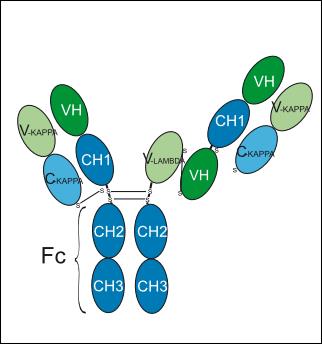
half-IgG1-kappa/VH-CH1-h-(scFv-heavy-lambda)-h-CH2-CH3
Species Reactivity
Human
IC50 & Target
CD3E & STEAP1
In Vitro
Xaluritamig (AMG-509) binds specifically to 293T cells transfected with human STEAP1, with an EC50 of 3.8 nM[2].
Xaluritamig potently induces T cell-mediated lysis of STEAP1-positive human cancer cells, with a median EC50 of 37 pM across 19 cell lines; it shows no activity against STEAP1-knockout prostate cancer cells[2].\n
Xaluritamig redirects prostate cancer cell lysis with higher potency than the anti-STEAP1 Fab XmAb molecule alone; it preferentially kills cancer cells with high STEAP1 expression and exhibits extremely low activity against normal cells[2].
Xaluritamig induces only extremely low levels of cytotoxicity in STEAP1-low-expressing human normal bronchial smooth muscle cells and aortic endothelial cells cultured in vitro[3].
MedChemExpress (MCE) has not independently confirmed the accuracy of these methods. They are for reference only.
In Vivo
Xaluritamig (0.3 mg/kg; intravenous injection; administered twice at a 7-day interval; total duration of 17 days) significantly inhibits tumor growth in the tibial bone metastasis model of Myc-CaP-LucSTEAP1 in FVB/N huCD3ε knock-in mice, but its combination with anti-PD-1 antibody does not enhance anti-tumor activity[4].
Xaluritamig (10 μg/kg, or an additional 40 μg/kg; intravenous injection; for 28 consecutive days) is well tolerated in male and female Mauritian-origin cynomolgus monkeys. Serum exposure is nearly dose-proportional, with no serious target-related off-tumor toxicity[4].
MedChemExpress (MCE) has not independently confirmed the accuracy of these methods. They are for reference only.
-
Animal Model:Male NSG mice (NOD.Cg-Prkdcscid Il2rgtm1N/j/SzJ), no specified weight and age + 22Rv1-LucSTEAP1 subcutaneous xenograft model[4]
-
Dosage:0.01 mg/kg, 0.1 mg/kg, 1 mg/kg
-
Administration:Intravenous injection; twice, 7 days apart; 16 days.
-
Result:Exerted significant antitumor activity.
The 0.01 mg/kg dose achieved 99.7% tumor growth inhibition with complete tumor stasis, while the 0.1 mg/kg and 1 mg/kg doses induced 61.6% and 66.2% tumor regression, respectively, after two administrations on days 9 and 16.
-
Animal Model:Male and female cynomolgus monkeys (Mauritian origin), normal toxicology evaluation model[4]
-
Dosage:10 μg/kg flat dose, 10 μg/kg initial dose followed by 40 μg/kg weekly
-
Administration:Intravenous injection; single-dose group: once; step-dose group: four times; 28 days.
-
Result:Was well tolerated during the 28-day study, with nearly dose-proportional and no gender differences in serum exposure.
Transient changes related to acute phase response were observed, including increased C-reactive protein, decreased absolute counts of total T cells, cytotoxic T cells, helper T cells and natural killer cells, and mild increases in neutrophils and globulins.
No severe target-related off-tumor toxicity was detected.
- RNA extraction experimental
- Cell Cytotoxicity Assay
- Mammalian live/dead viability and cytotoxicity staining
- Protocol for Pharmacokinetic Study
- Protein Extraction
- Research Protocol for Inflammation-related Diseases
- Research Protocol for Cancer Immunology
- Cell Viability Determination by MTT Colorimetric Assay
Clinical Trial
| NCT Number | Sponsor | Condition | Start Date |
Phase

|
|---|---|---|---|---|
| NCT01329991 | 2011-05 | PHASE1 |
Gene ID
Accession
Conjugated
Unconjugated
Reconsititution
The product can be reconstituted/diluted with sterile PBS or saline.
Format
-
half-IGG1-kappa/VH-CH1-h-(scFv-heavy-lambda)-h-CH2-CH3
Application
ELISA, FACS, Functional assay
Verified Bioactivity
-
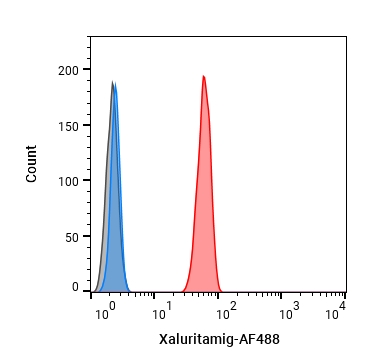 Flow cytometric analysis of 1X10⁶ Jurkat cells with Xaluritamig (HY-P990688, red). Cells were fixed with 4% paraformaldehyde. Then stained with the primary antibody at 1/200 dilution for an hour at 4℃. Alexa Fluor 488-conjugated AffiniPure Goat Anti-Human IgG H&L (HY-P83776) was used as the secondary antibody at 1/1,000 dilution for 30 minutes at 4℃. Human IgG1 kappa (HY-P99001, blue) was used as the isotype control, cells without incubation with primary antibody were used as the unlabeled control (black).
 -
 Flow cytometric analysis of 1X10⁶ FaDu cells with Xaluritamig (HY-P990688, red). Cells were fixed with 4% paraformaldehyde. Then stained with the primary antibody at 1/200 dilution for an hour at 4℃. AF 488-conjugated AffiniPure Goat Anti-Human IgG H&L (HY-P83776) was used as the secondary antibody at 1/1,000 dilution for 30 minutes at 4℃. Human IgG1 kappa (HY-P99001, blue) was used as the isotype control.


Chemical Information
-
CAS No. 2559056-68-5
-
Appearance Liquid
-
Molecular Weight 173.555 kDa
-
Color Colorless to light yellow
-
Synonyms
AMG-509
-
Shipping
Shipping with dry ice.
-
Formulation
Please refer to the lot-specific COA for specific buffer information.
-
Storage
Please store the product under the recommended conditions in the Certificate of Analysis.


Purity & Documentation
-
Data Sheet (264 KB)
-
SDS (251 KB)
- English - EN (251 KB)
- Français - FR (251 KB)
- Deutsch - DE (251 KB)
- Norwegian - NO (251 KB)
- Español - ES (251 KB)
- Swedish - SV (251 KB)
- Italian - IT (251 KB)
- Korean - KR (251 KB)
- Portuguese - PT (251 KB)
-
Inhibitory Antibodies User Guide (603 KB)
References
[1]. Kelly WK, et al. Xaluritamig, a STEAP1 × CD3 XmAb 2+1 Immune Therapy for Metastatic Castration-Resistant Prostate Cancer: Results from Dose Exploration in a First-in-Human Study. Cancer Discov. 2024 Jan 12;14(1):76-89. [Content Brief]
[4]. Nolan-Stevaux O, et al. AMG 509 (Xaluritamig), an Anti-STEAP1 XmAb 2+1 T-cell Redirecting Immune Therapy with Avidity-Dependent Activity against Prostate Cancer. Cancer Discov. 2024 Jan 12;14(1):90-103. [Content Brief]

Calculators
Concentration (start) × Volume (start) = Concentration (final) × Volume (final)


Xaluritamig Related Classifications
HY-P990688 Related Classifications
 Powered by Bioz