



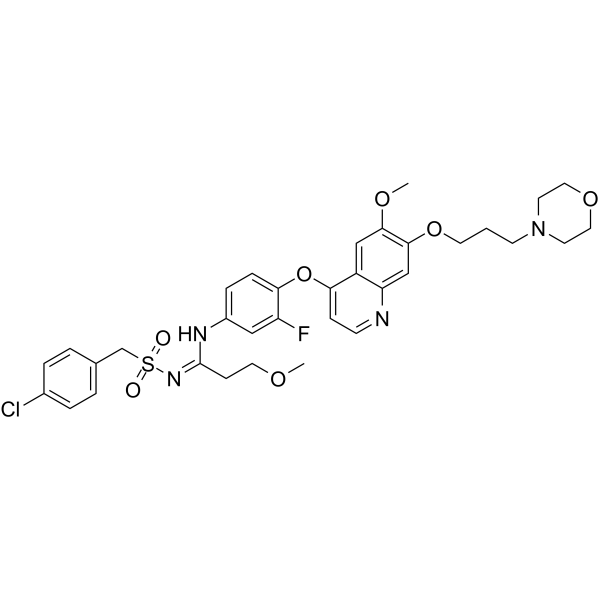
c-Met-IN-14
c-Met-IN-14 (compound 26af) is a selective inhibitor of c-Met kinase from N-sulfonylamidine-based derivatives, with an IC50 value of 2.89 nM. c-Met-IN-14 shows anticancer activity by blocking phosphorylation of c-Met, and arrests cell cycle at G2/M phase. c-Met-IN-14 induces apoptosis of A549 cells in a dose-dependent manner.
For research use only. We do not sell to patients.
- CAS No.: 2443380-34-3
- Formula: C34H38ClFN4O7S
- Molecular Weight:701.20
-
Storage:
Please store the product under the recommended conditions in the Certificate of Analysis.

To place orders, for customer services and technical support, please contact: MedChemExpress USA
Tel: 609-228-6898 E-mail: [email protected] [email protected]


-
 Biological Activity
-
Chemical Information
- Protocols
- Purity & Documentation
- References
-
 Help & FAQs




Biological Activity
Description
IC50 & Target
IC50: 2.89 nM (c-Met); 4.26 nM (c-kit); 7.28 nM (Flt-3)[1]
Cellular Effect
|
Cell Line

|
Type | Value | Description | References |
|---|---|---|---|---|
| A549 | IC50 |
0.28 μM
Compound: 26af
|
Cytotoxicity against human A549 cells assessed as inhibition of cell proliferation measured after 72 hrs by MTT assay
Cytotoxicity against human A549 cells assessed as inhibition of cell proliferation measured after 72 hrs by MTT assay
|
[PMID: 32505087] |
| FHC | IC50 |
6.12 μM
Compound: 26af
|
Cytotoxicity against human FHC cells assessed as inhibtion of cell proliferation measured after 72 hrs by MTT assay
Cytotoxicity against human FHC cells assessed as inhibtion of cell proliferation measured after 72 hrs by MTT assay
|
[PMID: 32505087] |
| HT-29 | IC50 |
0.32 μM
Compound: 26af
|
Cytotoxicity against human HT-29 cells assessed as inhibition of cell proliferation measured after 72 hrs by MTT assay
Cytotoxicity against human HT-29 cells assessed as inhibition of cell proliferation measured after 72 hrs by MTT assay
|
[PMID: 32505087] |
| HUVEC | IC50 |
1.35 μM
Compound: 26af
|
Cytotoxicity against human HUVEC cells assessed as inhibition of cell proliferation measured after 72 hrs by MTT assay
Cytotoxicity against human HUVEC cells assessed as inhibition of cell proliferation measured after 72 hrs by MTT assay
|
[PMID: 32505087] |
| MDA-MB-231 | IC50 |
0.72 μM
Compound: 26af
|
Cytotoxicity against human MDA-MB-231 cells assessed as inhibition of cell proliferation measured after 72 hrs by MTT assay
Cytotoxicity against human MDA-MB-231 cells assessed as inhibition of cell proliferation measured after 72 hrs by MTT assay
|
[PMID: 32505087] |
| MKN-45 | IC50 |
0.48 μM
Compound: 26af
|
Cytotoxicity against human MKN-45 cells assessed as inhibition of cell proliferation measured after 72 hrs by MTT assay
Cytotoxicity against human MKN-45 cells assessed as inhibition of cell proliferation measured after 72 hrs by MTT assay
|
[PMID: 32505087] |
In Vitro
c-Met-IN-14 (compound 26af) is a relatively selective inhibitor of c-Met kinase (IC50=2.89 nM), because of high inhibitory effects against c-Kit (IC50=4.26 nM) and Flt-3 (IC50=7.28 nM)[1].
c-Met-IN-14 (0.28-0.72 μM; 24 h) exhibits the remarkable anti-proliferative activities against cancer cell lines (A549, HT-29, MKN-45 and MDA-MB-231), with IC50s of 0.28-0.72 μM[1].
c-Met-IN-14 (0.25, 0.5, and 1.0 μM; 12 h) induces the late apoptotic and early apoptotic and (0.25, 0.5, and 1.0 μM; 24 h) shows anti-proliferative of A549 cells by arresting cell cycle at G2/M phase and apoptosis induction[1].
c-Met-IN-14 (1.35, or 6.12 μM, respectively; 24 h) has moderate selectivity towards cancer cells over normal cells, with the selectivity index of 4.2 and 19.1 to HUVEC (IC50=1.35 μM) and FHC cells (IC50=6.12 μM), respectively[1].
MedChemExpress (MCE) has not independently confirmed the accuracy of these methods. They are for reference only. Further protocols information, click here.
-
Cell Line:A549
-
Concentration:0, 2, 4, 8 μM
-
Incubation Time:6 hours
-
Result:Showed excellent inhibition against c-Met phosphorylation in a concentration-dependent manner.
In Vivo
c-Met-IN-14 (i.p.; below 200 mg/kg) doesn’t cause abnormalities, anaphylactic responses, allergic reactions on mice[1].
MedChemExpress (MCE) has not independently confirmed the accuracy of these methods. They are for reference only.
-
Animal Model:8-week-old male BALB/c mice [1]
-
Dosage:0 (vehicle), 100, 200, 300, or 400 mg/kg
-
Administration:Intraperitoneal injection; treatment on day 0 and assessment every 3 days for 15 days
-
Result:Showed no obvious toxicity in acute toxicity tests.
-
Animal Model:Pharmacokinetic profiles of compound 26af in BALB/c mouse[1]
-
Dosage:
-
Administration:
-
Result:
Route Dose (mg/kg) T1/2 (h) Cmax (ng.mL-1) Tmax (h) AUC0-∞ (μg.h.mL-1) CL (L.h-1.kg-1) CL (%) i.v. 2 1.8 675.6 - 2.3 - p.o. 8 3.5 1228.4 2.5 6.8 1.18 74


Chemical Information
-
CAS No. 2443380-34-3
-
Molecular Weight 701.20
-
Formula C34H38ClFN4O7S
-
SMILES
COCC/C(NC1=CC=C(OC2=CC=NC3=CC(OCCCN4CCOCC4)=C(OC)C=C23)C(F)=C1)=N/S(=O)(CC5=CC=C(Cl)C=C5)=O
-
Shipping
Room temperature in continental US; may vary elsewhere.
-
Storage
Please store the product under the recommended conditions in the Certificate of Analysis.

Protocols
-
Kinase activity and phosphorylation assays
Kinase activity assays measure the ability of kinases to transfer phosphate groups from ATP to specific substrates, while phosphorylation assays detect the presence and levels of phosphorylated proteins. Common methods include radiolabeled ATP incorporation (e. g. ,), ADP release detection via bioluminescence (e. g. ,[3]), enzyme-linked immunosorbent assays (ELISA) for phospho-specific epitopes (e. g. ,[6]), and microtiter-based formats for high-throughput screening (e. g. ,[8]). The ADP-Glo assay quantifies kinase activity by measuring ADP produced during phosphorylation using a luciferase-based system. Radiometric assays involve autoradiography or scintillation counting after incorporation of 32P-labeled ATP into substrate proteins. ELISA-based approaches rely on phospho-specific antibodies to detect activated kinases in cell lysates or purified samples.
-
Western Blot
Western blotting (WB) is a commonly used experimental method in molecular biology, biochemistry, and immunogenetics for identifying and quantifying target proteins. It combines gel electrophoresis with immunoassay, enabling researchers to analyze protein expression, post-translational modifications, and molecular weight.
-
Apoptosis
Apoptosis, also called programmed cell death, is generally characterized by distinct morphological characteristics.
-
TUNEL staining for apoptotic DNA fragmentation
TUNEL staining detects DNA strand breaks by using terminal deoxynucleotidyl transferase to add labeled nucleotides to exposed 3′-OH DNA termini, generating either microscopic staining in fixed cells or tissue sections, or fluorescence/cytometric signal in cell suspensions. TUNEL positivity reflects DNA fragmentation but should not be interpreted alone as definitive apoptosis, because TUNEL can also label necrotic, autolytic, mechanically damaged, or DNA-repair-associated DNA breaks.
-
Cell Cytotoxicity Assay
Cytotoxicity assays are usually based on the assessment of cell membrane damage, which can also be indirectly detected by measuring cell viability. Detection methods include MTT assay, CKK-8 assay, LDH assay and ATP assay, etc.
-
Flow cytometric DNA-content cell-cycle staining
Flow cytometric DNA-content cell-cycle staining measures the fluorescence intensity of DNA-bound fluorochromes in single cells or nuclei to estimate DNA content distributions, allowing assignment of populations to G0/G1, S, and G2/M phases by DNA histogram deconvolution. Propidium iodide (PI) intercalates into DNA, and PI fluorescence is proportional to cellular DNA content when staining is performed under conditions that make DNA accessible and minimize non-DNA signal. Cells with G2/M DNA content are expected to show approximately twice the fluorescence intensity of G0/G1 cells, while S-phase cells occupy intermediate fluorescence values. PI-based DNA-content analysis can also detect cells with fractional DNA content, often reported as sub-G1, when DNA fragmentation and extraction during staining reduce retained DNA signal in apoptotic cells. DAPI is an alternative DNA fluorochrome for univariate DNA-content analysis, while bivariate approaches combining DNA content with proliferation
-
Annexin V plus membrane-impermeant dye apoptosis staining
Annexin V-based apoptosis assays rely on the detection of phosphatidylserine (PS) externalization from the inner leaflet of the plasma membrane to the outer leaflet, an early biochemical hallmark of apoptosis. Fluorescently labeled Annexin V binds PS in a calcium-dependent manner, enabling identification of early apoptotic cells by flow cytometry or fluorescence microscopy. When combined with a membrane-impermeant DNA-binding dye (e. g. , propidium iodide), this approach allows discrimination between viable (Annexin V−/dye−), early apoptotic (Annexin V+/dye−), and late apoptotic or necrotic (Annexin V+/dye+) cell populations by assessing membrane integrity and PS exposure.
-
BrdU Incorporation Assay
Bromodeoxyuridine (BrdU) incorporation assay is based on the principle that BrdU, a thymidine analog, is incorporated into newly synthesized DNA during the S phase of the cell cycle, thereby serving as a marker of DNA replication and cellular proliferation. Incorporated BrdU can be detected using anti-BrdU antibodies following DNA denaturation, enabling visualization or quantification of proliferating cells through immunochemical detection methods such as immunofluorescence or immunohistochemistry.
-
Apoptosis Solutions
Apoptosis is a regulated, generally non-lytic cell-death pathway that removes unwanted, damaged, infected, or abnormal cells through coordinated morphological changes, caspase activation, DNA fragmentation, and membrane remodeling. The intrinsic apoptosis pathway is controlled mainly by mitochondrial outer membrane permeabilization, BCL-2 family proteins, cytochrome c release, apoptosome formation, caspase-9 activation, and downstream executioner caspase-3/7 activation. The extrinsic apoptosis pathway is initiated by death receptors such as Fas, TNFR, and TRAIL receptors, which recruit adaptor proteins and activate caspase-8 before engaging executioner caspases or mitochondrial amplification through BID cleavage. Apoptosis is linked to many phenotypes, including cancer cell killing, tissue homeostasis, immune regulation, neurodegeneration, infection response, and treatment-induced cytotoxicity; unresolved questions include how apoptosis interacts with necroptosis, pyroptosis, ferroptos
-
Protocol for Cell Cycle
Cell-cycle analysis by flow cytometry measures DNA content in single cells to estimate the fraction of cells in G0/G1, S, and G2/M phases. Propidium iodide intercalates into DNA, and after RNA removal with RNase, fluorescence intensity reflects cellular DNA content: 2N cells are assigned to G0/G1, cells between 2N and 4N to S phase, and 4N cells to G2/M. DNA-content analysis alone cannot reliably separate G0 from G1 or G2 from M. Ki-67 can distinguish quiescent G0 cells from cycling cells, EdU or BrdU incorporation marks active DNA synthesis in S phase, and phospho-histone H3 staining identifies mitotic cells within the 4N population.
-
Protocol for Kinase activity and phosphorylation assays
Kinase activity assays measure transfer of phosphate from ATP to a protein or peptide substrate, generating phosphorylated substrate, ADP, or incorporated radiolabeled phosphate as the readout; phosphorylation assays measure site-specific phosphorylation in cells or tissues as a proxy for kinase-pathway activation, inhibition, or substrate regulation. Phosphorylation can be detected by phospho-specific Western blot, immunoprecipitation kinase assay, phospho-immunofluorescence, phospho-flow cytometry, luminescent ADP detection, radiolabeled ATP incorporation, or reporter-based pathway assays, and these readouts can be applied to cancer cells, primary neurons, mouse tumors, organoids, inflammatory macrophages, ferroptosis studies, and mitophagy studies when the kinase target is biologically relevant.


Purity & Documentation
References

Calculators
Concentration (start) × Volume (start) = Concentration (final) × Volume (final)


c-Met-IN-14 Related Classifications
HY-150582 Related Classifications
 Powered by Bioz