



Bay 41-4109
Based on 14 publication(s) in Google Scholar
BAY 41-4109 is a potent inhibitor of human hepatitis B virus (HBV) with an IC50 of 53 nM.
For research use only. We do not sell to patients.
- Purity: 99.24%
- CAS No.: 298708-81-3
- Formula: C18H13ClF3N3O2
- Molecular Weight:395.76
-
Storage:Powder -20°C, 3 years , 4°C, 2 years ; In solvent -80°C, 2 years , -20°C, 1 year

To place orders, for customer services and technical support, please contact: MedChemExpress USA
Tel: 609-228-6898 E-mail: [email protected] [email protected]


-
 Biological Activity
-
Chemical Information
-
Solvent & Solubility
- Protocol
- Purity & Documentation
- References
-
 Help & FAQs



Publications Citing Use of MedChemExpress (MCE) Bay 41-4109
More- Sci Adv. 2026 Jun 12;12(24):eaed6483. [Abstract]
- Hepatol Commun. 2022 Feb;6(2):281-296. [Abstract]
- Int J Mol Sci. 2025 Dec 27;27(1):300. [Abstract]
- Molecules. 2022 May 18;27(10):3223. [Abstract]
- PLoS Pathog. 2022 Jan 14;18(1):e1010204. [Abstract]
- PLoS Pathog. 2021 Aug 9;17(8):e1009838. [Abstract]
- Antiviral Res. 2021 Jul:191:105080. [Abstract]
- Antiviral Res. 2020 Aug;180:104826. [Abstract]
- Antiviral Res. 2020 Mar;175:104709. [Abstract]
- Antiviral Res. 2018 Nov:159:1-12. [Abstract]
- Antimicrob Agents Chemother. 2018 Nov 26;62(12). pii: e01302-18. [Abstract]
- Virol J. 2025 Oct 27;22(1):342. [Abstract]
- Viruses. 2023 May 18;15(5):1195. [Abstract]
- J Glob Antimicrob Resist. 2022 Dec:31:371-378. [Abstract]
 Customer Validation & Images

-
WB


Biological Activity
IC50&Target: 53 nM (HBV)[1]
|
Cell Line

|
Type | Value | Description | References |
|---|---|---|---|---|
| HepaRG | CC50 |
>30 μM
Compound: Bay 41-4109
|
Cytotoxicity against human HepaRG cells assessed as effect on cell viability
Cytotoxicity against human HepaRG cells assessed as effect on cell viability
|
[PMID: 33062174] |
| HepG2 2.2.15 | CC50 |
>5 μM
Compound: Bay41-4109; 1
|
Cytotoxicity in human HepG2.2.15 cells assessed as reduction in cell viability incubated for 8 days by MTT assay
Cytotoxicity in human HepG2.2.15 cells assessed as reduction in cell viability incubated for 8 days by MTT assay
|
[PMID: 32692159] |
| HepG2 2.2.15 | CC50 |
19.3 μM
Compound: 4; Bay41-4109
|
Cytotoxicity in human HepG2.215 cells assessed as reduction in cell viability after 5 days by CCK8 assay
Cytotoxicity in human HepG2.215 cells assessed as reduction in cell viability after 5 days by CCK8 assay
|
[PMID: 28082068] |
| HepG2 2.2.15 | CC50 |
7 μM
Compound: BAY 41-4109
|
Cytotoxicity against human HepG2.2.15 cells
Cytotoxicity against human HepG2.2.15 cells
|
[PMID: 29438889] |
| HepG2 2.2.15 | EC50 |
53 nM
Compound: BAY41-4109
|
Antiviral activity against HBV infected in human HepG2.2.15 cells
Antiviral activity against HBV infected in human HepG2.2.15 cells
|
[PMID: 32421339] |
| HepG2 2.2.15 | IC50 |
0.042 μM
Compound: Bay41-4109; 1
|
Antiviral activity against HBV infected in human HepG2.2.15 cells assessed as reduction in cytoplasmic HBV-DNA replication incubated for 8 days by real-time PCR analysis
Antiviral activity against HBV infected in human HepG2.2.15 cells assessed as reduction in cytoplasmic HBV-DNA replication incubated for 8 days by real-time PCR analysis
|
[PMID: 32692159] |
| HepG2 2.2.15 | IC50 |
0.78 μM
Compound: BAY-414109
|
Antiviral activity against HBV infected in human HepG2.2.15 cells assessed as inhibition of viral DNA replication
Antiviral activity against HBV infected in human HepG2.2.15 cells assessed as inhibition of viral DNA replication
|
[PMID: 19897363] |
| HepG2 2.2.15 | IC50 |
567 μM
Compound: BAY-414109
|
Cytotoxicity against human HepG2(2.2.15) cells
Cytotoxicity against human HepG2(2.2.15) cells
|
[PMID: 19897363] |
BAY 41-4109 is able to both accelerate and misdirect capsid assembly in vitro. Preformed capsids are stabilized by BAY 41-4109, up to a ratio of one inhibitor molecule per two dimers[2]. BAY 41-4109 is equally effective at inhibiting HBV DNA release and the cytoplasmic HBcAg level, with IC50s of 32.6 and 132 nM in HepG2.2.15 cells, respectively. HBV DNA and HBcAg are inhibited in a dose-dependent manner, indicating that the anti-HBV mechanisms are associated with and dependent on the rate of HBcAg inhibition[3].
MedChemExpress (MCE) has not independently confirmed the accuracy of these methods. They are for reference only.
MedChemExpress (MCE) has not independently confirmed the accuracy of these methods. They are for reference only.


Chemical Information
-
CAS No. 298708-81-3
-
Appearance Solid
-
Molecular Weight 395.76
-
Formula C18H13ClF3N3O2
-
Color Light yellow to yellow
-
SMILES
O=C(C1=C(C)N=C(C2=NC=C(F)C=C2F)N[C@H]1C3=CC=C(F)C=C3Cl)OC
-
Shipping
Room temperature in continental US; may vary elsewhere.
-
Storage
Powder -20°C 3 years 4°C 2 years In solvent -80°C 2 years -20°C 1 year


Publications (14)
-
Journal Impact Factor
-
Most Recent
-
Sci Adv
Negative cooperativity drives activity of capsid-directed antivirals against hepatitis B virus. [Abstract]2026 Jun 12;12(24):eaed6483. PMID: 42284399 -
Hepatol Commun
Capsid Allosteric Modulators Enhance the Innate Immune Response in Hepatitis B Virus-Infected Hepatocytes During Interferon Administration. [Abstract]2022 Feb;6(2):281-296. PMID: 34558845 -
Int J Mol Sci
Triterpenoids CDDO and CDDO-EA Inhibit the Replication of Hepatitis B Virus by Modulating Nucleocapsid Assembly. [Abstract]2025 Dec 27;27(1):300. PMID: 41516181 -
Molecules
(-)-Lariciresinol Isolated from the Roots of Isatis indigotica Fortune ex Lindl. Inhibits Hepatitis B Virus by Regulating Viral Transcription. [Abstract]2022 May 18;27(10):3223. PMID: 35630700 -
PLoS Pathog
Bay41-4109-induced aberrant polymers of hepatitis b capsid proteins are removed via STUB1-promoted p62-mediated macroautophagy. [Abstract]2022 Jan 14;18(1):e1010204. PMID: 35030230 -
PLoS Pathog
Probing the spatiotemporal patterns of HBV multiplication reveals novel features of its subcellular processes. [Abstract]2021 Aug 9;17(8):e1009838. PMID: 34370796 -
Antiviral Res
Identification of hepatitis B virus core protein residues critical for capsid assembly, pgRNA encapsidation and resistance to capsid assembly modulators. [Abstract]2021 Jul:191:105080. PMID: 33933516 -
Antiviral Res
A novel recombinant cccDNA-based mouse model with long term maintenance of rcccDNA and antigenemia. [Abstract]2020 Aug;180:104826. PMID: 32502604 -
Antiviral Res
Identification and characterization of a novel hepatitis B virus pregenomic RNA encapsidation inhibitor. [Abstract]2020 Mar;175:104709. PMID: 31940474 -
Antiviral Res
CpAMs induce assembly of HBV capsids with altered electrophoresis mobility: Implications for mechanism of inhibiting pgRNA packaging. [Abstract]2018 Nov:159:1-12. PMID: 30201396
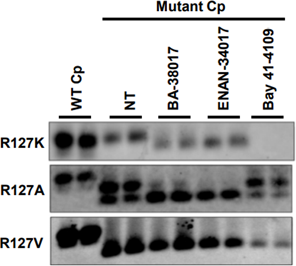
Bay 41-4109 purchased from MedChemExpress. Usage Cited in: Antiviral Res. 2018 Nov:159:1-12. [Abstract]
HepG2 cells are transfected with the indicated core protein-expressing plasmid. Six hours post transfection, the cells are left untreated or treated with 5 µM of BA38017, 5 µM of ENAN-34017 or 2 µM of Bay 41-4109 for 72 h. The cytoplasmic capsids are analyzed by a particle gel assay.
-
Antimicrob Agents Chemother
Identification of Compounds Targeting Hepatitis B Virus Core Protein Dimerization through a Split Luciferase Complementation Assay. [Abstract]2018 Nov 26;62(12). pii: e01302-18. PMID: 30224531 -
Virol J
Sophora alopecuroides biflavones glycoside, isolated from Sophora alopecuroides, inhibits the secretion of hepatitis B virus surface antigen through direct interaction with its antigenic loop domain. [Abstract]2025 Oct 27;22(1):342. PMID: 41146264 -
Viruses
Canocapavir Is a Novel Capsid Assembly Modulator Inducing a Conformational Change of the Linker Region of HBV Core Protein. [Abstract]2023 May 18;15(5):1195. PMID: 37243280 -
J Glob Antimicrob Resist
Compound IMB-Z inhibits hepatitis B virus replication through increasing APOBEC3G expression and incorporation into viral nucleocapsids. [Abstract]2022 Dec:31:371-378. PMID: 36396043


Solvent & Solubility
DMSO : 100 mg/mL (252.68 mM; Need ultrasonic; Hygroscopic DMSO has a significant impact on the solubility of product, please use newly opened DMSO)
Please refer to the solubility information to select the appropriate solvent. Once prepared, please aliquot and store the solution to prevent product inactivation from repeated freeze-thaw cycles.
Storage method and period of stock solution: -80°C, 2 years; -20°C, 1 year. When stored at -80°C, please use it within 2 years. When stored at -20°C, please use it within 1 year.
Please refer to the solubility information to select the appropriate solvent. Once prepared, please aliquot and store the solution to prevent product inactivation from repeated freeze-thaw cycles.
Storage method and period of stock solution: -80°C, 2 years; -20°C, 1 year. When stored at -80°C, please use it within 2 years. When stored at -20°C, please use it within 1 year.
Concentration (start) × Volume (start) = Concentration (final) × Volume (final)
Select the appropriate dissolution method based on your experimental animal and administration route.
- For the following dissolution methods, please ensure to first prepare a clear stock solution using an In Vitro approach and then sequentially add co-solvents:
- To ensure reliable experimental results, the clarified stock solution can be appropriately stored based on storage conditions. As for the working solution for In Vivo experiments, it is recommended to prepare freshly and use it on the same day.
- The percentages shown for the solvents indicate their volumetric ratio in the final prepared solution. If precipitation or phase separation occurs during preparation, heat and/or sonication can be used to aid dissolution.
Add each solvent one by one: 10% DMSO 40% PEG300 5% Tween-80 45% Saline
Solubility: ≥ 2.5 mg/mL (6.32 mM); Clear solution
This protocol yields a clear solution of ≥ 2.5 mg/mL (saturation unknown).
Taking 1 mL working solution as an example, add 100 μL DMSO stock solution (25.0 mg/mL) to 400 μL PEG300, and mix evenly; then add 50 μL Tween-80 and mix evenly; then add 450 μL Saline to adjust the volume to 1 mL.
Preparation of Saline: Dissolve 0.9 g sodium chloride in ddH₂O and dilute to 100 mL to obtain a clear Saline solution.
Please enter the basic information of animal experiments:
-
-
-
-
Recommended: Prepare an additional quantity of animals to account for potential losses during experiments.
Please enter your animal formula composition:
-
%DMSO +
Recommended: Keep the proportion of DMSO in working solution below 2% if your animal is weak.
-
%+
-
+%Tween-80 + +
-
%Saline +
The co-solvents required include: DMSO, . All of co-solvents are available by MedChemExpress (MCE). , Tween 80. All of co-solvents are available by MedChemExpress (MCE).
Working solution concentration: 0.22 mg/mL
Method for preparing stock solution: mg drug dissolved in μL DMSO. Stock solution concentration: mg/mL.
1. Take μL DMSO stock solution;
2. Add μL .
μL , mix evenly;
3. Then add μL Tween 80, mix evenly;
4. Then add μL
Please ensure that the stock solution in the first step is dissolved to a clear state, and add co-solvents in sequence. You can use ultrasonic heating (ultrasonic cleaner, recommended frequency 20-40 kHz), vortexing, etc. to assist dissolution.

Protocol
Cellular metabolism is evaluated by MTT colorimetry. HepG2.2.15 cells are plated at a density of 2×10³ cells per well in 96-well plates. After 8 d of treatment with different concentrations of each antiviral compound, 20 μL of MTT solution (5 g/L) are added to each well and incubated at 37°C for 4 h. Next, 150 μL of DMSO is added and stirred for 10 min to dissolve the crystals. Absorbance values are recorded at 490 nm by using an ELISA reader. The MTT values are calculated using the curve regression equation[3].
MedChemExpress (MCE) has not independently confirmed the accuracy of these methods. They are for reference only.
Mice: The HBV-transgenic mice are used in the study. Compounds (BAY 41-4109) are formulated as a suspension in 0.5% Tylose and administered per os to mice two times/day for a 28 day period. The 0.5% Tylose serves as a placebo. Six hours after the last treatment, the animals are sacrificed and livers are removed and immediately frozen for subsequent analysis. Blood is obtained by cardiac puncture of the anesthesized animals[1].
MedChemExpress (MCE) has not independently confirmed the accuracy of these methods. They are for reference only.


Purity & Documentation
-
Data Sheet (278 KB)
-
SDS (251 KB)
- English - EN (251 KB)
- Français - FR (251 KB)
- Deutsch - DE (251 KB)
- Norwegian - NO (251 KB)
- Español - ES (251 KB)
- Swedish - SV (251 KB)
- Italian - IT (251 KB)
- Korean - KR (251 KB)
- Portuguese - PT (251 KB)
-
Handling Instructions (2659 KB)
References
[1]. Weber O, et al. Inhibition of human hepatitis B virus (HBV) by a novel non-nucleosidic compound in a transgenic mouse model. Antiviral Res. 2002 May;54(2):69-78. [Content Brief]
[2]. Stray SJ, et al. BAY 41-4109 has multiple effects on Hepatitis B virus capsid assembly. J Mol Recognit. 2006 Nov-Dec;19(6):542-8. [Content Brief]
[3]. Wu GY, et al. Inhibition of hepatitis B virus replication by Bay 41-4109 and its association with nucleocapsid disassembly. J Chemother. 2008 Aug;20(4):458-67. [Content Brief]


Complete Stock Solution Preparation Table
Please refer to the solubility information to select the appropriate solvent. Once prepared, please aliquot and store the solution to prevent product inactivation from repeated freeze-thaw cycles.
Storage method and period of stock solution: -80°C, 2 years; -20°C, 1 year. When stored at -80°C, please use it within 2 years. When stored at -20°C, please use it within 1 year.
| Optional Solvent | Concentration Solvent Mass | 1 mg | 5 mg | 10 mg | 25 mg |
|---|---|---|---|---|---|
| DMSO | 1 mM | 2.5268 mL | 12.6339 mL | 25.2678 mL | 63.1696 mL |
| 5 mM | 0.5054 mL | 2.5268 mL | 5.0536 mL | 12.6339 mL | |
| 10 mM | 0.2527 mL | 1.2634 mL | 2.5268 mL | 6.3170 mL | |
| 15 mM | 0.1685 mL | 0.8423 mL | 1.6845 mL | 4.2113 mL | |
| 20 mM | 0.1263 mL | 0.6317 mL | 1.2634 mL | 3.1585 mL | |
| 25 mM | 0.1011 mL | 0.5054 mL | 1.0107 mL | 2.5268 mL | |
| 30 mM | 0.0842 mL | 0.4211 mL | 0.8423 mL | 2.1057 mL | |
| 40 mM | 0.0632 mL | 0.3158 mL | 0.6317 mL | 1.5792 mL | |
| 50 mM | 0.0505 mL | 0.2527 mL | 0.5054 mL | 1.2634 mL | |
| 60 mM | 0.0421 mL | 0.2106 mL | 0.4211 mL | 1.0528 mL | |
| 80 mM | 0.0316 mL | 0.1579 mL | 0.3158 mL | 0.7896 mL | |
| 100 mM | 0.0253 mL | 0.1263 mL | 0.2527 mL | 0.6317 mL |


Bay 41-4109 Related Classifications
HY-100029 Related Classifications
 Powered by Bioz