



BODIPY-C12
Based on 1 publication(s) in Google Scholar
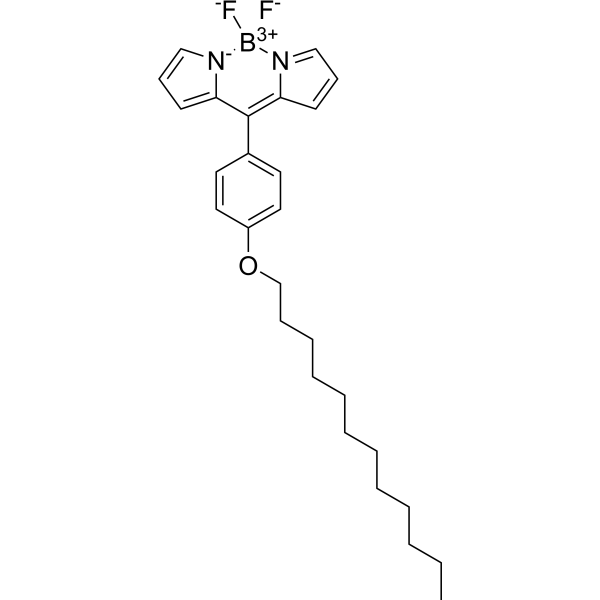
BODIPY-C12 is a boron-dipyrromethene derivative containing a lipophilic tail (excitation 490 nm). BODIPY-C12 is a hydrophobic molecular and sensitivity to the surrounding environment and can be used to quantify viscosity, critical micelle concentration, and critical micelle temperature.
For research use only. We do not sell to patients.
- Purity: 99.90%
- CAS No.: 1029138-21-3
- Formula: C27H35BF2N2O
- Molecular Weight:452.39
-
Storage:
4°C, protect from light
* In solvent : -80°C, 6 months; -20°C, 1 month (protect from light)

To place orders, for customer services and technical support, please contact: MedChemExpress USA
Tel: 609-228-6898 E-mail: [email protected] [email protected]


-
 Biological Activity
-
Chemical Information
-
Solvent & Solubility
- Purity & Documentation
- References
-
 Help & FAQs



Publications Citing Use of MedChemExpress (MCE) BODIPY-C12
More

Biological Activity
Guidelines (Following is our recommended protocol. This protocol only provides a guideline, and should be modified according to your specific needs).
Multi-parameter characterization of amphiphilic polymers using BODIPY-C12
1. Stock solution preparation:
1) Prepare an initial stock solution of BODIPY-C12 at a concentration of 1.32 mM in chloroform.
2. Dye working solution preparation:
1) Add the BODIPY-C12 stock solution to DPBS buffer to give a final concentration of 1.32-6.6 μM.
Remove residual chloroform by rotary evaporation at 22°C and 50 mBar pressure (or 37°C and 150 mBar pressure) for 5 min.
3. Specific staining steps:
3.1 Critical micelle concentration (CMC) determination:
1) Prepare 1 mM stock solutions of Pluronic P123 and F127.
2) Add different amounts of Pluronic polymer to DPBS buffer containing 1.32 μM BODIPY-C12. After each addition of polymer, remove the chloroform using a rotary evaporator and mix the solution thoroughly to ensure that the dye and copolymer are evenly distributed in the measurement solution. Repeat the evaporation and mixing steps to keep the volume of the measured sample and the concentration of the fluorescent probe constant.
3) Monitor the fluorescence intensity at 517 nm under an excitation wavelength of 490 nm using a steady-state fluorescence spectrometer. Plot a curve with polymer concentration as the horizontal axis and fluorescence intensity as the vertical axis. The polymer concentration corresponding to the turning point of the curve is the CMC.
3.2 Critical micelle temperature (CMT) determination staining steps
1) Prepare 3% w/v (5.2 mM) and 10% w/v (17 mM) solutions of P123, and 6% w/v (4.8 mM) and 10% w/v (7.9 mM) solutions of F127, all in DPBS, and add 6.6 μM BODIPY-C12.
2) Stir the above solutions at room temperature overnight to ensure that the polymer is completely dissolved and the chloroform is completely evaporated.
3) Monitor the fluorescence intensity at 517 nm using a steady-state fluorescence spectrometer with an excitation wavelength of 490 nm. Perform a temperature scan in the range of 4-25 °C with a step size of approximately 1 °C and record the change in fluorescence intensity at different temperatures. The temperature at which the fluorescence intensity stops increasing is the CMT.
3.3 Staining steps for intramicellar viscosity determination
1) Prepare micellar solutions of Pluronic P123 and F127 in DPBS at a concentration of 5 mM, which is much higher than the CMC of both polymers.
2) Test three different concentrations of BODIPY-C12 (1 μM, 5 μM, and 10 μM) at 22 °C and record the fluorescence intensity decay curves by a time-correlated single photon counting (TCSPC) system to confirm the absence of concentration quenching. The highest dye concentration (10 μM) was selected for viscosity measurement at 37 °C.
3) Plot a calibration curve of logτf versus logη in logarithmic form according to the modified Forster-Hoffman equation. Use the calibration curve to determine the intramicellar viscosity by measuring the fluorescence lifetime of BODIPY-C12 in micellar solution.
MedChemExpress (MCE) has not independently confirmed the accuracy of these methods. They are for reference only.
512
490


Chemical Information
-
CAS No. 1029138-21-3
-
Appearance Solid
-
Molecular Weight 452.39
-
Formula C27H35BF2N2O
-
Color Orange to red
-
SMILES
[F-][B+3]1([N]2=CC=CC2=C(C3=CC=C[N-]31)C4=CC=C(C=C4)OCCCCCCCCCCCC)[F-]
-
Shipping
Room temperature in continental US; may vary elsewhere.
-
Storage
4°C, protect from light
* In solvent : -80°C, 6 months; -20°C, 1 month (protect from light)


Publications (1)
-
Journal Impact Factor
-
Most Recent
-
Soft Matter
The cocktail method: influence of microbubble shell homogeneity on acoustic behavior and stability. [Abstract]2026 Jun 11. PMID: 42300627


Solvent & Solubility
DMSO : 25 mg/mL (55.26 mM; Need ultrasonic; Hygroscopic DMSO has a significant impact on the solubility of product, please use newly opened DMSO)
Please refer to the solubility information to select the appropriate solvent. Once prepared, please aliquot and store the solution to prevent product inactivation from repeated freeze-thaw cycles.
Storage method and period of stock solution: -80°C, 6 months; -20°C, 1 month (protect from light). When stored at -80°C, please use it within 6 months. When stored at -20°C, please use it within 1 month.
Please refer to the solubility information to select the appropriate solvent. Once prepared, please aliquot and store the solution to prevent product inactivation from repeated freeze-thaw cycles.
Storage method and period of stock solution: -80°C, 6 months; -20°C, 1 month (protect from light). When stored at -80°C, please use it within 6 months. When stored at -20°C, please use it within 1 month.
Concentration (start) × Volume (start) = Concentration (final) × Volume (final)


Purity & Documentation
-
Data Sheet (271 KB)
-
SDS (252 KB)
- English - EN (252 KB)
- Français - FR (252 KB)
- Deutsch - DE (252 KB)
- Norwegian - NO (252 KB)
- Español - ES (252 KB)
- Swedish - SV (252 KB)
- Italian - IT (252 KB)
- Korean - KR (252 KB)
- Portuguese - PT (252 KB)
-
Handling Instructions (2659 KB)
References


Complete Stock Solution Preparation Table
Please refer to the solubility information to select the appropriate solvent. Once prepared, please aliquot and store the solution to prevent product inactivation from repeated freeze-thaw cycles.
Storage method and period of stock solution: -80°C, 6 months; -20°C, 1 month (protect from light). When stored at -80°C, please use it within 6 months. When stored at -20°C, please use it within 1 month.
| Optional Solvent | Concentration Solvent Mass | 1 mg | 5 mg | 10 mg | 25 mg |
|---|---|---|---|---|---|
| DMSO | 1 mM | 2.2105 mL | 11.0524 mL | 22.1048 mL | 55.2621 mL |
| 5 mM | 0.4421 mL | 2.2105 mL | 4.4210 mL | 11.0524 mL | |
| 10 mM | 0.2210 mL | 1.1052 mL | 2.2105 mL | 5.5262 mL | |
| 15 mM | 0.1474 mL | 0.7368 mL | 1.4737 mL | 3.6841 mL | |
| 20 mM | 0.1105 mL | 0.5526 mL | 1.1052 mL | 2.7631 mL | |
| 25 mM | 0.0884 mL | 0.4421 mL | 0.8842 mL | 2.2105 mL | |
| 30 mM | 0.0737 mL | 0.3684 mL | 0.7368 mL | 1.8421 mL | |
| 40 mM | 0.0553 mL | 0.2763 mL | 0.5526 mL | 1.3816 mL | |
| 50 mM | 0.0442 mL | 0.2210 mL | 0.4421 mL | 1.1052 mL |


BODIPY-C12 Related Classifications
HY-D1553 Related Classifications
 Powered by Bioz