



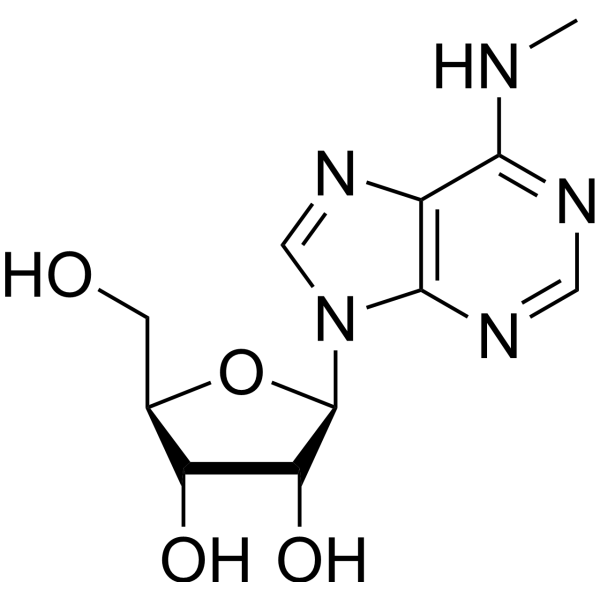
N6-Methyladenosine
Based on 7 publication(s) in Google Scholar
N6-Methyladenosine is the most prevalent internal (non-cap) modification present in the messenger RNA (mRNA) of all higher eukaryotes. N6-Methyladenosine can modifies viral RNAs and has antiviral activities.
Nos produits utilisent uniquement pour la recherche. Nous ne vendons pas aux patients.
- Pureté: 99.75%
- CAS No.: 1867-73-8
- Formule: C11H15N5O4
- Masse moléculaire:281.27
-
Stockage:Powder -20°C, 3 years , 4°C, 2 years ; In solvent -80°C, 2 years , -20°C, 1 year


-
 Activité biologique
-
Chemical Information
-
Solvant et solubilité
- Pureté et documentation
- Références
-
 Help & FAQs
-


Anti-Infection Compound Library
HY-L002
-
Metabolism/Protease Compound Library
HY-L012
-
Natural Product Library
HY-L021
-
Antiviral Compound Library
HY-L027
-
Human Endogenous Metabolite Compound Library
HY-L030
-
Nucleotide Compound Library
HY-L044
-
Microbial Metabolite Library
HY-L084
-
Food-Sourced Compound Library
HY-L094
-
Human Metabolite Library
HY-L123
-
Animal-Sourced Natural Product Library
HY-L157
-
Multi-Target Compound Library
HY-L176
-
Bioactive Compound Library Max
HY-L181
-
MCE Bioactive Compound Library
HY-L001V
-
Natural Product Library Plus
HY-L021P
-
Natural Product and Natural Product-Like Compound Library
HY-L021M
-
Bioactive Compound Library
HY-L001
-
RO5 Drug-like Natural Product Library
HY-L200
-
High-Throughput Bioactive Compound Library
HY-L205
-
High-Throughput Natural Product Library
HY-L206
-
Mass Spectrometry Human Endogenous Metabolite Library
HY-L207
-
Mass Spectrometry Human Metabolite Library
HY-L215
-
RNA Binding Bioactive Compound Library
HY-L248
-
Mass Spectrometry Natural Product Library
HY-L262
-
MCE Kinase Hinge Binder Fragment Library
HY-L907


Publications Citing Use of MedChemExpress (MCE) N6-Methyladenosine
More- Nat Commun. 2023 Mar 27;14(1):1694. [Abstract]
- Adv Sci (Weinh). 2026 Mar 13.
- Nucleic Acids Res. 2022 Jan 25;50(2):e9. [Abstract]
- Mol Ther. 2024 Dec 4;32(12):4418-4434. [Abstract]
- Talanta. 2023 Oct 1:263:124697. [Abstract]
- bioRxiv. 2024 Jan 27:2024.01.26.577511. [Abstract]
- bioRxiv. 2023 Mar 16:2023.03.16.532618. [Abstract]
 Customer Validation & Images

-
RT-PCR
-
Cell Imaging/Staining
-
Cell Imaging/Staining
-
Bio/Physico-chemical Assay
-
Bio/Physico-chemical Assay
Voir tous les produits spécifiques à Isoform Endogenous Metabolite
More

Activité biologique
|
Microbial Metabolite |
Human Endogenous Metabolite |
|
Cell Line

|
Type | Value | Description | References |
|---|---|---|---|---|
| HT-29 | IC50 |
>100 μM
Compound: N6-Me-Ado
|
In vitro inhibitory activity against human colon carcinoma HT-29 cell line
In vitro inhibitory activity against human colon carcinoma HT-29 cell line
|
[PMID: 16033277] |
| K562 | IC50 |
>100 μM
Compound: N6-Me-Ado
|
In vitro inhibitory activity against human leukemia K562IU cell line
In vitro inhibitory activity against human leukemia K562IU cell line
|
[PMID: 16033277] |
| K562 | IC50 |
>100 μM
Compound: N6-Me-Ado
|
In vitro inhibitory activity against human myelogenous leukemia K562 cell line
In vitro inhibitory activity against human myelogenous leukemia K562 cell line
|
[PMID: 16033277] |
| MCF7 | IC50 |
>100 μM
Compound: N6-Me-Ado
|
In vitro inhibitory activity against human breast carcinoma MCF-7 cell line
In vitro inhibitory activity against human breast carcinoma MCF-7 cell line
|
[PMID: 16033277] |
N6-methyladenosine (m6A) is selectively recognized by the human YTH domain family 2 (YTHDF2) protein to regulate mRNA degradation. N6-methyladenosine (m6A), a prevalent internal modification in the messenger RNA of all eukaryotes, is post-transcriptionally installed by m6A methyltransferase (e.g., MT-A70) within the consensus sequence of G(m6A)C (70%) or A(m6A)C (30%). N6-methyladenosine (m6A)-containing RNAs are greatly enriched in the YTHDF-bound portion and diminished in the flow-through portion[1]. N6-methyladenosine (m6A), the most abundant internal RNA modification, functions in diverse biological processes, including regulation of embryonic stem cell self-renewal and differentiation. N6-methyladenosine (m6A) is a large protein complex, consisting in part of methyltransferase-like 3 (METTL3) and methyltransferase-like 14 (METTL14) catalytic subunits[2].
MedChemExpress (MCE) has not independently confirmed the accuracy of these methods. They are for reference only.


Chemical Information
-
CAS No. 1867-73-8
-
Appearance Solid
-
Masse moléculaire 281.27
-
Formule C11H15N5O4
-
Color White to off-white
-
SMILES
O[C@@H]1[C@H](O)[C@@H](CO)O[C@H]1N2C3=C(N=C2)C(NC)=NC=N3
-
Synonyms
6-Methyladenosine; N-Methyladenosine
-
Structure Classification
-
Initial Source
-
Livraison
Room temperature in continental US; may vary elsewhere.
-
Stockage
Powder -20°C 3 years 4°C 2 years In solvent -80°C 2 years -20°C 1 year


Publications (7)
-
Journal Impact Factor
-
Most Recent
-
Nat Commun
2023 Mar 27;14(1):1694. PMID: 36973285
N6-Methyladenosine purchased from MedChemExpress. Usage Cited in: Nat Commun. 2023 Mar 27;14(1):1694. [Abstract]
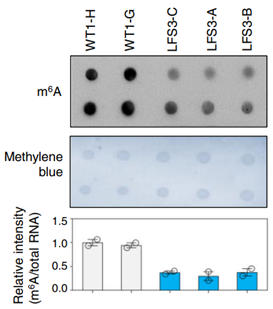
N6-Methyladenosine (m6A) methylation dot blotting shows decreased m6A methylation in LFS astrocytes. Dot blotting is performed to identify polyadenylated mRNAs immunoblotted with anti-m6A antibodies (upper panel). Methylene blue staining of total mRNA is used as a loading control (lower panel).
N6-Methyladenosine purchased from MedChemExpress. Usage Cited in: Nat Commun. 2023 Mar 27;14(1):1694. [Abstract]
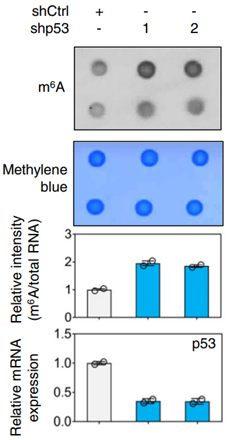
N6-Methyladenosine (m6A) methylation dot blotting indicates increased m6A methylation upon depletion of mutant p53 in LFS astrocytes. Dot blotting identifies polyadenylated mRNA isolated from shCtrl and shp53 transduced LFS astrocytes and immunoblotted with anti-m6A antibodies (upper panel). Methylene blue staining of total mRNA is used as a loading control (lower panel).
-
-
Nucleic Acids Res
High-Throughput-Methyl-Reading (HTMR) assay: a solution based on nucleotide methyl-binding proteins enables large-scale screening for DNA/RNA methyltransferases and demethylases. [Abstract]2022 Jan 25;50(2):e9. PMID: 34718755 -
Mol Ther
Host RNA N6-methyladenosine and incoming DNA N6-methyldeoxyadenosine modifications cooperatively elevate the condensation potential of DNA to activate immune surveillance. [Abstract]2024 Dec 4;32(12):4418-4434. PMID: 39473181
N6-Methyladenosine purchased from MedChemExpress. Usage Cited in: Mol Ther. 2024 Dec 4;32(12):4418-4434. [Abstract]
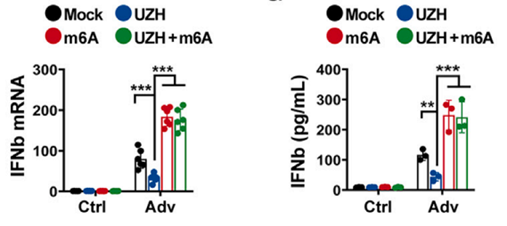
IFNb mRNA and protein levels in the N6-Methyladenosine (m6A)-pretreated MEF cells. Cells were treated with vehicle, 5 μM UZH1a or 50 μM m6A nucleoside for 12 h, then infected with 1 MOI Adv for 6 h and 12 h.
N6-Methyladenosine purchased from MedChemExpress. Usage Cited in: Mol Ther. 2024 Dec 4;32(12):4418-4434. [Abstract]
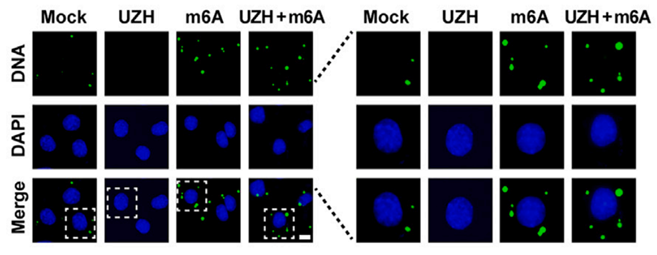
N6-Methyladenosine (m6A, 50 μM, 12 h). Representative fluorescent images of MEF cells transfected with 200 ng/mL DNA for 30 min. Green: fluorescein 5-isothiocyanate (FITC)-labeled DNA; blue: 4′,6-diamidino-2-phenylindole (DAPI).
N6-Methyladenosine purchased from MedChemExpress. Usage Cited in: Mol Ther. 2024 Dec 4;32(12):4418-4434. [Abstract]
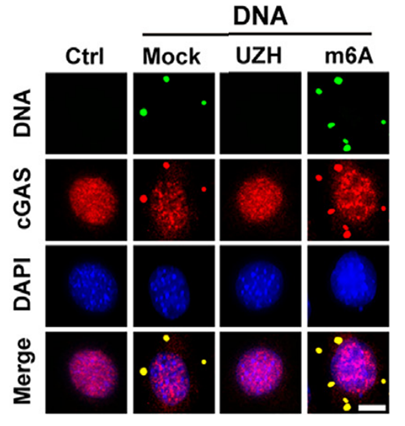
N6-Methyladenosine (m6A, 50 μM, 12 h). Representative fluorescent images of cGAS-DNA condensates in the m6A-pretreated MEF cells transfected with 200 ng/mL fluorescein 5-isothiocyanate (FITC)-labeled DNA for 30 min.
N6-Methyladenosine purchased from MedChemExpress. Usage Cited in: Mol Ther. 2024 Dec 4;32(12):4418-4434. [Abstract]
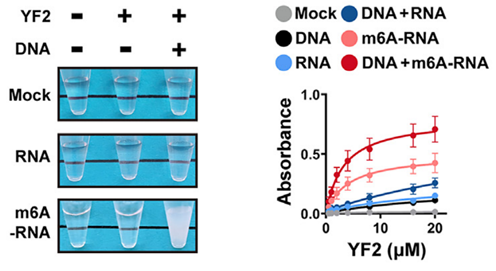
(Left) Representative images of 10 μM YF2 incubated with 5 μM 45-bp DNA and/or 5 μM 45-bp RNA with or without N6-Methyladenosine (m6A) modification for 10 min. (Right) Turbidity assays of serial dilutions of YF2 incubated with 1 μM DNA and/or RNA for 10 min. Drilled water was used as Mock. n = 3.
-
Talanta
High-throughput profiling of RNA modifications by ultra-performance liquid chromatography coupled to complementary mass spectrometry: Methods, quality control, and applications. [Abstract]2023 Oct 1:263:124697. PMID: 37262985 -
bioRxiv
2024 Jan 27:2024.01.26.577511. PMID: 38328125 -
bioRxiv
2023 Mar 16:2023.03.16.532618. PMID: 36993753


Solvant et solubilité
DMSO : ≥ 31 mg/mL (110.21 mM; Hygroscopic DMSO has a significant impact on the solubility of product, please use newly opened DMSO)
H2O : 5.56 mg/mL (19.77 mM; ultrasonic and warming and heat to 60°C)
* "≥" means soluble, but saturation unknown.
Please refer to the solubility information to select the appropriate solvent. Once prepared, please aliquot and store the solution to prevent product inactivation from repeated freeze-thaw cycles.
Storage method and period of stock solution: -80°C, 2 years; -20°C, 1 year. When stored at -80°C, please use it within 2 years. When stored at -20°C, please use it within 1 year.
* Note: If you choose water as the stock solution, please dilute it to the working solution, then filter and sterilize it with a 0.22 μm filter before use.
Please refer to the solubility information to select the appropriate solvent. Once prepared, please aliquot and store the solution to prevent product inactivation from repeated freeze-thaw cycles.
Storage method and period of stock solution: -80°C, 2 years; -20°C, 1 year. When stored at -80°C, please use it within 2 years. When stored at -20°C, please use it within 1 year.
* Note: If you choose water as the stock solution, please dilute it to the working solution, then filter and sterilize it with a 0.22 μm filter before use.
Concentration (start) × Volume (start) = Concentration (final) × Volume (final)
Select the appropriate dissolution method based on your experimental animal and administration route.
- For the following dissolution methods, please ensure to first prepare a clear stock solution using an In Vitro approach and then sequentially add co-solvents:
- To ensure reliable experimental results, the clarified stock solution can be appropriately stored based on storage conditions. As for the working solution for In Vivo experiments, it is recommended to prepare freshly and use it on the same day.
- The percentages shown for the solvents indicate their volumetric ratio in the final prepared solution. If precipitation or phase separation occurs during preparation, heat and/or sonication can be used to aid dissolution.
Add each solvent one by one: 10% DMSO 40% PEG300 5% Tween-80 45% Saline
Solubility: ≥ 2.08 mg/mL (7.40 mM); Clear solution
This protocol yields a clear solution of ≥ 2.08 mg/mL (saturation unknown).
Taking 1 mL working solution as an example, add 100 μL DMSO stock solution (20.8 mg/mL) to 400 μL PEG300, and mix evenly; then add 50 μL Tween-80 and mix evenly; then add 450 μL Saline to adjust the volume to 1 mL.
Preparation of Saline: Dissolve 0.9 g sodium chloride in ddH₂O and dilute to 100 mL to obtain a clear Saline solution.
Add each solvent one by one: 10% DMSO 90% (20% SBE-β-CD in Saline)
Solubility: ≥ 2.08 mg/mL (7.40 mM); Clear solution
This protocol yields a clear solution of ≥ 2.08 mg/mL (saturation unknown).
Taking 1 mL working solution as an example, add 100 μL DMSO stock solution (20.8 mg/mL) to 900 μL 20% SBE-β-CD in Saline, and mix evenly.
Preparation of 20% SBE-β-CD in Saline (4°C, storage for one week): 2 g SBE-β-CD powder is dissolved in 10 mL Saline, completely dissolve until clear.
Please enter the basic information of animal experiments:
-
-
-
-
Recommended: Prepare an additional quantity of animals to account for potential losses during experiments.
Please enter your animal formula composition:
-
%DMSO +
Recommended: Keep the proportion of DMSO in working solution below 2% if your animal is weak.
-
%+
-
+%Tween-80 + +
-
%Saline +
The co-solvents required include: DMSO, . All of co-solvents are available by MedChemExpress (MCE). , Tween 80. All of co-solvents are available by MedChemExpress (MCE).
Working solution concentration: 0.22 mg/mL
Method for preparing stock solution: mg drug dissolved in μL DMSO. Stock solution concentration: mg/mL.
1. Take μL DMSO stock solution;
2. Add μL .
μL , mix evenly;
3. Then add μL Tween 80, mix evenly;
4. Then add μL
Please ensure that the stock solution in the first step is dissolved to a clear state, and add co-solvents in sequence. You can use ultrasonic heating (ultrasonic cleaner, recommended frequency 20-40 kHz), vortexing, etc. to assist dissolution.


Pureté et documentation
-
Fiche technique (278 KB)
-
SDS (393 KB)
- English - EN (393 KB)
- Français - FR (393 KB)
- Deutsch - DE (393 KB)
- Norwegian - NO (393 KB)
- Español - ES (393 KB)
- Swedish - SV (393 KB)
- Italian - IT (393 KB)
- Portuguese - PT (393 KB)
-
Instruction de manipulation (2659 KB)
Références
[1]. Wang X, et al. N6-methyladenosine-dependent regulation of messenger RNA stability. Nature. 2014 Jan 2;505(7481):117-20. [Content Brief]
[2]. Li Y, et al. Genome-wide detection of high abundance N6-methyladenosine sites by microarray. RNA. 2015 Aug;21(8):1511-8. [Content Brief]
[3]. Dang W, et al. N6-Methyladenosine and Viral Infection. Front Microbiol. 2019 Mar 5;10:417. [Content Brief]


Complete Stock Solution Preparation Table
Please refer to the solubility information to select the appropriate solvent. Once prepared, please aliquot and store the solution to prevent product inactivation from repeated freeze-thaw cycles.
Storage method and period of stock solution: -80°C, 2 years; -20°C, 1 year. When stored at -80°C, please use it within 2 years. When stored at -20°C, please use it within 1 year.
| Optional Solvent | Concentration Solvent Mass | 1 mg | 5 mg | 10 mg | 25 mg |
|---|---|---|---|---|---|
| H2O / DMSO | 1 mM | 3.5553 mL | 17.7765 mL | 35.5530 mL | 88.8826 mL |
| 5 mM | 0.7111 mL | 3.5553 mL | 7.1106 mL | 17.7765 mL | |
| 10 mM | 0.3555 mL | 1.7777 mL | 3.5553 mL | 8.8883 mL | |
| 15 mM | 0.2370 mL | 1.1851 mL | 2.3702 mL | 5.9255 mL | |
| DMSO | 20 mM | 0.1778 mL | 0.8888 mL | 1.7777 mL | 4.4441 mL |
| 25 mM | 0.1422 mL | 0.7111 mL | 1.4221 mL | 3.5553 mL | |
| 30 mM | 0.1185 mL | 0.5926 mL | 1.1851 mL | 2.9628 mL | |
| 40 mM | 0.0889 mL | 0.4444 mL | 0.8888 mL | 2.2221 mL | |
| 50 mM | 0.0711 mL | 0.3555 mL | 0.7111 mL | 1.7777 mL | |
| 60 mM | 0.0593 mL | 0.2963 mL | 0.5926 mL | 1.4814 mL | |
| 80 mM | 0.0444 mL | 0.2222 mL | 0.4444 mL | 1.1110 mL | |
| 100 mM | 0.0356 mL | 0.1778 mL | 0.3555 mL | 0.8888 mL |
* Note: If you choose water as the stock solution, please dilute it to the working solution, then filter and sterilize it with a 0.22 μm filter before use.


 Powered by Bioz