



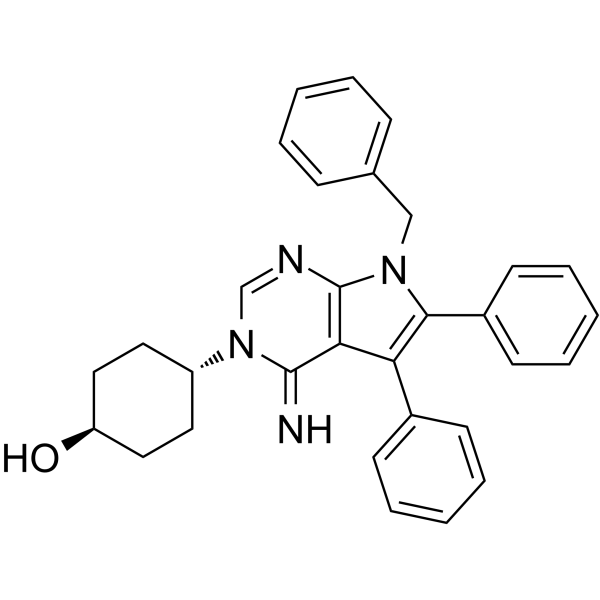
Metarrestin

Based on 1 Customer Validation
Metarrestin (ML246) is an orally active, first-in-class and specific perinucleolar compartment inhibitor. Metarrestin disrupts the nucleolar structure and inhibits RNA polymerase (Pol) I transcription, at least in part by interacting with the translation elongation factor eEF1A2. Metarrestin blocks metastatic development and extends survival in mouse cancer models.
Nos produits utilisent uniquement pour la recherche. Nous ne vendons pas aux patients.
- Pureté: 99.90%
- CAS No.: 1443414-10-5
- Formule: C31H30N4O
- Masse moléculaire:474.60
-
Stockage:Powder -20°C, 3 years , 4°C, 2 years ; In solvent -80°C, 2 years , -20°C, 1 year

To place orders, for customer services and technical support, please contact: MedChemExpress USA
Tel: 609-228-6898 E-mail: [email protected] [email protected]


-
 Activité biologique
-
Chemical Information
-
Solvant et solubilité
- Pureté et documentation
- Références
-
 Help & FAQs
-


Cell Cycle/DNA Damage Compound Library
HY-L004
-
Anti-Cancer Compound Library
HY-L025
-
Clinical Compound Library
HY-L026
-
Anti-Aging Compound Library
HY-L034
-
Orally Active Compound Library
HY-L061
-
Anti-Breast Cancer Compound Library
HY-L074
-
Anti-Pancreatic Cancer Compound Library
HY-L077
-
Protein-protein Interaction Inhibitor Library
HY-L109
-
Highly Selective Inhibitors Library
HY-L158
-
Bioactive Compound Library Max
HY-L181
-
MCE Bioactive Compound Library
HY-L001V
-
Clinical Compound Library Plus
HY-L026P
-
Bioactive Compound Library
HY-L001
-
High-Throughput Bioactive Compound Library
HY-L205


Voir tous les produits spécifiques à Isoform DNA/RNA Synthesis
More

Activité biologique
|
RNA Polymerase |
|
Cell Line

|
Type | Value | Description | References |
|---|---|---|---|---|
| PC-3M | IC50 |
0.2 μM
Compound: 5f
|
Anticancer activity in human PC-3M cells expressing PTB/GFP fusion protein assessed as perinucleolar compartment disassembly and measured after 24 hrs by Hoechst 33342 staining based microscopic method
Anticancer activity in human PC-3M cells expressing PTB/GFP fusion protein assessed as perinucleolar compartment disassembly and measured after 24 hrs by Hoechst 33342 staining based microscopic method
|
[PMID: 35696646] |
| PC-3M | IC50 |
0.61 μM
Compound: 5f
|
Antiproliferative activity against human PC-3M cells expressing PTB/GFP fusion protein assessed as inhibition of nucleolar volume measured after 24 hrs by Nucleolar-id Green Detection based confocal microscopic analysis
Antiproliferative activity against human PC-3M cells expressing PTB/GFP fusion protein assessed as inhibition of nucleolar volume measured after 24 hrs by Nucleolar-id Green Detection based confocal microscopic analysis
|
[PMID: 35696646] |
| PC-3M | IC50 |
7.65 μM
Compound: 5f
|
Cytotoxicity against human PC-3M cells expressing PTB/GFP fusion protein assessed as reduction in ATP level and measured after 24 to 48 hrs by ATPlite luminescence assay
Cytotoxicity against human PC-3M cells expressing PTB/GFP fusion protein assessed as reduction in ATP level and measured after 24 to 48 hrs by ATPlite luminescence assay
|
[PMID: 35696646] |
Metarrestin (ML246) disrupts perinucleolar compartments in PC3M-GFP-PTB cells with an IC50 of 0.39 μM[2].
Metarrestin (1 μM; 24 hours) reduces perinucleolar compartment prevalence in different human cancer cell lines. Metarrestin impacts cell growth in cancer cell line PC3M but not in normal fibroblasts (GM02153)[2].
Metarrestin (0.6 μM; 24 hours) effectively blocks the invasion of PC3M and PANC1 cells[2].
Metarrestin (1 μM; 24 hours) does not significantly change the amounts of Pol I large subunit RPA194 and UBF in the three cell lines, PANC1, PC3M, and HeLa. Metarrestin shows a substantial reduction of 5’ETS RNA in cells[2].
MedChemExpress (MCE) has not independently confirmed the accuracy of these methods. They are for reference only.
Metarrestin (drug-infused chow; 10 mg/kg; 70 ppm) extends survival in the NSG PANC1 pancreatic cancer metastasis mice model[2].
Metarrestin (5, 25 mg/kg; ip; for 4 additional week) reduces metastasis of prostate cancer (PC3M) and growth of metastatic breast cancer PDX mice models[2].
Metarrestin (5 and 25 mg/kg; IP) has a half-life of 4.6 to 5.5 hours[2].
MedChemExpress (MCE) has not independently confirmed the accuracy of these methods. They are for reference only.
-
Animal Model:NOD/IL2 gamma (null) PANC1 mice over primary tumor tissues[2]
-
Dosage:5 and 25 mg/kg
-
Administration:IP; once daily; continuing for six weeks
-
Result:Displayed a decrease in metastatic burden in both liver (p <0.01) and lung with 25 mg/kg.
Demonstrated a significant reduction of perinucleolar compartment prevalence in metastatic and primary tumor tissues.
-
Animal Model:Female BALB/c mice[2]
-
Dosage:5 and 25 mg/kg (Pharmacokinetic Analysis)
-
Administration:IP
-
Result:Indicated good exposure, distribution, and tolerability in vivo, with a half-life of 4.6 to 5.5 hours.
| NCT Number | Sponsor | Condition | Start Date |
Phase
|
|---|---|---|---|---|
| NCT01329991 | Plexxikon| | 2011-05 | PHASE1 |


Chemical Information
-
CAS No. 1443414-10-5
-
Appearance Solid
-
Masse moléculaire 474.60
-
Formule C31H30N4O
-
Color White to off-white
-
SMILES
O[C@H]1CC[C@H](N(C=NC2=C3C(C4=CC=CC=C4)=C(C5=CC=CC=C5)N2CC6=CC=CC=C6)C3=N)CC1
-
Synonyms
ML246
-
Livraison
Room temperature in continental US; may vary elsewhere.
-
Stockage
Powder -20°C 3 years 4°C 2 years In solvent -80°C 2 years -20°C 1 year


Solvant et solubilité
DMSO : 31.25 mg/mL (65.84 mM; Need ultrasonic; Hygroscopic DMSO has a significant impact on the solubility of product, please use newly opened DMSO)
Please refer to the solubility information to select the appropriate solvent. Once prepared, please aliquot and store the solution to prevent product inactivation from repeated freeze-thaw cycles.
Storage method and period of stock solution: -80°C, 2 years; -20°C, 1 year. When stored at -80°C, please use it within 2 years. When stored at -20°C, please use it within 1 year.
Please refer to the solubility information to select the appropriate solvent. Once prepared, please aliquot and store the solution to prevent product inactivation from repeated freeze-thaw cycles.
Storage method and period of stock solution: -80°C, 2 years; -20°C, 1 year. When stored at -80°C, please use it within 2 years. When stored at -20°C, please use it within 1 year.
Concentration (start) × Volume (start) = Concentration (final) × Volume (final)
Select the appropriate dissolution method based on your experimental animal and administration route.
- For the following dissolution methods, please ensure to first prepare a clear stock solution using an In Vitro approach and then sequentially add co-solvents:
- To ensure reliable experimental results, the clarified stock solution can be appropriately stored based on storage conditions. As for the working solution for In Vivo experiments, it is recommended to prepare freshly and use it on the same day.
- The percentages shown for the solvents indicate their volumetric ratio in the final prepared solution. If precipitation or phase separation occurs during preparation, heat and/or sonication can be used to aid dissolution.
Add each solvent one by one: 10% DMSO 40% PEG300 5% Tween-80 45% Saline
Solubility: 2.08 mg/mL (4.38 mM); Suspended solution; Need ultrasonic
This protocol yields a suspended solution of 2.08 mg/mL. Suspended solution can be used for oral and intraperitoneal injection.
Taking 1 mL working solution as an example, add 100 μL DMSO stock solution (20.8 mg/mL) to 400 μL PEG300, and mix evenly; then add 50 μL Tween-80 and mix evenly; then add 450 μL Saline to adjust the volume to 1 mL.
Preparation of Saline: Dissolve 0.9 g sodium chloride in ddH₂O and dilute to 100 mL to obtain a clear Saline solution.
Please enter the basic information of animal experiments:
-
-
-
-
Recommended: Prepare an additional quantity of animals to account for potential losses during experiments.
Please enter your animal formula composition:
-
%DMSO +
Recommended: Keep the proportion of DMSO in working solution below 2% if your animal is weak.
-
%+
-
+%Tween-80 + +
-
%Saline +
The co-solvents required include: DMSO, . All of co-solvents are available by MedChemExpress (MCE). , Tween 80. All of co-solvents are available by MedChemExpress (MCE).
Working solution concentration: 0.22 mg/mL
Method for preparing stock solution: mg drug dissolved in μL DMSO. Stock solution concentration: mg/mL.
1. Take μL DMSO stock solution;
2. Add μL .
μL , mix evenly;
3. Then add μL Tween 80, mix evenly;
4. Then add μL
Please ensure that the stock solution in the first step is dissolved to a clear state, and add co-solvents in sequence. You can use ultrasonic heating (ultrasonic cleaner, recommended frequency 20-40 kHz), vortexing, etc. to assist dissolution.


Pureté et documentation
-
Fiche technique (278 KB)
-
SDS (393 KB)
- English - EN (393 KB)
- Français - FR (393 KB)
- Deutsch - DE (393 KB)
- Norwegian - NO (393 KB)
- Español - ES (393 KB)
- Swedish - SV (393 KB)
- Italian - IT (393 KB)
- Korean - KR (393 KB)
- Portuguese - PT (393 KB)
-
Instruction de manipulation (2659 KB)
Références
[1]. Vilimas T, et al. Pharmacokinetic evaluation of the perinucleolar compartment disassembler metarrestin in wild-type and Pdx1-Cre;LSL-KrasG12D/+;Tp53R172H/+ (KPC) mice, a genetically engineered model of pancreatic cancer. Cancer Chemother Pharmacol. 2018 Dec;82(6):1067-1080. [Content Brief]
[2]. Frankowski KJ, et al. Metarrestin, a perinucleolar compartment inhibitor, effectively suppresses metastasis. Sci Transl Med. 2018 May 16;10(441). [Content Brief]


Complete Stock Solution Preparation Table
Please refer to the solubility information to select the appropriate solvent. Once prepared, please aliquot and store the solution to prevent product inactivation from repeated freeze-thaw cycles.
Storage method and period of stock solution: -80°C, 2 years; -20°C, 1 year. When stored at -80°C, please use it within 2 years. When stored at -20°C, please use it within 1 year.
| Optional Solvent | Concentration Solvent Mass | 1 mg | 5 mg | 10 mg | 25 mg |
|---|---|---|---|---|---|
| DMSO | 1 mM | 2.1070 mL | 10.5352 mL | 21.0704 mL | 52.6759 mL |
| 5 mM | 0.4214 mL | 2.1070 mL | 4.2141 mL | 10.5352 mL | |
| 10 mM | 0.2107 mL | 1.0535 mL | 2.1070 mL | 5.2676 mL | |
| 15 mM | 0.1405 mL | 0.7023 mL | 1.4047 mL | 3.5117 mL | |
| 20 mM | 0.1054 mL | 0.5268 mL | 1.0535 mL | 2.6338 mL | |
| 25 mM | 0.0843 mL | 0.4214 mL | 0.8428 mL | 2.1070 mL | |
| 30 mM | 0.0702 mL | 0.3512 mL | 0.7023 mL | 1.7559 mL | |
| 40 mM | 0.0527 mL | 0.2634 mL | 0.5268 mL | 1.3169 mL | |
| 50 mM | 0.0421 mL | 0.2107 mL | 0.4214 mL | 1.0535 mL | |
| 60 mM | 0.0351 mL | 0.1756 mL | 0.3512 mL | 0.8779 mL |


Metarrestin Related Classifications
HY-120118 Related Classifications
 Powered by Bioz