



Pancuronium dibromide (Standard)
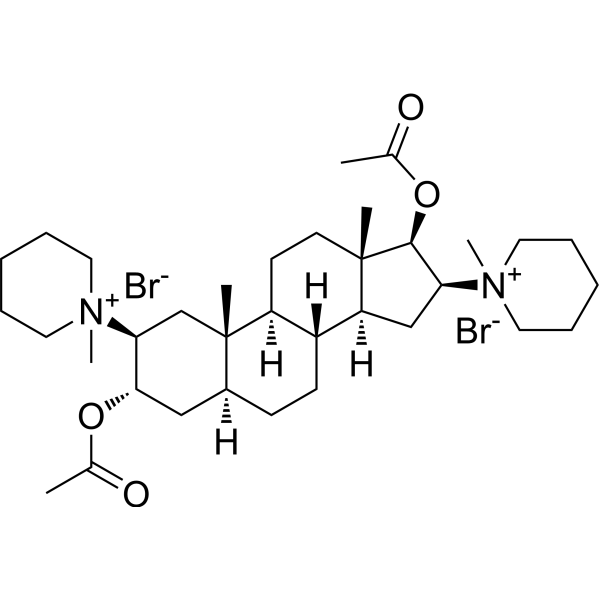
Pancuronium (dibromide) (Standard) is the analytical standard of Pancuronium (dibromide). This product is intended for research and analytical applications. Pancuronium dibromide, a bis-quaternary steroid, is a neuromuscular relaxant. Pancuronium dibromide inhibits neuromuscular transmission by competing with acetylcholine for binding sites on nACh receptors. Pancuronium dibromide also inhibits cardiac muscarinic receptors and has a sympathomimetic action.
Nur für Forschungszwecke. Wir verkaufen nicht an Patienten.
- Reinheit: 95%
- CAS. Nr.: 15500-66-0
- Formel: C35H60Br2N2O4
- Molecular Weight:732.67
-
Speicherung:
Please store the product under the recommended conditions in the Certificate of Analysis.

To place orders, for customer services and technical support, please contact: MedChemExpress USA
Tel: 609-228-6898 E-mail: [email protected] [email protected]


-
 Product Information
-
Chemical Information
- Reinheit & Dokumentation
-
 Help & FAQs




Product Information
The compound is the grade of analytical standard, which is the reference standard supplied assay. It is commonly used in qualitative, quantitative and methodological research experiments in HPLC, GC and MS.


Chemical Information
-
CAS. Nr. 15500-66-0
-
Molecular Weight 732.67
-
Formel C35H60Br2N2O4
-
SMILES
C[N+]1([C@@H]2[C@@H](OC(C)=O)C[C@@](CC[C@]3([H])[C@]4([H])CC[C@@]5(C)[C@@]3([H])C[C@H]([N+]6(C)CCCCC6)[C@@H]5OC(C)=O)([H])[C@]4(C)C2)CCCCC1.[Br-].[Br-]
-
Versand
Room temperature in continental US; may vary elsewhere.
-
Speicherung
Please store the product under the recommended conditions in the Certificate of Analysis.


Reinheit & Dokumentation
Verweise
[1]. A D Fryer, et al. Pancuronium and gallamine are antagonists for pre- and post-junctional muscarinic receptors in the guinea-pig lung. Naunyn Schmiedebergs Arch Pharmacol. 1987 Apr;335(4):367-71. [Content Brief]
[2]. E Maestrone, et al. Extracellular pancuronium affects sodium current in chick embryo sensory neurons. Br J Pharmacol. 1994 Jan;111(1):283-7. [Content Brief]
[3]. J R Docherty, et al. A comparison of the effects of pancuronium bromide and its monoquaternary analogue, ORG NC 45, on autonomic and somatic neurotransmission in the rat. Br J Pharmacol. 1980;71(1):225-33. [Content Brief]

Calculators
Konzentration (Stammlösung) × Volumen (Stammlösung) = Konzentration (Ziellösung) × Volumen (Ziellösung)


Pancuronium dibromide (Standard) Related Classifications
HY-B0429R Related Classifications
 Powered by Bioz