



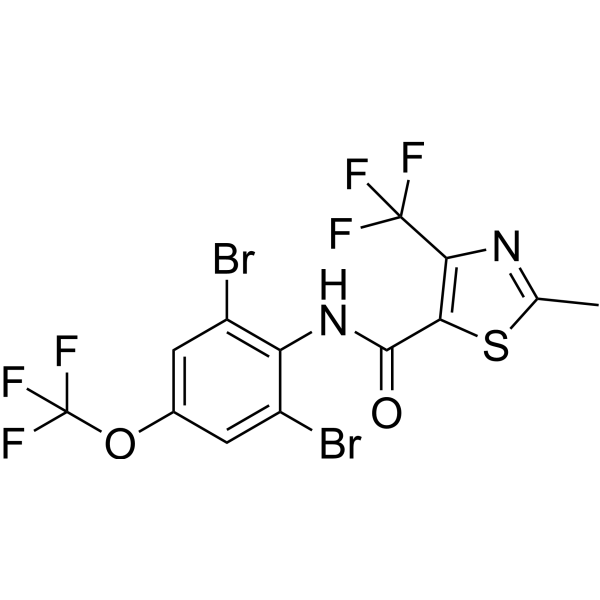
Thifluzamide

Based on 1 Customer Validation
Thifluzamide is a fungicide that inhibits fungal respiration by blocking the ubiquinone-binding site in mitochondrial complex II. Thifluzamide exhibits significant activity against Basidiomycota pathogens (such as Rhizoctonia cerealis, Ustilago and Puccinia genera) and is commonly used in studies on wheat sharp eyespot. Thifluzamide displays a dual mechanism in regulating lipid metabolism: it reduces fatty acid synthase activity to inhibit endogenous fatty acid synthesis, and increases carnitine palmitoyltransferase-I activity to accelerate fatty acid β-oxidation, thereby reducing total cholesterol and triglyceride levels in the liver. Thifluzamide also induces hepatotoxicity in zebrafish models and carries a risk of developmental toxicity. Thifluzamide inhibition of Rhizoctonia cerealis may result in low to moderate levels of drug resistance, leading to the generation of stable drug-resistant mutants.
Nos produits utilisent uniquement pour la recherche. Nous ne vendons pas aux patients.
- Pureté: 98.36%
- CAS No.: 130000-40-7
- Formule: C13H6Br2F6N2O2S
- Masse moléculaire:528.06
-
Stockage:Powder -20°C, 3 years , 4°C, 2 years ; In solvent -80°C, 2 years , -20°C, 1 year

To place orders, for customer services and technical support, please contact: MedChemExpress USA
Tel: 609-228-6898 E-mail: [email protected] [email protected]


-
 Activité biologique
-
Chemical Information
-
Solvant et solubilité
- Pureté et documentation
- Références
-
 Help & FAQs
-

Anti-Infection Compound Library
HY-L002
-
Metabolism/Protease Compound Library
HY-L012
-
Stem Cell Signaling Compound Library
HY-L017
-
Anti-Aging Compound Library
HY-L034
-
Antifungal Compound Library
HY-L048
-
Glutamine Metabolism Compound Library
HY-L064
-
Anti-Cancer Metabolism Compound Library
HY-L083
-
Mitochondria-Targeted Compound Library
HY-L089
-
Lipid Metabolism Compound Library
HY-L091
-
Glucose Metabolism Compound Library
HY-L092
-
Cuproptosis Compound Library
HY-L133
-
Metabolic Enzyme Compound Library
HY-L146
-
TCA Cycle Compound Library
HY-L148
-
Anti-Drug-Resistant Compound Library
HY-L169
-
Bioactive Compound Library Max
HY-L181
-
MCE Bioactive Compound Library
HY-L001V
-
Bioactive Compound Library
HY-L001
-
Pesticide Compound Library
HY-L183
-
Non-Alcoholic Fatty Liver Disease (NAFLD) Compound Library
HY-L199
-
Lactic Acid Metabolic Compound Library
HY-L204
-
High-Throughput Bioactive Compound Library
HY-L205




Activité biologique
Thifluzamide (0.01-0.4 μg/mL; 4-5 d) inhibits mycelial growth of field-isolated Rhizoctonia cerealis strains, with an EC50 of 0.064 μg/mL[2].
Treatment with Thifluzamide (1-200 μg/mL) induces the generation of two Rhizoctonia cerealis mutants with high resistance (RF=120) and moderate resistance (RF=40), respectively[2].
Resistance to Thifluzamide in Rhizoctonia cerealis mutants WX14-1 and WX14-2 remains stable after 10 successive transfers on fungicide-free media; compared with the wild-type Rhizoctonia cerealis strain WX14, these mutants show no fitness cost in terms of mycelial growth, pathogenicity or sclerotial production[2].
MedChemExpress (MCE) has not independently confirmed the accuracy of these methods. They are for reference only.
MedChemExpress (MCE) has not independently confirmed the accuracy of these methods. They are for reference only.
-
Animal Model:Danio rerio Zebrafish (adult, approximately five months old)[1]
-
Dosage:0.019 mg/L; 0.19 mg/L; 1.90 mg/L
-
Administration:aqueous exposure; continuous; 28 days (daily solution refreshment)
-
Result:Decreased condition factor to 0.84-fold of the control at 1.90 mg/L.
Decreased hepatic triglyceride (TG) content to 0.56-fold, 0.51-fold, and 0.36-fold of the control at 0.019 mg/L, 0.19 mg/L, and 1.90 mg/L, respectively.
Decreased hepatic total cholesterol (TCHO) content to 0.68-fold and 0.62-fold of the control at 0.19 mg/L and 1.90 mg/L, respectively.
Detected no accumulation of lipid droplets in the liver at any dose.
Decreased fatty acid synthetase (FAS) activity to 0.76-fold and 0.81-fold of the control at 0.19 mg/L and 1.90 mg/L, respectively; no change at 0.019 mg/L.
Increased carnitine palmitoyltransferase (CPT-I) activity by 1.21-fold and 1.29-fold of the control at 0.19 mg/L and 1.90 mg/L, respectively; no change at 0.019 mg/L.
Observed no apparent changes in hepatic lipase (HL) or lipoprotein lipase (LPL) activities at any dose.


Chemical Information
-
CAS No. 130000-40-7
-
Appearance Solid
-
Masse moléculaire 528.06
-
Formule C13H6Br2F6N2O2S
-
Color Light yellow to khaki
-
SMILES
O=C(C1=C(C(F)(F)F)N=C(C)S1)NC2=C(Br)C=C(OC(F)(F)F)C=C2Br
-
Livraison
Room temperature in continental US; may vary elsewhere.
-
Stockage
Powder -20°C 3 years 4°C 2 years In solvent -80°C 2 years -20°C 1 year


Solvant et solubilité
DMSO : ≥ 29 mg/mL (54.92 mM; Hygroscopic DMSO has a significant impact on the solubility of product, please use newly opened DMSO)
* "≥" means soluble, but saturation unknown.
Please refer to the solubility information to select the appropriate solvent. Once prepared, please aliquot and store the solution to prevent product inactivation from repeated freeze-thaw cycles.
Storage method and period of stock solution: -80°C, 2 years; -20°C, 1 year. When stored at -80°C, please use it within 2 years. When stored at -20°C, please use it within 1 year.
Please refer to the solubility information to select the appropriate solvent. Once prepared, please aliquot and store the solution to prevent product inactivation from repeated freeze-thaw cycles.
Storage method and period of stock solution: -80°C, 2 years; -20°C, 1 year. When stored at -80°C, please use it within 2 years. When stored at -20°C, please use it within 1 year.
Concentration (start) × Volume (start) = Concentration (final) × Volume (final)


Pureté et documentation
-
Fiche technique (276 KB)
-
SDS (458 KB)
- English - EN (458 KB)
- Français - FR (458 KB)
- Deutsch - DE (458 KB)
- Norwegian - NO (458 KB)
- Español - ES (458 KB)
- Swedish - SV (458 KB)
- Italian - IT (458 KB)
- Korean - KR (458 KB)
- Portuguese - PT (458 KB)
-
Instruction de manipulation (2659 KB)
Références
[1]. Yang Y, et al. Thifluzamide affects lipid metabolism in zebrafish (Danio reio). Sci Total Environ. 2018;633:1227-1236. [Content Brief]
[2]. Zhang Y, et al. Baseline sensitivity and resistance risk assessmemt of Rhizoctonia cerealis to thifluzamide, a succinate dehydrogenase inhibitor. Pestic Biochem Physiol. 2015;124:97-102. [Content Brief]


Complete Stock Solution Preparation Table
Please refer to the solubility information to select the appropriate solvent. Once prepared, please aliquot and store the solution to prevent product inactivation from repeated freeze-thaw cycles.
Storage method and period of stock solution: -80°C, 2 years; -20°C, 1 year. When stored at -80°C, please use it within 2 years. When stored at -20°C, please use it within 1 year.
| Optional Solvent | Concentration Solvent Mass | 1 mg | 5 mg | 10 mg | 25 mg |
|---|---|---|---|---|---|
| DMSO | 1 mM | 1.8937 mL | 9.4686 mL | 18.9372 mL | 47.3431 mL |
| 5 mM | 0.3787 mL | 1.8937 mL | 3.7874 mL | 9.4686 mL | |
| 10 mM | 0.1894 mL | 0.9469 mL | 1.8937 mL | 4.7343 mL | |
| 15 mM | 0.1262 mL | 0.6312 mL | 1.2625 mL | 3.1562 mL | |
| 20 mM | 0.0947 mL | 0.4734 mL | 0.9469 mL | 2.3672 mL | |
| 25 mM | 0.0757 mL | 0.3787 mL | 0.7575 mL | 1.8937 mL | |
| 30 mM | 0.0631 mL | 0.3156 mL | 0.6312 mL | 1.5781 mL | |
| 40 mM | 0.0473 mL | 0.2367 mL | 0.4734 mL | 1.1836 mL | |
| 50 mM | 0.0379 mL | 0.1894 mL | 0.3787 mL | 0.9469 mL |


Thifluzamide Related Classifications
HY-B2004 Related Classifications
 Powered by Bioz