



Desmethylazelastine
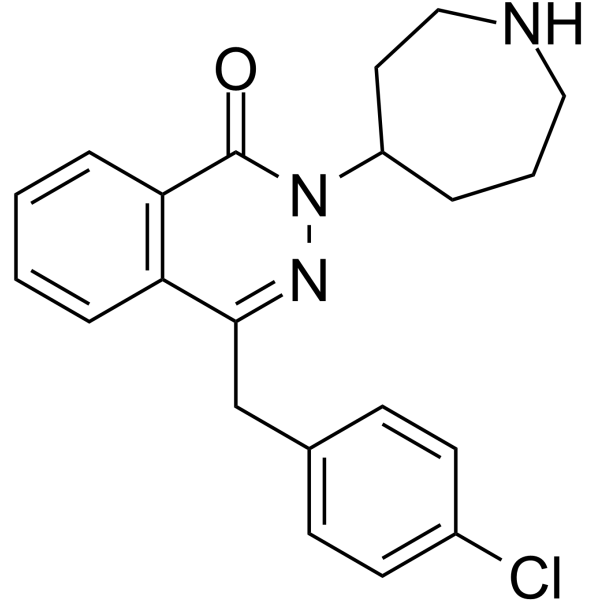
Desmethylazelastine is a main active metabolite of Azelastine that is oxidatively metabolized by the cytochrome P450 enzyme system with a protein binding rate of 97% and an elimination half-life of 54 hours. Azelastine is an orally active, selective and high-affinity histamine H1-receptor antagonist. Azelastine can be used in studies of allergic rhinitis, asthma, diabetic hyperlipidemic and SARS-CoV-2.
Nur für Forschungszwecke. Wir verkaufen nicht an Patienten.
- CAS. Nr.: 47491-38-3
- Formel: C21H22ClN3O
- Molecular Weight:367.87
-
Speicherung:
Please store the product under the recommended conditions in the Certificate of Analysis.

To place orders, for customer services and technical support, please contact: MedChemExpress USA
Tel: 609-228-6898 E-mail: [email protected] [email protected]


-
 Biologische Aktivität
-
Chemical Information
- Protokoll
- Reinheit & Dokumentation
- Verweise
-
 Help & FAQs


-
HY-N0455AS6
L-Arginine-13C6 hydrochlorideStable Isotope -
HY-100599
Urolithin AMitophagy Activator -
HY-N0455AS2
L-Arginine-d7 hydrochlorideStable Isotope -
HY-17506S
Azithromycin-d3Stable Isotope -
HY-13315A
MontelukastCysLT1 Antagonist -
HY-W107464
G6PDi-1G6PD Inhibitor -

HY-13315AR
Montelukast (Standard)CysLT1 Antagonist -
HY-B0462
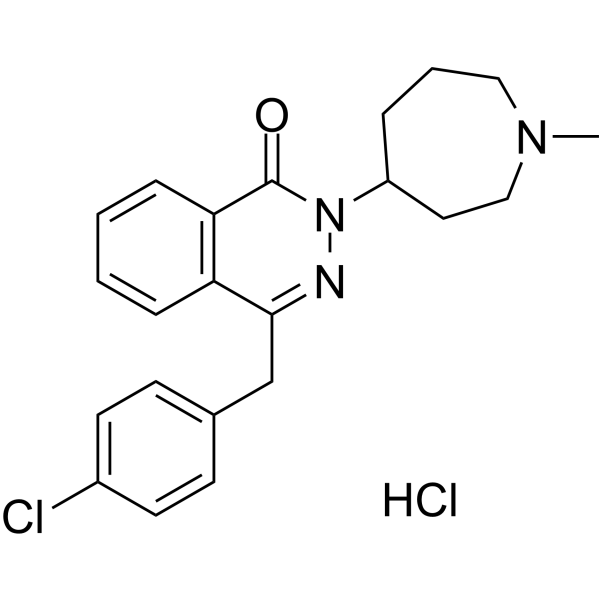
Azelastine hydrochlorideHistamine 1 Antagonist -
HY-149267
STING agonist-30STING Agonist -
HY-10163S1
Dabigatran-d3Stable Isotope -

HY-B1397C
Cyclizine hydrochlorideH1 Receptor Antagonist -
HY-105713
SulochrinAntimicrobial Agent


Biologische Aktivität
Beschreibung
Cellular Effect
|
Cell Line

|
Type | Value | Description | References |
|---|---|---|---|---|
| LLC-PK1 | IC50 |
11.8 μM
Compound: Desmethylazelastine
|
TP_TRANSPORTER: inhibition of Daunorubicin transepithelial transport (basal to apical) (Daunorubicin: 0.035 uM) in MDR1-expressing LLC-PK1 cells
TP_TRANSPORTER: inhibition of Daunorubicin transepithelial transport (basal to apical) (Daunorubicin: 0.035 uM) in MDR1-expressing LLC-PK1 cells
|
[PMID: 11231118] |
| LLC-PK1 | IC50 |
41.8 μM
Compound: Desmethylazelastine
|
TP_TRANSPORTER: inhibition of Digoxin transepithelial transport (basal to apical) (Digoxin: 0.025 uM) in MDR1-expressing LLC-PK1 cells
TP_TRANSPORTER: inhibition of Digoxin transepithelial transport (basal to apical) (Digoxin: 0.025 uM) in MDR1-expressing LLC-PK1 cells
|
[PMID: 11231118] |
In Vivo
| Blood | Lung | |
| Cmax (ng/mL)[a] | 17.6 | 2863 |
| Tmax (h) | 3.0-6.0 | 4.0-6.0 |
| Tlag (h) | 0.25 | 0.39 |
| AUC0-24 (ng•h/mL)[a] | 180 | 28502 |
| t1/2 (h) | 4.24 | 3.90 |
| CL (L/h) | 0.213 | |
| Lung-blood ratio[b] | 146 | 146 |
MedChemExpress (MCE) has not independently confirmed the accuracy of these methods. They are for reference only.


Chemical Information
-
CAS. Nr. 47491-38-3
-
Molecular Weight 367.87
-
Formel C21H22ClN3O
-
SMILES
O=C1C2=C(C(CC3=CC=C(C=C3)Cl)=NN1C4CCNCCC4)C=CC=C2
-
Versand
Room temperature in continental US; may vary elsewhere.
-
Speicherung
Please store the product under the recommended conditions in the Certificate of Analysis.


Reinheit & Dokumentation
Verweise
[1]. Chand N, et al. Pharmacodynamic and pharmacokinetic studies with azelastine in the guinea pig: evidence for preferential distribution into the lung. Allergy. 1993 Jan;48(1):19-24. [Content Brief]
[2]. Lieberman P, et al. Management of allergic rhinitis with a combination antihistamine/anti-inflammatory agent. J Allergy Clin Immunol. 1999 Mar;103(3 Pt 2):S400-4. [Content Brief]
[3]. Craig La Force. Review of the pharmacology, clinical efficacy, and safety of azelastine hydrochloridel. Expert Rev Clin Immunol. 2005 Jul;1(2):191-201. [Content Brief]
[4]. Mohamed M Elseweidy, et al. Azelastine a potent antihistamine agent, as hypolipidemic and modulator for aortic calcification in diabetic hyperlipidemic rats model. Arch Physiol Biochem. 2020 Jul 2;1-8. [Content Brief]
[5]. Li Yang, et al. Identification of SARS-CoV-2 entry inhibitors among already approved drugs. Acta Pharmacol Sin. 2020 Oct 28 : 1-7. [Content Brief]

Calculators
Konzentration (Stammlösung) × Volumen (Stammlösung) = Konzentration (Ziellösung) × Volumen (Ziellösung)


Desmethylazelastine Related Classifications
HY-147336 Related Classifications
 Powered by Bioz