



Prion Disease
-
Prion Disease (5)

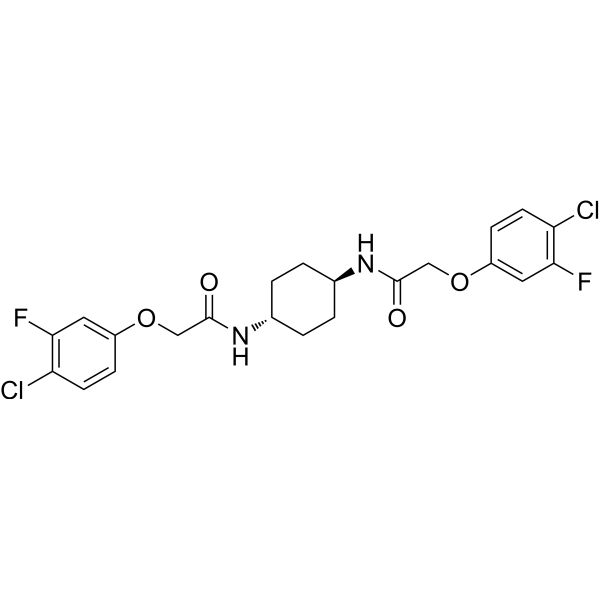
- Formula: C22H22Cl2F2N2O4
- Molecular Weight: 487.32
ISR-IN-1 is an integrated stress response (ISR) inhibitor targeting eIF2B. ISR-IN-1 enhances eIF2B guanine nucleotide exchange factor activity, stabilizes eIF2B heteropentamer dimers via symmetrical protein-protein interface binding, and releases global protein synthesis inhibition from phosphorylated eIF2αα. ISR-IN-1 can be used for the research of prion disease.

- Formula: C10H18NO3S2
- Molecular Weight: 264.38
MTSSL (Otmpmms) is a highly reactive thiol-specific spin label that can be used to label thiol residues in proteins for the determination of protein structure and dynamics, as well as studies on protein-protein interactions. MTSSL serves as a nitroxide labeling reagent for cysteine residues in recombinant mouse prion protein (moPrPC) mutants. MTSSL can be applied in studies of transmissible spongiform encephalopathies (prion diseases).

- Formula: C16H12N2O2S2
- Molecular Weight: 328.41
IBT21 is an endoplasmic reticulum stress inhibitor that binds to unfolded or misfolded proteins and prevents their aggregation. IBT21 inhibits UPR activation of the ATF6, IRE1 and PERK branches under ER stress, with IC50 values of 0.24 μM, 0.33 μM, and 0.46 μM, respectively. IBT21 protects cells from ER stress-induced death and mutant prion protein (protein toxin)-induced growth inhibition. IBT21 exhibits chemical chaperone activity distinct from UPR modulators, does not affect protein translation, moderately reduces DTT (HY-15917)-induced ER stress, and fails to inhibit the heat shock response. IBT21 is useful for research related to prion diseases.

- Formula: C88H157N29O27
- Molecular Weight: 2053.37
ccβ is a 17-residue peptide that folds into a coiled-coil trimer at low temperatures and aggregates to form amyloid fibrils at high temperatures. ccβ serves as a simple model system for investigating α-helix to β-sheet conformational transitions and template-mediated aggregation processes associated with prion and amyloidogenic diseases. ccβ can be used in studies of prion diseases and Alzheimer's disease.

- Formula: C88H157N29O27·xC2H4O2
- Molecular Weight: 2053.37 (free base)
ccβ acetate is a 17-residue peptide that folds into a coiled-coil trimer at low temperatures and aggregates to form amyloid fibrils at high temperatures. ccβ acetate serves as a simple model system for investigating α-helix to β-sheet conformational transitions and template-mediated aggregation processes associated with prion and amyloidogenic diseases. ccβ acetate can be used in studies of prion diseases and Alzheimer's disease.



