



BI-0115
Based on 2 publication(s) in Google Scholar
BI-0115 is a selective inhibitor of LOX-1 (IC50=5.4 μM) that blocks cellular uptake of oxLDL. BI-0115 binding triggers receptor inhibition by formation of dimers of the homodimeric ligand binding domain.
For research use only. We do not sell to patients.
The BI-0115 was designed by Boehringer Ingelheim and could be obtained free of charge through the Boehringer Ingelheim open innovation portal opnMe.com, associated with its negative control.
- Purity: 99.72%
- CAS No.: 4929-23-1
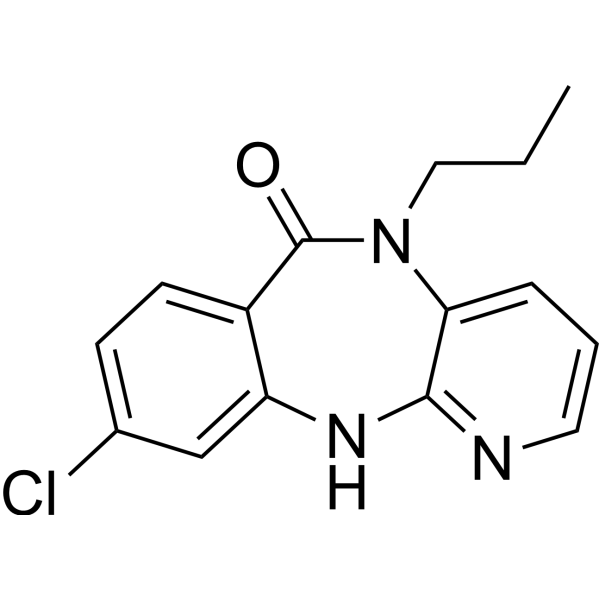
- Formula: C15H14ClN3O
- Molecular Weight:287.74
-
Storage:Powder -20°C, 3 years , 4°C, 2 years ; In solvent -80°C, 6 months , -20°C, 1 month

To place orders, for customer services and technical support, please contact: MedChemExpress USA
Tel: 609-228-6898 E-mail: [email protected] [email protected]


-
 Biological Activity
-
Chemical Information
-
Solvent & Solubility
- Purity & Documentation
- References
-
 Help & FAQs



Publications Citing Use of MedChemExpress (MCE) BI-0115
More

Biological Activity
BI-0115 efficiently reduces oxLDL internalization in the cellular context. The IC50 values of the cellular assay (5.4 μM) are in good agreement with the determined Kd values in SPR (4.3 μM) and ITC (6.99 μM)[1].
MedChemExpress (MCE) has not independently confirmed the accuracy of these methods. They are for reference only.


Chemical Information
-
CAS No. 4929-23-1
-
Appearance Solid
-
Molecular Weight 287.74
-
Formula C15H14ClN3O
-
Color Light yellow to yellow
-
SMILES
O=C1N(CCC)C2=CC=CN=C2NC3=CC(Cl)=CC=C13
-
Shipping
Room temperature in continental US; may vary elsewhere.
-
Storage
Powder -20°C 3 years 4°C 2 years In solvent -80°C 6 months -20°C 1 month


Publications (2)
-
Journal Impact Factor
-
Most Recent
-
Cells
Selective Azapeptide CD36 Ligand MPE-298 Regulates oxLDL-LOX-1-Mediated Inflammation and Mitochondrial Oxidative Stress in Macrophages. [Abstract]2025 Mar 6;14(5):385. PMID: 40072113 -
Biomed Pharmacother
Pancreatic β-cell apoptosis caused by apolipoprotein C3-rich low-density lipoprotein is attenuated by kansuinine A through oxidative stress inhibition. [Abstract]2025 Apr 21:187:118066. PMID: 40262236


Solvent & Solubility
DMSO : 100 mg/mL (347.54 mM; Need ultrasonic; Hygroscopic DMSO has a significant impact on the solubility of product, please use newly opened DMSO)
Please refer to the solubility information to select the appropriate solvent. Once prepared, please aliquot and store the solution to prevent product inactivation from repeated freeze-thaw cycles.
Storage method and period of stock solution: -80°C, 6 months; -20°C, 1 month. When stored at -80°C, please use it within 6 months. When stored at -20°C, please use it within 1 month.
Please refer to the solubility information to select the appropriate solvent. Once prepared, please aliquot and store the solution to prevent product inactivation from repeated freeze-thaw cycles.
Storage method and period of stock solution: -80°C, 6 months; -20°C, 1 month. When stored at -80°C, please use it within 6 months. When stored at -20°C, please use it within 1 month.
Concentration (start) × Volume (start) = Concentration (final) × Volume (final)
Select the appropriate dissolution method based on your experimental animal and administration route.
- For the following dissolution methods, please ensure to first prepare a clear stock solution using an In Vitro approach and then sequentially add co-solvents:
- To ensure reliable experimental results, the clarified stock solution can be appropriately stored based on storage conditions. As for the working solution for In Vivo experiments, it is recommended to prepare freshly and use it on the same day.
- The percentages shown for the solvents indicate their volumetric ratio in the final prepared solution. If precipitation or phase separation occurs during preparation, heat and/or sonication can be used to aid dissolution.
Please enter the basic information of animal experiments:
-
-
-
-
Recommended: Prepare an additional quantity of animals to account for potential losses during experiments.
Please enter your animal formula composition:
-
%DMSO +
Recommended: Keep the proportion of DMSO in working solution below 2% if your animal is weak.
-
%+
-
+%Tween-80 + +
-
%Saline +
The co-solvents required include: DMSO, . All of co-solvents are available by MedChemExpress (MCE). , Tween 80. All of co-solvents are available by MedChemExpress (MCE).
Working solution concentration: 0.22 mg/mL
Method for preparing stock solution: mg drug dissolved in μL DMSO. Stock solution concentration: mg/mL.
1. Take μL DMSO stock solution;
2. Add μL .
μL , mix evenly;
3. Then add μL Tween 80, mix evenly;
4. Then add μL
Please ensure that the stock solution in the first step is dissolved to a clear state, and add co-solvents in sequence. You can use ultrasonic heating (ultrasonic cleaner, recommended frequency 20-40 kHz), vortexing, etc. to assist dissolution.


Purity & Documentation
-
Data Sheet (278 KB)
-
SDS (251 KB)
- English - EN (251 KB)
- Français - FR (251 KB)
- Deutsch - DE (251 KB)
- Norwegian - NO (251 KB)
- Español - ES (251 KB)
- Swedish - SV (251 KB)
- Italian - IT (251 KB)
- Korean - KR (251 KB)
- Portuguese - PT (251 KB)
-
Handling Instructions (2659 KB)
References


Complete Stock Solution Preparation Table
Please refer to the solubility information to select the appropriate solvent. Once prepared, please aliquot and store the solution to prevent product inactivation from repeated freeze-thaw cycles.
Storage method and period of stock solution: -80°C, 6 months; -20°C, 1 month. When stored at -80°C, please use it within 6 months. When stored at -20°C, please use it within 1 month.
| Optional Solvent | Concentration Solvent Mass | 1 mg | 5 mg | 10 mg | 25 mg |
|---|---|---|---|---|---|
| DMSO | 1 mM | 3.4754 mL | 17.3768 mL | 34.7536 mL | 86.8840 mL |
| 5 mM | 0.6951 mL | 3.4754 mL | 6.9507 mL | 17.3768 mL | |
| 10 mM | 0.3475 mL | 1.7377 mL | 3.4754 mL | 8.6884 mL | |
| 15 mM | 0.2317 mL | 1.1585 mL | 2.3169 mL | 5.7923 mL | |
| 20 mM | 0.1738 mL | 0.8688 mL | 1.7377 mL | 4.3442 mL | |
| 25 mM | 0.1390 mL | 0.6951 mL | 1.3901 mL | 3.4754 mL | |
| 30 mM | 0.1158 mL | 0.5792 mL | 1.1585 mL | 2.8961 mL | |
| 40 mM | 0.0869 mL | 0.4344 mL | 0.8688 mL | 2.1721 mL | |
| 50 mM | 0.0695 mL | 0.3475 mL | 0.6951 mL | 1.7377 mL | |
| 60 mM | 0.0579 mL | 0.2896 mL | 0.5792 mL | 1.4481 mL | |
| 80 mM | 0.0434 mL | 0.2172 mL | 0.4344 mL | 1.0860 mL | |
| 100 mM | 0.0348 mL | 0.1738 mL | 0.3475 mL | 0.8688 mL |


BI-0115 Related Classifications
HY-23999 Related Classifications
 Powered by Bioz