



Eloralintide sodium

Based on 1 Customer Validation
Eloralintide sodium is an Amylin Receptor agonist. Eloralintide sodium selectively activates AMY1R and AMY3R in cells expressing human or rat AMY1R, AMY3R or CTR. Eloralintide sodium activates AMYRs and CTR in rats, inducing a sustained decrease in plasma Ca2+ levels. Eloralintide sodium reduces appetite and body weight in both lean and obese rats. Eloralintide sodium can be used for research related to obesity.
For research use only. We do not sell to patients.
- Purity : 99.92%
- Formula: C201H319N49O65S2.xNa
- Molecular Weight:4526.10 (free base)
-
Storage:
Sealed storage, away from moisture.
Powder -80°C, 2 years , -20°C, 1 year* In solvent : -80°C, 6 months; -20°C, 1 month (sealed storage, away from moisture)


To place orders, for customer services and technical support, please contact: MedChemExpress USA
Tel: 609-228-6898 E-mail: [email protected] [email protected]


-
 Biological Activity
-
Chemical Information
-
Solvent & Solubility
- Purity & Documentation
- References
-
 Help & FAQs



All Calcium Channel Isoforms
More

Biological Activity
Description
In Vitro
Eloralintide selectively activates AMY1R and AMY3R in UMUC3 cells expressing human or rat AMY1R, AMY3R or CTR, with an EC50 of 23.9 pM and a Ki of 478.1 pM for human AMY1R, an EC50 of 5.4 pM and a Ki of 48.1 pM for rat AMY1R, as well as an EC50 of 13.8 pM and a Ki of 161.0 pM for rat AMY3R[3].
MedChemExpress (MCE) has not independently confirmed the accuracy of these methods. They are for reference only.
Parmacokinetics
In Vivo
Eloralintide sodium (0.1-300 nmol/kg; s.c.; single dose) reduces food intake and body weight in lean rats, attenuates the induced conditioned taste aversion, and has an ED50 of 8.9 nmol/kg for reducing sweetener preference[3].
Eloralintide sodium (0.1-100 nmol/kg; s.c.; once every three days; 13 days) reduces food intake and body weight in male DIO rats by decreasing fat mass[3].
MedChemExpress (MCE) has not independently confirmed the accuracy of these methods. They are for reference only.
-
Animal Model:Rat[1]
-
Dosage:10 or 30 nmol/kg
-
Administration:s.c.; single dose
-
Result:Induced a prolonged decrease in Ca2+ plasma levels.
-
Animal Model:Sprague-Dawley Rats (male, lean)[3]
-
Dosage:0.1, 0.3, 1, 30, 100, 300 nmol/kg
-
Administration:s.c.; single dose
-
Result:Dose-dependently reduced food intake and body
weight, with an ED50 of 3.7 nmol/kg for 96-hour food intake reduction and a 14.9% body weight reduction at the 300 nmol/kg single dose.
Attenuated the induced conditioned taste avoidance.
Reached an ED50 of 8.9 nmol/kg for saccharin preference reduction.
-
Animal Model:Long Evans DIO SD Rat (male, diet-induced obese)[3]
-
Dosage:0.1, 0.3, 1, 30, 100 nmol/kg
-
Administration:s.c.; every three days; 13 days
-
Result:Reduced food intake and body weight in a dose-dependent manner.
Reached an ED50 of 3.7 nmol/kg for change from baseline in food intake at 96 h.
Reached an ED50 of 6.1 nmol/kg for change from baseline in body weight at 96 h.
Resulted in fat mass loss accounting for approximately 85%, 77%, and 68% of total body weight loss at doses of 10, 30, and 100 nmol/kg Q3D, respectively.\nReached an ED50 of 0.8 nmol/kg for loss of fat mass.


Chemical Information
-
Appearance Solid
-
Molecular Weight 4526.10 (free base)
-
Formula C201H319N49O65S2.xNa
-
Color White to off-white
-
Synonyms
LY-3841136 sodium
-
Sequence
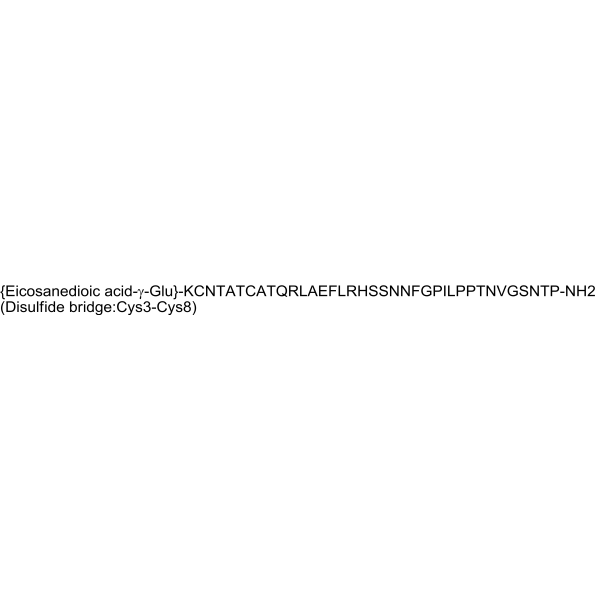
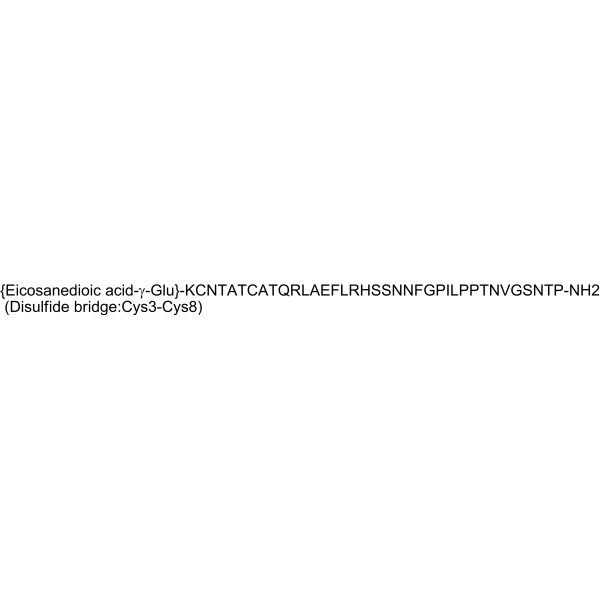
{γGlu}-Cys-Asn-Thr-Ala-Thr-Cys-Ala-Thr-Gly-{Orn}-Leu-Ala-Glu-{(α-Me-Phe)}-Leu-Val-Arg-Ser-Ser-Asn-{(N-Me-Asn)}-Phe-Gly-Pro-{Lys(γGlu-γGlu-C20 diacid)}-Leu-Pro-Pro-Thr-Glu-Val-Gly-Ser-Asn-Thr-Tyr-NH2 (Methylene bridge: Cys2-Cys7)
-
Sequence Shortening
{γGlu}-CNTATCATG-{Orn}-LAE-{(α-Me-Phe)}-LVRSSN-{(N-Me-Asn)}-FGP-{Lys(γGlu-γGlu-C20 diacid)}-LPPTEVGSNTY-NH2 (Methylene bridge: Cys2-Cys7)
-
Shipping
Room temperature in continental US; may vary elsewhere.
-
Storage
Sealed storage, away from moisture
Powder -80°C 2 years -20°C 1 year * In solvent : -80°C, 6 months; -20°C, 1 month (sealed storage, away from moisture)


Solvent & Solubility
In Vitro:
H2O : 100 mg/mL (Need ultrasonic)


Purity & Documentation
-
Data Sheet (300 KB)
-
SDS (254 KB)
- English - EN (254 KB)
- Français - FR (254 KB)
- Deutsch - DE (254 KB)
- Norwegian - NO (254 KB)
- Español - ES (254 KB)
- Swedish - SV (254 KB)
- Italian - IT (254 KB)
- Korean - KR (254 KB)
- Portuguese - PT (254 KB)
-
Handling Instructions (2659 KB)
References
[2]. Billings LK, et al. Eloralintide, a selective amylin receptor agonist for the treatment of obesity: a 48-week phase 2, multicentre, double-blind, randomised, placebo-controlled trial. Lancet. 2025;406(10520):2631-2643. [Content Brief]
[3]. Briere DA, et al. Eloralintide (LY3841136), a novel amylin receptor agonist for the treatment of obesity: From discovery to clinical proof of concept. Mol Metab. 2025;102:102271. [Content Brief]

Calculators
Concentration (start) × Volume (start) = Concentration (final) × Volume (final)


Eloralintide sodium Related Classifications
HY-P10798A Related Classifications
 Powered by Bioz