



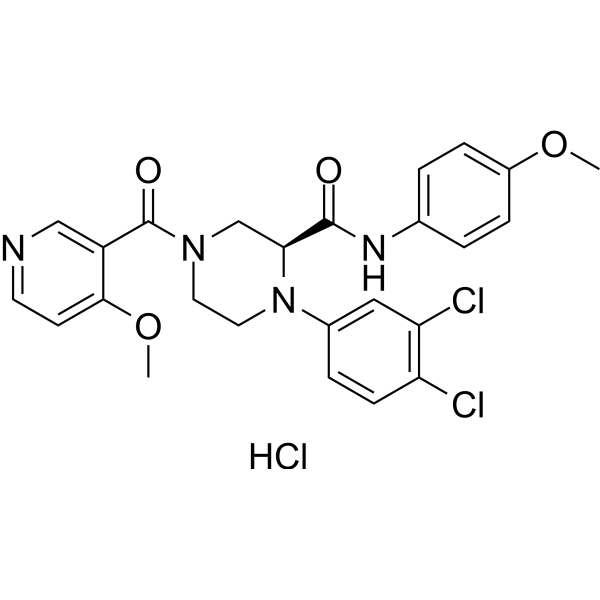
GC-78-HCl
GC-78-HCl is an orally and nonpeptidic SARS-CoV-2 Mpro inhibitor, with an IC50 of 0.19 μM for enzyme. GC-78-HCl has excellent antiviral activity and favorable pharmacokinetic properties.
Para uso exclusivo en investigación. No vendemos a pacientes.
- No. CAS: 3022242-53-8
- Fòrmula: C25H25Cl3N4O4
- Peso molecular:551.85
-
Almacenamiento:
Please store the product under the recommended conditions in the Certificate of Analysis.

To place orders, for customer services and technical support, please contact: MedChemExpress USA
Tel: 609-228-6898 E-mail: [email protected] [email protected]


-
 Actividad biológica
-
Chemical Information
- Protocolo
- Pureza y Documentación
- Referencias
-
 Help & FAQs




Actividad biológica
Descripciòn
IC50 & Target
EC50 Tatget: SARS-CoV[1] EC50: 0.40 μM (SARS-CoV-2), 0.21 ± 0.030 μM (wild-type), 0.21 ± 0.080 μM (Alpha), 0.24 ± 0.080 μM (Delta), 0.25 ± 0.060 μM (Omicron B.1)[1]
Cellular Effect
|
Cell Line

|
Type | Value | Description | References |
|---|---|---|---|---|
| Vero C1008 | CC50 |
86 μM
Compound: GC-78-HCl
|
Cytotoxicity in African green monkey Vero E6 cells measured after 25 days by Neutral red release assay
Cytotoxicity in African green monkey Vero E6 cells measured after 25 days by Neutral red release assay
|
[PMID: 37992202] |
In Vitro
GC-78-HCl (0.01-10 μM) has low cytotoxicity in Vero E6 cells[1].
GC-78-HCl exhibits potent antiviral activity against SARS-CoV-2 variants and other human coronaviruses in MRC-5/Vero E6 cells, indicates its potential broad-spectrum anticoronaviral activity[1].
GC-78-HCl (50 μM) has no inhibitory activity against human cathepsins B/F/K/L and Caspase 3, indicates high target specificity toward coronavirus proteases[1].
MedChemExpress (MCE) has not independently confirmed the accuracy of these methods. They are for reference only.
In Vivo
MedChemExpress (MCE) has not independently confirmed the accuracy of these methods. They are for reference only.
-
Animal Model:Sprague−Dawley rats[1]
-
Dosage:2 mg/kg
-
Administration:Intravenous injection (i.v.)
-
Result:With the clearance rate (CL) of 4343 mL/h/kg.
With half-life (t1/2) of 0.46 h.
-
Animal Model:Sprague−Dawley rats[1]
-
Dosage:10 mg/kg
-
Administration:Oral gavage (p.o.)
-
Result:With half-life (t1/2) of 1.64 h.
With time-to-maximum concentration (Tmax) of 1.17 h.
With maximum concentration (Cmax) of 148 ng/mL.
With an area under curve (AUC0‑t) of 465 ng•h/mL.
-
Animal Model:Kunming rats[1]
-
Dosage:800 mg/kg
-
Administration:Oral gavage (p.o.)
-
Result:Exhibited no significant change in mice weight.


Chemical Information
-
No. CAS 3022242-53-8
-
Peso molecular 551.85
-
Fòrmula C25H25Cl3N4O4
-
SMILES
O=C([C@@H]1CN(CCN1C2=CC(Cl)=C(Cl)C=C2)C(C3=CN=CC=C3OC)=O)NC4=CC=C(C=C4)OC.Cl
-
Envío
Room temperature in continental US; may vary elsewhere.
-
Almacenamiento
Please store the product under the recommended conditions in the Certificate of Analysis.


Pureza y Documentación
Referencias

Calculators
Concentration (start) × Volume (start) = Concentration (final) × Volume (final)


GC-78-HCl Related Classifications
HY-149774 Related Classifications
 Powered by Bioz