



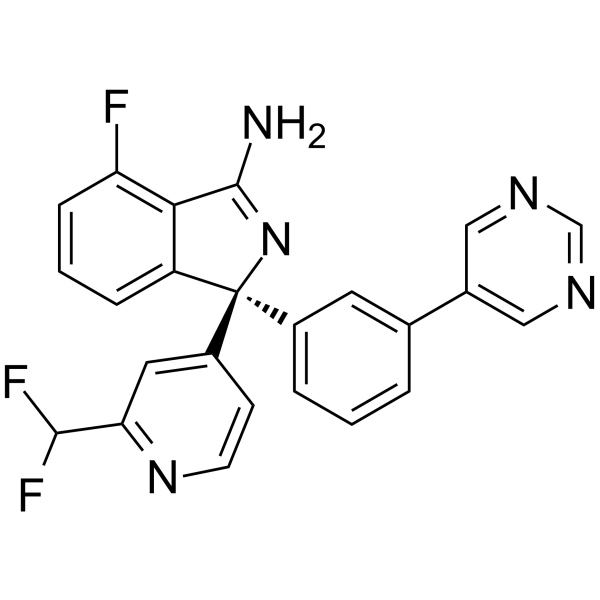
AZD3839 free base
Based on 2 publication(s) in Google Scholar
AZD3839 is an orally available, selective, reversible inhibitor of the β-site amyloid precursor protein cleaving enzyme BACE1 that can cross the blood-brain barrier. AZD3839 inhibits recombinant human BACE1 with a Ki=26.1 nM. AZD3839 inhibits A40 production in SH-SY5Y cells with an IC50 of 4.8 nM. AZD3839 binds to BACE1 and reduces the Aβ amyloid produced by the cleavage of amyloid precursor protein (APP) by BACE1 and γ-secretase. AZD3839 can be used in the field of Alzheimer's disease research.
For research use only. We do not sell to patients.
- Purity: 99.97%
- CAS No.: 1227163-84-9
- Formula: C24H16F3N5
- Molecular Weight:431.41
-
Storage:Powder -20°C, 3 years , 4°C, 2 years ; In solvent -80°C, 2 years , -20°C, 1 year


-
 Biological Activity
-
Chemical Information
-
Solvent & Solubility
- Purity & Documentation
- References
-
 Help & FAQs
-

Neuronal Signaling Compound Library
HY-L013
-
Clinical Compound Library
HY-L026
-
CNS-Penetrant Compound Library
HY-L028
-
Orally Active Compound Library
HY-L061
-
Anti-Alzheimer's Disease Compound Library
HY-L069
-
Neurodegenerative Disease-related Compound Library
HY-L086
-
Heterocyclic Compound Library
HY-L138
-
Protease Inhibitor Library
HY-L147
-
Highly Selective Inhibitors Library
HY-L158
-
Bioactive Compound Library Max
HY-L181
-
MCE Bioactive Compound Library
HY-L001V
-
Clinical Compound Library Plus
HY-L026P
-
Bioactive Compound Library
HY-L001
-
High-Throughput Bioactive Compound Library
HY-L205


Publications Citing Use of MedChemExpress (MCE) AZD3839 free base
More

Biological Activity
|
BACE1 |
|
Cell Line

|
Type | Value | Description | References |
|---|---|---|---|---|
| Cerebral cortex neuron | IC50 |
51 nM
Compound: (S)-32
|
Inhibition of BACE1-mediated amyloid beta 40 release in C57/BL6 mouse primary cortical neurons after overnight incubation by ELISA
Inhibition of BACE1-mediated amyloid beta 40 release in C57/BL6 mouse primary cortical neurons after overnight incubation by ELISA
|
[PMID: 22924815] |
| CHO | IC50 |
4.8 μM
Compound: (S)-32
|
Inhibition of human ERG expressed in CHO cells by IonWorks assay
Inhibition of human ERG expressed in CHO cells by IonWorks assay
|
[PMID: 22924815] |
| SH-SY5Y | IC50 |
16.7 nM
Compound: (S)-32
|
Inhibition of BACE1 in human SH-SY5Y cells assessed as inhibition of sAPPbeta release after 16 hrs by immunoassay
Inhibition of BACE1 in human SH-SY5Y cells assessed as inhibition of sAPPbeta release after 16 hrs by immunoassay
|
[PMID: 22924815] |
In the hBACE1 and hBACE2 time-resolved fluorescence resonance energy transfer (TR-FRET) experiment, AZD3839 free base can inhibit the cleavage of APP sequence by recombinant human BACE1 in a concentration-dependent manner and inhibit the activity of BACE2. The inhibitory effect on BACE1 is 14 times stronger than that on BACE2[1].
AZD3839 free base can effectively reduce the levels of A40 or sAPPβ secreted by the corresponding cells or neurons in the SH-SY5Y sAPPβ release assay, SH-SY5Y A40 release assay, N2A A40 release assay, mouse primary neuron A40 release assay, and guinea pig primary neuron A40 release assay, and the IC50 values ??in different cells are different. For example, the IC50 for inhibiting A40 levels in SH-SY5Y cells is 4.8 nM, and that in mouse primary neurons is 50.9 nM[1].
MedChemExpress (MCE) has not independently confirmed the accuracy of these methods. They are for reference only.
-
Cell Line:SH-SY5Y
-
Concentration:IC50
-
Incubation Time:16 h
-
Result:Significantly reduced the levels of A40 and sAPPβ secreted by SH-SY5Y cells with IC50s of 4.8 nM, and 16.7 nM.
There was no mention of effects on cell viability, cell apoptosis, cell cycle, WB, qPCR, cell migration, or IF experiments in the document, so no relevant conclusions can be drawn in this regard.
AZD3839 free base (100 μmol/kg; oral gavage; twice a day; 7 days) inhibits the level and accumulation of Aβ40 in the mouse brain and plasma in the female C57BL/6 mouse model[1].
AZD3839 free base (100 μmol/kg, 200 μmol/kg; oral gavage; single dose) reduces the levels of Aβ40 and Aβ42 in plasma, brain and cerebrospinal fluid of guinea pigs in a concentration- and time-dependent manner in the male Dunkin-Hartley guinea pig model[1].
AZD3839 free base (5.5 μmol/kg, 20 μmol/kg; intravenous injection; single dose) significantly reduces the levels of Aβ40, Aβ42 and sAPP in the cerebrospinal fluid of 3-5 year old female cynomolgus monkeys[1].
MedChemExpress (MCE) has not independently confirmed the accuracy of these methods. They are for reference only.
-
Animal Model:Female C57BL/6 mice (11-14 weeks old)[1]
-
Dosage:80 μmol/kg (35 mg/kg), 160 μmol/kg (69 mg/kg), 100 μmol/kg (43 mg/kg)
-
Administration:80 μmol/kg (35 mg/kg), 160 μmol/kg (69 mg/kg) as a single dose; 100 μmol/kg (43 mg/kg) as repeated doses twice daily for 7 days (dissolved in 5% dimethylacetamide and 20% hydroxypropyl-β-cyclodextrin in 0.3 M gluconic acid, pH 3, or 0.3 M gluconic acid, pH 3 alone)
-
Result:Treated with a single dose of 80 μmol/kg or 160 μmol/kg, the brain concentration of AZD3839 peaked at 0.5 h after dosing. Brain Aβ40 levels decreased by 30% (80 μmol/kg dose) or 50% (160 μmol/kg dose) versus vehicle at 1.5 h after dose, and returned to baseline after 4.5 h (80 μmol/kg) or 8 h (160 μmol/kg).
The levels of brain Aβ42 and sAPP followed the same pattern as Aβ40. Both doses reduced plasma levels of Aβ40 by 60% versus vehicle over a prolonged period.
At 8 h after administration, the inhibitory effect started to decline within the low dose group, while maximal efficacy was maintained within the high dose group.
When treated with 100 μmol/kg twice daily for 7 days, the effect on brain and plasma Aβ40 was comparable to a single administration, and no drug accumulation was observed.
-
Animal Model:Male Dunkin-Hartley guinea pigs (4-9 weeks old)
-
Dosage:100 μmol/kg (43 mg/kg), 200 μmol/kg (86 mg/kg)
-
Administration:Oral gavage; 100 μmol/kg (43 mg/kg), 200 μmol/kg (86 mg/kg) as a single dose (dissolved in 20% hydroxypropyl-β-cyclodextrin in 0.3 M gluconic acid, pH 3)
-
Result:After a single dose of 100 μmol/kg or 200 μmol/kg, brain Aβ40 was reduced up to 8 h after the dose in animals receiving the higher dose (20-60% versus vehicle), while guinea pigs receiving the lower dose demonstrated a reduction at 1.5-4.5 h after dose (20-30% versus vehicle).
Reduced CSF Aβ40 levels by 50% at 3 h after 200 μmol/kg dose, and still reduced the levels were by 40% at 8 h after dose, although the reduction failed to reach statistical significance at this later time point.
-
Animal Model:Female cynomolgus monkeys (3-5 years old)[1]
-
Dosage:5.5 μmol/kg (2.4 mg/kg), 20 μmol/kg (8.6 mg/kg)
-
Administration:Intravenous injection via an implanted cannula in the vena cava at a constant infusion rate of 10 ml/kg/h for 15 min; single dose; dissolved in 0.3 M gluconic acid, pH 3.89
-
Result:Despite a large variation in the basal CSF levels of Aβ40, Aβ42, and sAPP, an intravenous infusion of 20 μmol/kg AZD3839 significantly reduced the levels of Aβ40, Aβ42, and sAPP in CSF between 3 and 12 h after dose. The inhibitory effect on sAPP was more pronounced than the effect
| NCT Number | Sponsor | Condition | Start Date |
Phase
|
|---|---|---|---|---|
| NCT01329991 | Plexxikon| | 2011-05 | PHASE1 |


Chemical Information
-
CAS No. 1227163-84-9
-
Appearance Solid
-
Molecular Weight 431.41
-
Formula C24H16F3N5
-
Color White to off-white
-
SMILES
FC1=C2C([C@](C3=CC=CC(C4=CN=CN=C4)=C3)(C5=CC(C(F)F)=NC=C5)N=C2N)=CC=C1
-
Shipping
Room temperature in continental US; may vary elsewhere.
-
Storage
Powder -20°C 3 years 4°C 2 years In solvent -80°C 2 years -20°C 1 year


Publications (2)
-
Journal Impact Factor
-
Most Recent
-
Neuron
Differential and substrate-specific inhibition of γ-secretase by the C-terminal region of ApoE2, ApoE3, and ApoE4. [Abstract]2023 Jun 21;111(12):1898-1913.e5. PMID: 37040764 -
Cytokine
Shedding new light on BACE1-mediated modulation of IL-6 signaling: Implications for neural activity and synaptic plasticity in mice. [Abstract]2025 Apr 3:190:156925. PMID: 40184913


Solvent & Solubility
DMSO : 125 mg/mL (289.75 mM; Need ultrasonic; Hygroscopic DMSO has a significant impact on the solubility of product, please use newly opened DMSO)
Please refer to the solubility information to select the appropriate solvent. Once prepared, please aliquot and store the solution to prevent product inactivation from repeated freeze-thaw cycles.
Storage method and period of stock solution: -80°C, 2 years; -20°C, 1 year. When stored at -80°C, please use it within 2 years. When stored at -20°C, please use it within 1 year.
Please refer to the solubility information to select the appropriate solvent. Once prepared, please aliquot and store the solution to prevent product inactivation from repeated freeze-thaw cycles.
Storage method and period of stock solution: -80°C, 2 years; -20°C, 1 year. When stored at -80°C, please use it within 2 years. When stored at -20°C, please use it within 1 year.
Concentration (start) × Volume (start) = Concentration (final) × Volume (final)
Select the appropriate dissolution method based on your experimental animal and administration route.
- For the following dissolution methods, please ensure to first prepare a clear stock solution using an In Vitro approach and then sequentially add co-solvents:
- To ensure reliable experimental results, the clarified stock solution can be appropriately stored based on storage conditions. As for the working solution for In Vivo experiments, it is recommended to prepare freshly and use it on the same day.
- The percentages shown for the solvents indicate their volumetric ratio in the final prepared solution. If precipitation or phase separation occurs during preparation, heat and/or sonication can be used to aid dissolution.
Add each solvent one by one: 10% DMSO 40% PEG300 5% Tween-80 45% Saline
Solubility: ≥ 2.08 mg/mL (4.82 mM); Clear solution
This protocol yields a clear solution of ≥ 2.08 mg/mL (saturation unknown).
Taking 1 mL working solution as an example, add 100 μL DMSO stock solution (20.8 mg/mL) to 400 μL PEG300, and mix evenly; then add 50 μL Tween-80 and mix evenly; then add 450 μL Saline to adjust the volume to 1 mL.
Preparation of Saline: Dissolve 0.9 g sodium chloride in ddH₂O and dilute to 100 mL to obtain a clear Saline solution.
Add each solvent one by one: 10% DMSO 90% (20% SBE-β-CD in Saline)
Solubility: ≥ 2.08 mg/mL (4.82 mM); Clear solution
This protocol yields a clear solution of ≥ 2.08 mg/mL (saturation unknown).
Taking 1 mL working solution as an example, add 100 μL DMSO stock solution (20.8 mg/mL) to 900 μL 20% SBE-β-CD in Saline, and mix evenly.
Preparation of 20% SBE-β-CD in Saline (4°C, storage for one week): 2 g SBE-β-CD powder is dissolved in 10 mL Saline, completely dissolve until clear.
Please enter the basic information of animal experiments:
-
-
-
-
Recommended: Prepare an additional quantity of animals to account for potential losses during experiments.
Please enter your animal formula composition:
-
%DMSO +
Recommended: Keep the proportion of DMSO in working solution below 2% if your animal is weak.
-
%+
-
+%Tween-80 + +
-
%Saline +
The co-solvents required include: DMSO, . All of co-solvents are available by MedChemExpress (MCE). , Tween 80. All of co-solvents are available by MedChemExpress (MCE).
Working solution concentration: 0.22 mg/mL
Method for preparing stock solution: mg drug dissolved in μL DMSO. Stock solution concentration: mg/mL.
1. Take μL DMSO stock solution;
2. Add μL .
μL , mix evenly;
3. Then add μL Tween 80, mix evenly;
4. Then add μL
Please ensure that the stock solution in the first step is dissolved to a clear state, and add co-solvents in sequence. You can use ultrasonic heating (ultrasonic cleaner, recommended frequency 20-40 kHz), vortexing, etc. to assist dissolution.


Purity & Documentation
-
Data Sheet (290 KB)
-
SDS (392 KB)
- English - EN (392 KB)
- Français - FR (392 KB)
- Deutsch - DE (392 KB)
- Norwegian - NO (392 KB)
- Español - ES (392 KB)
- Swedish - SV (392 KB)
- Italian - IT (392 KB)
- Korean - KR (392 KB)
- Portuguese - PT (392 KB)
-
Handling Instructions (2659 KB)
References
[1]. Sparve E et al. Prediction and modeling of effects on the QTc interval for clinical safety margin assessment, based on single-ascending-dose study data with AZD3839. J Pharmacol Exp Ther. 2014 Aug;350(2):469-78. [Content Brief]
[2]. Jeppsson F et al. Discovery of AZD3839, a potent and selective BACE1 inhibitor clinical candidate for the treatment of Alzheimer disease. J Biol Chem. 2012 Nov 30;287(49):41245-57. [Content Brief]
[3]. Eketjäll S, et al. AZD3293: A Novel, Orally Active BACE1 Inhibitor with High Potency and Permeability and Markedly Slow Off-Rate Kinetics. J Alzheimers Dis. 2016;50(4):1109-23. [Content Brief]


Complete Stock Solution Preparation Table
Please refer to the solubility information to select the appropriate solvent. Once prepared, please aliquot and store the solution to prevent product inactivation from repeated freeze-thaw cycles.
Storage method and period of stock solution: -80°C, 2 years; -20°C, 1 year. When stored at -80°C, please use it within 2 years. When stored at -20°C, please use it within 1 year.
| Optional Solvent | Concentration Solvent Mass | 1 mg | 5 mg | 10 mg | 25 mg |
|---|---|---|---|---|---|
| DMSO | 1 mM | 2.3180 mL | 11.5899 mL | 23.1798 mL | 57.9495 mL |
| 5 mM | 0.4636 mL | 2.3180 mL | 4.6360 mL | 11.5899 mL | |
| 10 mM | 0.2318 mL | 1.1590 mL | 2.3180 mL | 5.7950 mL | |
| 15 mM | 0.1545 mL | 0.7727 mL | 1.5453 mL | 3.8633 mL | |
| 20 mM | 0.1159 mL | 0.5795 mL | 1.1590 mL | 2.8975 mL | |
| 25 mM | 0.0927 mL | 0.4636 mL | 0.9272 mL | 2.3180 mL | |
| 30 mM | 0.0773 mL | 0.3863 mL | 0.7727 mL | 1.9317 mL | |
| 40 mM | 0.0579 mL | 0.2897 mL | 0.5795 mL | 1.4487 mL | |
| 50 mM | 0.0464 mL | 0.2318 mL | 0.4636 mL | 1.1590 mL | |
| 60 mM | 0.0386 mL | 0.1932 mL | 0.3863 mL | 0.9658 mL | |
| 80 mM | 0.0290 mL | 0.1449 mL | 0.2897 mL | 0.7244 mL | |
| 100 mM | 0.0232 mL | 0.1159 mL | 0.2318 mL | 0.5795 mL |


 Powered by Bioz