



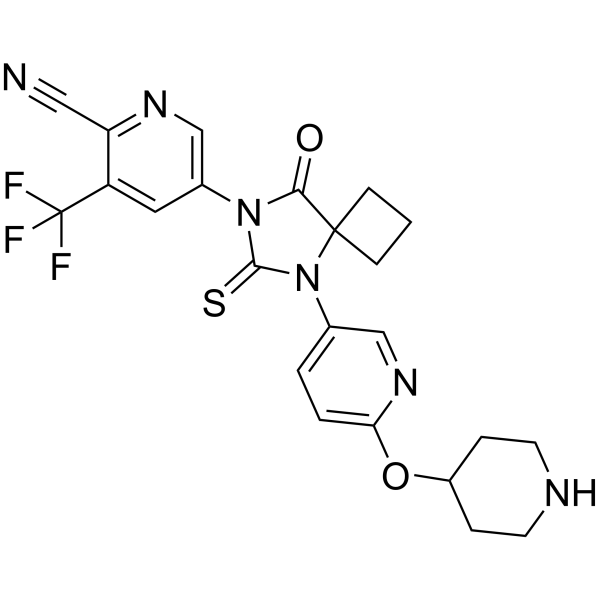
JNJ-63576253 free base
Based on 1 publication(s) in Google Scholar
JNJ-63576253 (TRC-253) free base is a potent and orally active full antagonist of androgen receptor (AR), with IC50s of 37 and 54 nM for F877L mutant AR and wild-type AR in LNCaP cells. JNJ-63576253 free base can be used for the research of castration-resistant prostate cancer (CRPC).
Para uso exclusivo en investigación. No vendemos a pacientes.
- No. CAS: 2110426-27-0
- Fòrmula: C23H21F3N6O2S
- Peso molecular:502.51
-
Almacenamiento:
Please store the product under the recommended conditions in the Certificate of Analysis.

To place orders, for customer services and technical support, please contact: MedChemExpress USA
Tel: 609-228-6898 E-mail: [email protected] [email protected]


-
 Actividad biológica
-
Chemical Information
- Protocolo
- Pureza y Documentación
- Referencias
-
 Help & FAQs


Publications Citing Use of MedChemExpress (MCE) JNJ-63576253 free base
More

Actividad biológica
Descripciòn
IC50 & Target
IC50: 37 nM (F877L mutant AR in LNCaP cells); 54 nM (wild-type AR in LNCaP cells)[1]
Cellular Effect
|
Cell Line

|
Type | Value | Description | References |
|---|---|---|---|---|
| VCaP | IC50 |
265 nM
Compound: 5; JNJ-63576253
|
Antiproliferative activity against human VCaP cells expressing wild-type androgen receptor assessed as reduction in cell viability incubated for 5 days in presence of R1881 by CellTiter-glo assay
Antiproliferative activity against human VCaP cells expressing wild-type androgen receptor assessed as reduction in cell viability incubated for 5 days in presence of R1881 by CellTiter-glo assay
|
[PMID: 33470111] |
| VCaP | IC50 |
290 nM
Compound: 110; JNJ-63576253
|
Antiproliferative activity against human VCaP cells
Antiproliferative activity against human VCaP cells
|
[PMID: 35786895] |
In Vitro
In Vivo
JNJ-63576253 (30 mg/kg; p.o. once daily for 10 days) inhibits the five androgen sensitive organs (ASOs) under stimulation by testosterone propionate (TP) in mice[1].
JNJ-63576253 (10 mg/kg; p.o.) exhibits moderate oral bioavailability (45%), Cmax (0.66 μM) and AUClast (4.9 μg h/mL) in mice[1].
JNJ-63576253 (2 mg/kg; i.v.) exhibits reasonable half-life (5.99 h), CL (15.0 mL/min/kg) and Vdss (6.11 L/kg) in mice[1].
MedChemExpress (MCE) has not independently confirmed the accuracy of these methods. They are for reference only.
-
Animal Model:Castrated SHO mice with prostate LNCaP SRα F877L tumor[1]
-
Dosage:30 mg/kg
-
Administration:P.o. once daily for 72 days
-
Result:Inhibited the tumor growth by 87%.
-
Animal Model:CD-1 male mice[1]
-
Dosage:2 mg/kg for i.v.; 10 mg/kg for p.o. (Pharmacokinetic Analysis)
-
Administration:Intravenous administration and oral administration
-
Result:I.v.: T1/2=5.99 h; CL=15.0 mL/min/kg; Vdss=6.11 L/kg.
P.o.: F=45%; Cmax=0.66 μM; AUClast=4.9 μg•h/mL.


Chemical Information
-
No. CAS 2110426-27-0
-
Peso molecular 502.51
-
Fòrmula C23H21F3N6O2S
-
SMILES
O=C(N(C(N1C2=CC=C(N=C2)OC3CCNCC3)=S)C(C=C4C(F)(F)F)=CN=C4C#N)C51CCC5
-
Synonyms
TRC-253 free base
-
Envío
Room temperature in continental US; may vary elsewhere.
-
Almacenamiento
Please store the product under the recommended conditions in the Certificate of Analysis.


Publications (1)
-
Journal Impact Factor
-
Most Recent
-
Eur J Med Chem
Elevated labile iron in castration-resistant prostate cancer is targetable with ferrous iron-activatable antiandrogen therapy. [Abstract]2023 Mar 5:249:115110. PMID: 36708680


Pureza y Documentación
Referencias

Calculators
Concentration (start) × Volume (start) = Concentration (final) × Volume (final)


JNJ-63576253 free base Related Classifications
HY-115282 Related Classifications
 Powered by Bioz