



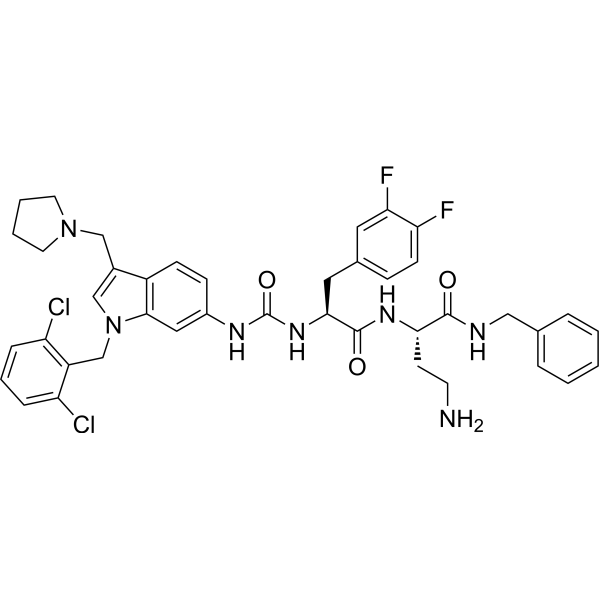
RWJ-56110
RWJ-56110 is a potent, selective, peptide-mimetic inhibitor of PAR-1 activation and internalization (binding IC50=0.44 uM) and shows no effect on PAR-2, PAR-3, or PAR-4. RWJ-56110 inhibits the aggregation of human platelets induced by both SFLLRN-NH2 (IC50=0.16 μM) and thrombin (IC50=0.34 μM), quite selective relative to U46619 (HY-108566). RWJ-56110 inhibits angiogenesis and blocks the formation of new vessels in vivo. RWJ-56110 induces cell apoptosis.
For research use only. We do not sell to patients.
- CAS No.: 252889-88-6
- Formula: C41H43Cl2F2N7O3
- Molecular Weight:790.73
-
Storage:
Please store the product under the recommended conditions in the Certificate of Analysis.

To place orders, for customer services and technical support, please contact: MedChemExpress USA
Tel: 609-228-6898 E-mail: [email protected] [email protected]


-
 Biological Activity
-
Chemical Information
- Purity & Documentation
- References
-
 Help & FAQs




Biological Activity
|
PAR1 .4 μM (IC50) |
Proteinase-activated receptors (PARs) are a family of G protein-coupled receptors activated by the proteolytic cleavage of their N-terminal extracellular domain, exposing a new amino terminal sequence that functions as a tethered ligand to activate the receptors. RWJ56110 inhibits the aggregation of human platelets induced by both SFLLRN-NH2 (IC50=0.16 μM) and thrombin (IC50=0.34 μM) while being quite selective relative to collagen and the thromboxane mimetic U46619 (HY-108566)[1].RWJ-56110 is fully inhibits thrombin-induced RASMC proliferation with an IC50 value of 3.5 μM. RWJ-56110 shows blockade of thrombin’s action with RASMC calcium mobilization (IC50=0.12 μM), as well as with HMVEC (IC50=0.13 μM) and HASMC calcium mobilization (IC50=0.17 μM)[1].RWJ56110 (0.1-10 μM; 24-96 hours) inhibits endothelial cell growth dose-dependently, with half-maximal inhibitory concentration of RWJ56110 is approximately 10 μM[2].RWJ56110 (0.1-10 μM; 6 hours) inhibits DNA synthesis of endothelial cells in a thymidine incorporation assays. Endothelial cells are in fast-growing state (50-60% confluence), RWJ56110 inhibits cell DNA synthesis in a dose-dependent manner, but when cells that are in the quiescent state (100% confluent), the inhibitory effect of PAR-1 antagonists is much less pronounced[2].RWJ56110 (0.1-10 μM; pretreatment for 15 min) inhibits thrombin-induced Erk1/2 activation in a concentration-dependent manner. However, when endothelial cells are stimulated by FBS (final concentration 4%), it reduces partially the activated levels of Erk1/2[2].RWJ56110 (30 μM; 24 hours) has an inhibitory effect on endothelial cell cycle progression. It reduces the percentage of cells in the S phase, while alterations in the percentages of G1 and G2/M cells are less pronounced[2].
MedChemExpress (MCE) has not independently confirmed the accuracy of these methods. They are for reference only.
-
Cell Line:Endothelial cells
-
Concentration:0 μM; 3 μM; 1 μM; 3 μM; 10 μM
-
Incubation Time:Pretreatment for 15 min
-
Result:Resulted in MAPK activation in Endothelial cells.
-
Cell Line:Endothelial cells
-
Concentration:0 μM; 3 μM; 1 μM; 3 μM; 10 μM
-
Incubation Time:Pretreatment for 15 min
-
Result:Reduced cell number in S phase.


Chemical Information
-
CAS No. 252889-88-6
-
Molecular Weight 790.73
-
Formula C41H43Cl2F2N7O3
-
SMILES
O=C(N[C@H](C(NCC1=CC=CC=C1)=O)CCN)[C@@H](NC(NC2=CC3=C(C=C2)C(CN4CCCC4)=CN3CC5=C(Cl)C=CC=C5Cl)=O)CC6=CC=C(F)C(F)=C6
-
Shipping
Room temperature in continental US; may vary elsewhere.
-
Storage
Please store the product under the recommended conditions in the Certificate of Analysis.


Purity & Documentation
References
[1]. Andrade-Gordon, et al.Design, synthesis, and biological characterization of a peptide-mimetic antagonist for a tethered-ligand receptor. oc Natl Acad Sci U S A. 1999 Oct 26;96(22):12257-62. [Content Brief]
[2]. Panagiota Zania, et al. Blockade of angiogenesis by small molecule antagonists to protease-activated receptor-1: association with endothelial cell growth suppression and induction of apoptosis. J Pharmacol Exp Ther. 2006 Jul;318(1):246-54. [Content Brief]

Calculators
Concentration (start) × Volume (start) = Concentration (final) × Volume (final)


RWJ-56110 Related Classifications
HY-108556 Related Classifications
 Powered by Bioz