



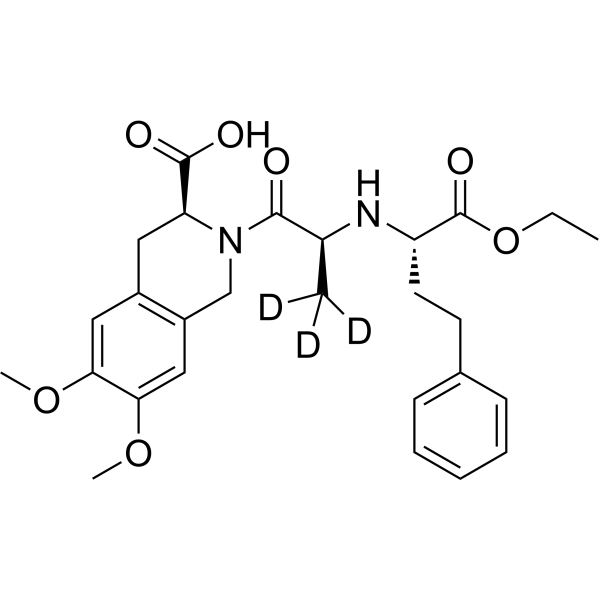
Moexipril-d3
Moexipril-d3 is deuterated labeled Moexipril (HY-117281). Moexipril is an orally active inhibitor of angiotensin-converting enzyme (ACE), and becomes effective by being hydrolyzed to moexiprila hydrochloride. Moexipril exhibits antihypertensive and neuroprotective effects-.
For research use only. We do not sell to patients.
- Formula: C27H31D3N2O7
- Molecular Weight:501.59
-
Storage:
Please store the product under the recommended conditions in the Certificate of Analysis.

To place orders, for customer services and technical support, please contact: MedChemExpress USA
Tel: 609-228-6898 E-mail: [email protected] [email protected]


-
 Biological Activity
-
Chemical Information
- Purity & Documentation
- References
-
 Help & FAQs




Biological Activity
Description
In Vitro
Stable heavy isotopes of hydrogen, carbon, and other elements have been incorporated into drug molecules, largely as tracers for quantitation during the drug development process. Deuteration has gained attention because of its potential to affect the pharmacokinetic and metabolic profiles of drugs[1].
Moexipril is devoid of anti-inflammatory properties and has no effect on platelet function[3].
Moexipril hydrolyzes to Moexiprilat, and Moexiprilat inhibits ACE in guinea pig serum as well as on purified ACE from rabbit lung with IC50s of 2.6 nM and 4.9 nM, respectively[3].
Moexipril (0.01 nM-0.1 mM) exhibits high potency against both ACE in rats plasma and purified ACE from rabbit lung, with IC50s of 1.75 nM and 2.1 nM, respectively[4].
Moexipril (0-100 μM, 24 h) significantly reduced the percentage of damaged neurons in a dose-dependent manner[5].
Moexipril (0-100 μM, 24 h) significantly attenuates Fe2+/3+-induced neurotoxicity[5].
Moexipril dose not cause significant changes in the percentage of apoptotic neurons[5].
MedChemExpress (MCE) has not independently confirmed the accuracy of these methods. They are for reference only.
In Vivo
Moexipril (3 mg/kg, 30 mg/kg and 10 mg/kg; p.o.; once daily; 5 days) exhibits a dose-dependent and antihypertensive effects in renal hypertensive rats, spontaneously hypertensive rats and perinephritic hypertensive dogs, respectively[4].
Moexipril (0.3 mg/kg, i.p.) significantly reduces the infarct area on the mouse brain surface in NMRI mice[5].
Moexipril (0.1 mg/kg, i.p.) significantly attenuates the cortical infarct volume in Long-Evans rats[5].
MedChemExpress (MCE) has not independently confirmed the accuracy of these methods. They are for reference only.
Application
1. This compound can be used as a tracer
2. This compound can be used as an internal standard for quantitative analysis by NMR, GC-MS, or LC-MS.


Chemical Information
-
Unlabeled CAS 103775-10-6
-
Molecular Weight 501.59
-
Formula C27H31D3N2O7
-
SMILES
O=C([C@H]1N(C([C@@H](N[C@H](C(OCC)=O)CCC2=CC=CC=C2)C([2H])([2H])[2H])=O)CC3=C(C=C(OC)C(OC)=C3)C1)O
-
Shipping
Room temperature in continental US; may vary elsewhere.
-
Storage
Please store the product under the recommended conditions in the Certificate of Analysis.


Purity & Documentation
References
[1]. Russak EM, et al. Impact of Deuterium Substitution on the Pharmacokinetics of Pharmaceuticals. Ann Pharmacother. 2019 Feb;53(2):211-216. [Content Brief]
[2]. Chrysant, S.G. and G.S. Chrysant, Pharmacological and clinical profile of moexipril: a concise review. J Clin Pharmacol, 2004. 44(8): p. 827-36. [Content Brief]
[3]. Friehe H, et al. Pharmacological and toxicological studies of the new angiotensin converting enzyme inhibitor moexipril hydrochloride. Arzneimittelforschung. 1997 Feb. 47(2):132-44. [Content Brief]
[4]. Edling O, et al. Moexipril, a new angiotensin-converting enzyme (ACE) inhibitor: pharmacological characterization and comparison with enalapril. J Pharmacol Exp Ther. 1995 Nov;275(2):854-63. [Content Brief]
[5]. Ravati A, et al. Enalapril and moexipril protect from free radical-induced neuronal damage in vitro and reduce ischemic brain injury in mice and rats. Eur J Pharmacol. 1999 May 28;373(1):21-33. [Content Brief]

Calculators
Concentration (start) × Volume (start) = Concentration (final) × Volume (final)


Moexipril-d3 Related Classifications
HY-117281S1 Related Classifications
 Powered by Bioz