



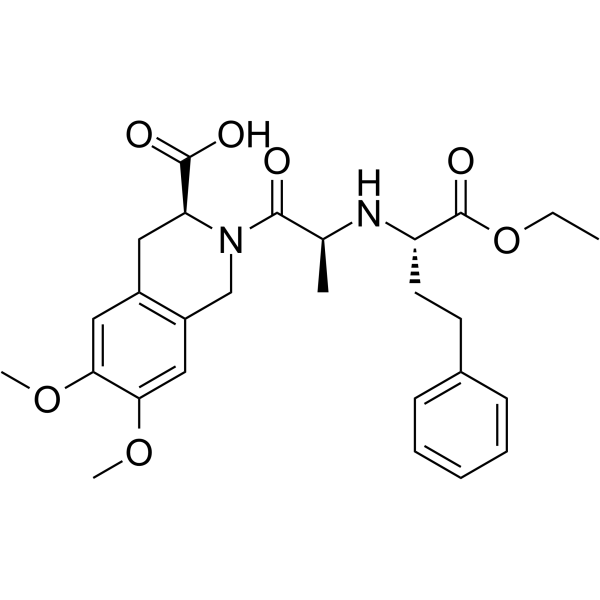
Moexipril
Moexipril is an orally active inhibitor of angiotensin-converting enzyme (ACE), and becomes effective by being hydrolyzed to moexiprila (hydrochloride). Moexipril exhibits antihypertensive and neuroprotective effects-.
For research use only. We do not sell to patients.
- CAS No.: 103775-10-6
- Formula: C27H34N2O7
- Molecular Weight:498.57
-
Storage:
Please store the product under the recommended conditions in the Certificate of Analysis.

To place orders, for customer services and technical support, please contact: MedChemExpress USA
Tel: 609-228-6898 E-mail: [email protected] [email protected]


-
 Biological Activity
-
Chemical Information
- Purity & Documentation
- References
-
 Help & FAQs




Biological Activity
Description
IC50 & Target
IC50: 2.1 nM (purified ACE from rabbit lung), 1.75 nM (ACE in rat plasma)[3]
In Vitro
Moexipril is devoid of anti-inflammatory properties and has no effect on platelet function[2].
Moexipril hydrolyzes to Moexiprilat, and Moexiprilat inhibits ACE in guinea pig serum as well as on purified ACE from rabbit lung with IC50s of 2.6 nM and 4.9 nM, respectively[2].
Moexipril (0.01 nM-0.1 mM) exhibits high potency against both ACE in rats plasma and purified ACE from rabbit lung, with IC50s of 1.75 nM and 2.1 nM, respectively[3].
Moexipril (0-100 μM, 24 h) significantly reduced the percentage of damaged neurons in a dose-dependent manner[4].
Moexipril (0-100 μM, 24 h) significantly attenuates Fe2+/3+-induced neurotoxicity[4].
Moexipril dose not cause significant changes in the percentage of apoptotic neurons[4].
MedChemExpress (MCE) has not independently confirmed the accuracy of these methods. They are for reference only.
In Vivo
Moexipril (3 mg/kg, 30 mg/kg and 10 mg/kg; p.o.; once daily; 5 days) exhibits a dose-dependent and antihypertensive effects in renal hypertensive rats, spontaneously hypertensive rats and perinephritic hypertensive dogs, respectively[3].
Moexipril (0.3 mg/kg, i.p.) significantly reduces the infarct area on the mouse brain surface in NMRI mice[4].
Moexipril (0.1 mg/kg, i.p.) significantly attenuates the cortical infarct volume in Long-Evans rats[4].
MedChemExpress (MCE) has not independently confirmed the accuracy of these methods. They are for reference only.
-
Animal Model:Spontaneously hypertensive rats[3]
-
Dosage:30 mg/kg
-
Administration:Oral gavage; once daily; 5 days
-
Result:Caused a progressive lowering of mean blood pressure from pretreatment values of 180 +/- 7 mmHg to a trough on day 4 of 127 +/- 4 mmHg.
Dose-dependently decreased arterial blood pressure, and inhibited plasma and tissue ACE activity.
-
Animal Model:Renal hypertensive rats[3]
-
Dosage:0.03-10 mg/kg
-
Administration:Oral gavage; once daily; 5 days
-
Result:Caused a dose-dependent decrease in blood pressure with a threshold dose of 0.3 mg/kg.
Lowered mean blood pressure by about 70 mmHg of 3 mg/kg.
-
Animal Model:Perinephritic hypertensive dogs[3]
-
Dosage:10 mg/kg
-
Administration:Oral gavage; once daily; 5 days
-
Result:Caused a drop of mean blood pressure by 25 mmHg from pre-treatment control, which persisted for 24 h, by a rapid onset and a long duration of action.
-
Animal Model:NMRI mice (male, Permanent focal ischemia)[4]
-
Dosage:0, 0.03, 0.3, and 3 mg/kg
-
Administration:Intraperitoneal injection (1 h before middle cerebral artery occlusion)
-
Result:Significantly reduced the infarct area on the mouse brain surface with a dose of 0.3 mg/kg, and other doses were not effective.
-
Animal Model:Long-Evans rats (male, Permanent focal ischemia)[4]
-
Dosage:0, 0.01, 0.1 mg/kg
-
Administration:Intraperitoneal injection (1 h before middle cerebral artery occlusion)
-
Result:Significantly attenuated the cortical infarct volume from 114.4 to 98.2 mm as compared to non-treated animals in a dose of 0.01 mg/kg, without reducing the infarct volume of the rat brain at dosages >0.01 mg/kg.
Clinical Trial
| NCT Number | Sponsor | Condition | Start Date |
Phase

|
|---|---|---|---|---|
| NCT01329991 | 2011-05 | PHASE1 |


Chemical Information
-
CAS No. 103775-10-6
-
Molecular Weight 498.57
-
Formula C27H34N2O7
-
SMILES
O=C([C@H]1N(C([C@@H](N[C@H](C(OCC)=O)CCC2=CC=CC=C2)C)=O)CC3=C(C=C(OC)C(OC)=C3)C1)O
-
Shipping
Room temperature in continental US; may vary elsewhere.
-
Storage
Please store the product under the recommended conditions in the Certificate of Analysis.


Purity & Documentation
References
[1]. Chrysant, S.G. and G.S. Chrysant, Pharmacological and clinical profile of moexipril: a concise review. J Clin Pharmacol, 2004. 44(8): p. 827-36. [Content Brief]
[2]. Friehe H, et al. Pharmacological and toxicological studies of the new angiotensin converting enzyme inhibitor moexipril hydrochloride. Arzneimittelforschung. 1997 Feb. 47(2):132-44. [Content Brief]
[3]. Edling O, et al. Moexipril, a new angiotensin-converting enzyme (ACE) inhibitor: pharmacological characterization and comparison with enalapril. J Pharmacol Exp Ther. 1995 Nov;275(2):854-63. [Content Brief]
[4]. Ravati A, et al. Enalapril and moexipril protect from free radical-induced neuronal damage in vitro and reduce ischemic brain injury in mice and rats. Eur J Pharmacol. 1999 May 28;373(1):21-33. [Content Brief]

Calculators
Concentration (start) × Volume (start) = Concentration (final) × Volume (final)


Moexipril Related Classifications
HY-117281 Related Classifications
 Powered by Bioz