



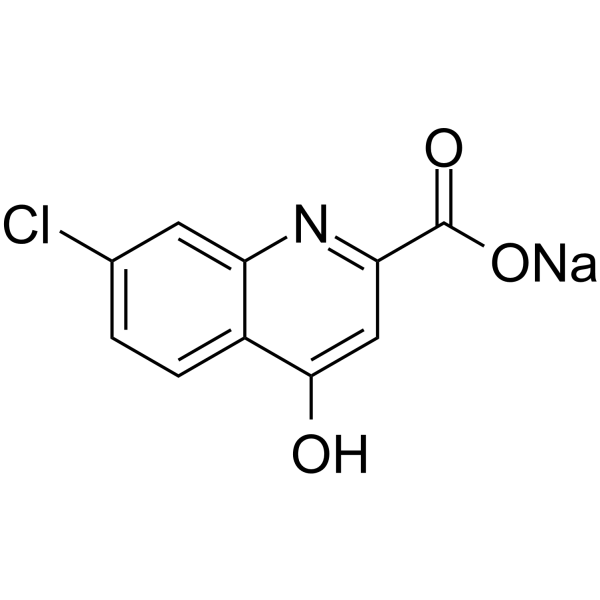
7-Chlorokynurenic acid sodium salt
Based on 4 publication(s) in Google Scholar
7-Chlorokynurenic acid sodium salt (7-CKA sodium salt) is a potent and selective antagonist of the glycine B coagonist site of the N-methyl-D-aspartate (NMDA) receptor (IC50=0.56 μM). 7-Chlorokynurenic acid sodium salt is also a potent inhibitor of the reuptake of glutamate into synaptic vesicles with a Ki of 0.59 μM. 7-Chlorokynurenic acid sodium salt has potent antinociceptive actions after neuraxial delivery.
For research use only. We do not sell to patients.
- Purity: 99.89%
- CAS No.: 1263094-00-3
- Formula: C10H5ClNNaO3
- Molecular Weight:245.59
-
Storage:
4°C, stored under nitrogen
* In solvent : -80°C, 6 months; -20°C, 1 month (stored under nitrogen)


-
 Biological Activity
-
Chemical Information
-
Solvent & Solubility
- Purity & Documentation
- References
-
 Help & FAQs
-

Membrane Transporter/Ion Channel Compound Library
HY-L011
-
Neuronal Signaling Compound Library
HY-L013
-
Neurotransmitter Receptor Compound Library
HY-L062
-
Anti-Alzheimer's Disease Compound Library
HY-L069
-
Neuroprotective Compound Library
HY-L070
-
Anti-Parkinson's Disease Compound Library
HY-L085
-
Neurodegenerative Disease-related Compound Library
HY-L086
-
Antidepressant Compound Library
HY-L108
-
Human Metabolite Library
HY-L123
-
Heterocyclic Compound Library
HY-L138
-
Pain-Related Compound Library
HY-L139
-
Membrane Protein-targeted Compound Library
HY-L149
-
Membrane Receptor-targeted Compound Library
HY-L150
-
Highly Selective Inhibitors Library
HY-L158
-
Ion Channel Compound Library
HY-L166
-
Bioactive Compound Library Max
HY-L181
-
MCE Bioactive Compound Library
HY-L001V
-
Bioactive Compound Library
HY-L001
-
High-Throughput Bioactive Compound Library
HY-L205
-
Mass Spectrometry Human Metabolite Library
HY-L215


Publications Citing Use of MedChemExpress (MCE) 7-Chlorokynurenic acid sodium salt
MoreAll iGluR Isoforms
More

Biological Activity
|
NMDA Receptor |
MedChemExpress (MCE) has not independently confirmed the accuracy of these methods. They are for reference only.


Chemical Information
-
CAS No. 1263094-00-3
-
Appearance Solid
-
Molecular Weight 245.59
-
Formula C10H5ClNNaO3
-
Color White to off-white
-
SMILES
O=C(C1=NC2=CC(Cl)=CC=C2C(O)=C1)O[Na]
-
Synonyms
7-CKA sodium salt
-
Shipping
Room temperature in continental US; may vary elsewhere.
-
Storage
4°C, stored under nitrogen
* In solvent : -80°C, 6 months; -20°C, 1 month (stored under nitrogen)


Publications (4)
-
Journal Impact Factor
-
Most Recent
-
-
Neuron
Astrocyte-mediated regulation of BLAWFS1 neurons alleviates risk-assessment deficits in DISC1-N mice. [Abstract]2024 Apr 16:S0896-6273(24)00235-6. PMID: 38642554 -
Nat Chem Biol
2025 Jun 2. PMID: 40456963 -
Anal Chem
Exposome-Scale Investigation of Cl-/Br-Containing Chemicals Using High-Resolution Mass Spectrometry, Multistage Machine Learning, and Cloud Computing. [Abstract]2025 Jun 3;97(21):11099-11109. PMID: 40401576


Solvent & Solubility
H2O : 50 mg/mL (203.59 mM; Need ultrasonic)
DMSO : ≥ 33.67 mg/mL (137.10 mM; Hygroscopic DMSO has a significant impact on the solubility of product, please use newly opened DMSO)
* "≥" means soluble, but saturation unknown.
Please refer to the solubility information to select the appropriate solvent. Once prepared, please aliquot and store the solution to prevent product inactivation from repeated freeze-thaw cycles.
Storage method and period of stock solution: -80°C, 6 months; -20°C, 1 month (stored under nitrogen). When stored at -80°C, please use it within 6 months. When stored at -20°C, please use it within 1 month.
* Note: If you choose water as the stock solution, please dilute it to the working solution, then filter and sterilize it with a 0.22 μm filter before use.
Please refer to the solubility information to select the appropriate solvent. Once prepared, please aliquot and store the solution to prevent product inactivation from repeated freeze-thaw cycles.
Storage method and period of stock solution: -80°C, 6 months; -20°C, 1 month (stored under nitrogen). When stored at -80°C, please use it within 6 months. When stored at -20°C, please use it within 1 month.
* Note: If you choose water as the stock solution, please dilute it to the working solution, then filter and sterilize it with a 0.22 μm filter before use.
Concentration (start) × Volume (start) = Concentration (final) × Volume (final)
Select the appropriate dissolution method based on your experimental animal and administration route.
- For the following dissolution methods, please ensure to first prepare a clear stock solution using an In Vitro approach and then sequentially add co-solvents:
- To ensure reliable experimental results, the clarified stock solution can be appropriately stored based on storage conditions. As for the working solution for In Vivo experiments, it is recommended to prepare freshly and use it on the same day.
- The percentages shown for the solvents indicate their volumetric ratio in the final prepared solution. If precipitation or phase separation occurs during preparation, heat and/or sonication can be used to aid dissolution.
Add each solvent one by one: 10% DMSO 40% PEG300 5% Tween-80 45% Saline
Solubility: ≥ 0.67 mg/mL (2.73 mM); Clear solution
This protocol yields a clear solution of ≥ 0.67 mg/mL (saturation unknown).
Taking 1 mL working solution as an example, add 100 μL DMSO stock solution (6.7 mg/mL) to 400 μL PEG300, and mix evenly; then add 50 μL Tween-80 and mix evenly; then add 450 μL Saline to adjust the volume to 1 mL.
Preparation of Saline: Dissolve 0.9 g sodium chloride in ddH₂O and dilute to 100 mL to obtain a clear Saline solution.
Add each solvent one by one: 10% DMSO 90% (20% SBE-β-CD in Saline)
Solubility: ≥ 0.67 mg/mL (2.73 mM); Clear solution
This protocol yields a clear solution of ≥ 0.67 mg/mL (saturation unknown).
Taking 1 mL working solution as an example, add 100 μL DMSO stock solution (6.7 mg/mL) to 900 μL 20% SBE-β-CD in Saline, and mix evenly.
Preparation of 20% SBE-β-CD in Saline (4°C, storage for one week): 2 g SBE-β-CD powder is dissolved in 10 mL Saline, completely dissolve until clear.
For the following dissolution methods, please prepare the working solution directly:
It is recommended to prepare fresh solutions and use them promptly within a short period of time.
The percentages shown for the solvents indicate their volumetric ratio in the final prepared solution. If precipitation or phase separation occurs during preparation, heat and/or sonication can be used to aid dissolution.
Add each solvent one by one: PBS
Solubility: 6.67 mg/mL (27.16 mM); Clear solution; Need ultrasonic and warming and heat to 60°C
Please enter the basic information of animal experiments:
-
-
-
-
Recommended: Prepare an additional quantity of animals to account for potential losses during experiments.
Working solution concentration: 0.22 mg/mL
This product has good water solubility, please refer to the measured solubility data in water/PBS/Saline for details.


Purity & Documentation
-
Data Sheet (275 KB)
-
SDS (252 KB)
- English - EN (252 KB)
- Français - FR (252 KB)
- Deutsch - DE (252 KB)
- Norwegian - NO (252 KB)
- Español - ES (252 KB)
- Swedish - SV (252 KB)
- Italian - IT (252 KB)
- Portuguese - PT (252 KB)
-
Handling Instructions (2659 KB)
References
[1]. Kemp JA, et al. 7-Chlorokynurenic acid is a selective antagonist at the glycine modulatory site of the N-methyl-D-aspartate receptor complex. Proc Natl Acad Sci U S A. 1988 Sep;85(17):6547-50. [Content Brief]
[2]. Yaksh TL, et al. Characterization of the Effects of L-4-Chlorokynurenine on Nociception in Rodents. J Pain. 2017 Oct;18(10):1184-1196. [Content Brief]
[3]. Croucher MJ, et al. 7-Chlorokynurenic acid, a strychnine-insensitive glycine receptor antagonist, inhibits limbic seizurekindling. Neurosci Lett. 1990 Oct 2;118(1):29-32. [Content Brief]


Complete Stock Solution Preparation Table
Please refer to the solubility information to select the appropriate solvent. Once prepared, please aliquot and store the solution to prevent product inactivation from repeated freeze-thaw cycles.
Storage method and period of stock solution: -80°C, 6 months; -20°C, 1 month (stored under nitrogen). When stored at -80°C, please use it within 6 months. When stored at -20°C, please use it within 1 month.
| Optional Solvent | Concentration Solvent Mass | 1 mg | 5 mg | 10 mg | 25 mg |
|---|---|---|---|---|---|
| DMSO / H2O | 1 mM | 4.0718 mL | 20.3591 mL | 40.7183 mL | 101.7957 mL |
| 5 mM | 0.8144 mL | 4.0718 mL | 8.1437 mL | 20.3591 mL | |
| 10 mM | 0.4072 mL | 2.0359 mL | 4.0718 mL | 10.1796 mL | |
| 15 mM | 0.2715 mL | 1.3573 mL | 2.7146 mL | 6.7864 mL | |
| 20 mM | 0.2036 mL | 1.0180 mL | 2.0359 mL | 5.0898 mL | |
| 25 mM | 0.1629 mL | 0.8144 mL | 1.6287 mL | 4.0718 mL | |
| 30 mM | 0.1357 mL | 0.6786 mL | 1.3573 mL | 3.3932 mL | |
| 40 mM | 0.1018 mL | 0.5090 mL | 1.0180 mL | 2.5449 mL | |
| 50 mM | 0.0814 mL | 0.4072 mL | 0.8144 mL | 2.0359 mL | |
| 60 mM | 0.0679 mL | 0.3393 mL | 0.6786 mL | 1.6966 mL | |
| 80 mM | 0.0509 mL | 0.2545 mL | 0.5090 mL | 1.2724 mL | |
| 100 mM | 0.0407 mL | 0.2036 mL | 0.4072 mL | 1.0180 mL |
* Note: If you choose water as the stock solution, please dilute it to the working solution, then filter and sterilize it with a 0.22 μm filter before use.


 Powered by Bioz