



cIAP
Cellular inhibitors of apoptosis proteins (cIAPs), including cIAP1 and cIAP2, function as E3 ubiquitin ligases that regulate apoptosis, innate immune signaling, and NF-κB activation[1][2]. Mechanistically, cIAP1 promotes NF-κB-dependent gene expression in skeletal muscle, contributing to denervation-induced atrophy, whereas cIAP2 modulates inflammasome activation and intestinal epithelial regeneration[3][4]. cIAP1 and cIAP2 also mediate NOD1/NOD2 receptor signaling through RIP2 ubiquitination, critical for cytokine production and host defense against inflammatory insults[5]. Compared with other IAP isoforms such as XIAP, cIAP1/2 exhibit isoform-specific roles in regulating Ripoptosome assembly, with cIAP absence promoting RIP1/caspase-8 complex formation that determines apoptotic or necroptotic outcomes[6]. In disease models, cIAP1 and cIAP2 overexpression supports tumorigenesis by sustaining NF-κB signaling, whereas their inhibition can sensitize cancer or proinflammatory macrophages to apoptosis[7][8][9]. Agonists or small-molecule IAP antagonists, including SMAC mimetics, selectively degrade cIAP1/2, enhancing death receptor-mediated apoptosis and reducing pathogenic cell survival, demonstrating their utility as experimental tools and therapeutic candidates[9][10]. Therefore, cIAPs act at the intersection of apoptosis, immune signaling, and disease modulation, with isoform-specific mechanisms providing a foundation for targeted intervention in cancer, inflammatory diseases, and tissue regeneration[1][2].
References:
- [1]. Vu NT, et al. Caspase-9b Interacts Directly with cIAP1 to Drive Agonist-Independent Activation of NF-κB and Lung Tumorigenesis. Cancer Res. 2016 May 15;76(10):2977-89. [Content Brief]
- [2]. Dagenais M, et al. A critical role for cellular inhibitor of protein 2 (cIAP2) in colitis-associated colorectal cancer and intestinal homeostasis mediated by the inflammasome and survival pathways. Mucosal Immunol. 2016 Jan;9(1):146-58. [Content Brief]
- [3]. Lala-Tabbert N, et al. Targeted ablation of the cellular inhibitor of apoptosis 1 (cIAP1) attenuates denervation-induced skeletal muscle atrophy. Skelet Muscle. 2019 May 24;9(1):13. [Content Brief]
- [4]. Bertrand MJ, et al. Cellular inhibitors of apoptosis cIAP1 and cIAP2 are required for innate immunity signaling by the pattern recognition receptors NOD1 and NOD2. Immunity. 2009 Jun 19;30(6):789-801. [Content Brief]
- [5]. Ali H, et al. Selective Induction of Cell Death in Human M1 Macrophages by Smac Mimetics Is Mediated by cIAP-2 and RIPK-1/3 through the Activation of mTORC. J Immunol. 2021 Nov 1;207(9):2359-2373. [Content Brief]
- [6]. Zhuang J, et al. Selective IAP inhibition results in sensitization of unstimulated but not CD40-stimulated chronic lymphocytic leukaemia cells to TRAIL-induced apoptosis. Pharmacol Res Perspect. 2014 Dec;2(6):e00081. [Content Brief]
- [7]. Lalaoui N, et al. Recent advances in understanding inhibitor of apoptosis proteins. F1000Res. 2018 Dec 3;7:F1000 Faculty Rev-1889. [Content Brief]
- [8]. Silke J, et al. Inhibitor of apoptosis (IAP) proteins-modulators of cell death and inflammation. Cold Spring Harb Perspect Biol. 2013 Feb 1;5(2):a008730. [Content Brief]
- [9]. Guicciardi ME, et al. Biliary tract instillation of a SMAC mimetic induces TRAIL-dependent acute sclerosing cholangitis-like injury in mice. Cell Death Dis. 2017 Jan 5;8(1):e2535. [Content Brief]
- [10]. Feoktistova M, et al. cIAPs block Ripoptosome formation, a RIP1/caspase-8 containing intracellular cell death complex differentially regulated by cFLIP isoforms. Mol Cell. 2011 Aug 5;43(3):449-63. [Content Brief]
-
cIAP Related Products (7)

-
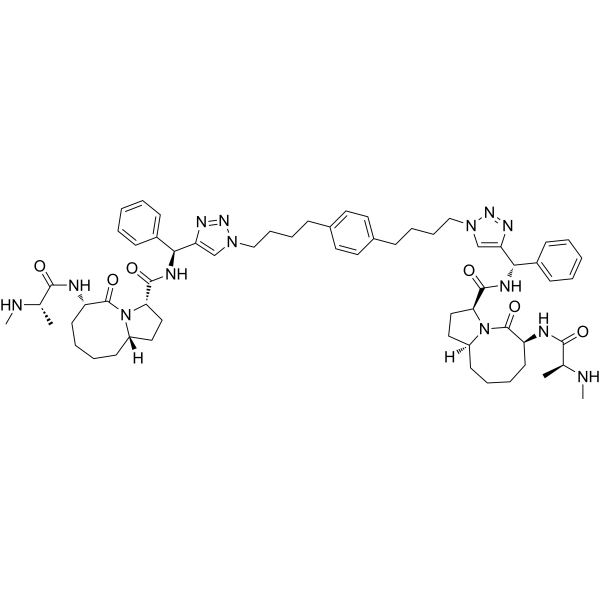
SM-164 hydrochloride
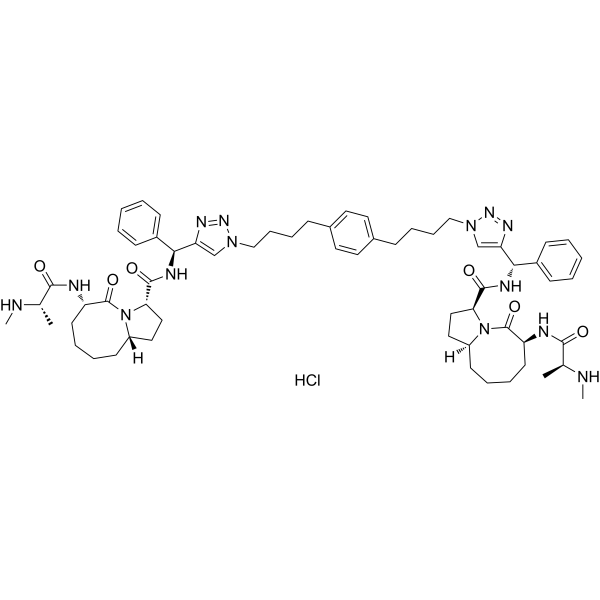 0 ImagesCat. No.: HY-15989ACAS No.: 2734174-02-6
-
Bestatin methyl ester
 0 ImagesCat. No.: HY-137159CAS No.: 65322-89-6Bestatin methyl ester is a cell permeable Zn2+-binding aminopeptidases inhibitor. Bestatin methyl ester inhibits spore cell differentiation.
-
Ciapavir
 0 ImagesCat. No.: HY-134844CAS No.: 2433895-70-4Synonyms: SBI-0953294Ciapavir (SBI-0953294) is a HIV-1 latency-reversing agent. Ciapavir reverses latent HIV-1 reservoir in vitro and in vivo without inducing systemic T cell activation or broad cytokine release. Ciapavir degrades cIAP1 and activates non-canonical NF-κB pathway. Ciapavir can be used for the research of HIV-1 infection.
-
PROTAC EZH2 Degrader-21
 0 ImagesCat. No.: HY-181319CAS No.: 3093642-36-2PROTAC EZH2 Degrader-21 is an EZH2 degrader developed based on PROTAC technology. PROTAC EZH2 Degrader-21 induces the degradation of the target protein EZH2 via specific recruitment of the cIAP E3 ligase. PROTAC EZH2 Degrader-21 exhibits significant inhibitory activity in a variety of lymphoma cell lines. PROTAC EZH2 Degrader-21 can be used for research on the pathogenesis of lymphoma.
-
PROTAC EZH2 Degrader-41
 0 ImagesCat. No.: HY-181410CAS No.: 3093642-41-9PROTAC EZH2 Degrader-41 is an EZH2-targeting PROTAC and cIAP E3 ubiquitin ligase recruiter. PROTAC EZH2 Degrader-41 induces EZH2 degradation via ubiquitination and proteasomal breakdown. PROTAC EZH2 Degrader-41 exerts antiproliferative effects in lymphoma cells. PROTAC EZH2 Degrader-41 can be used for the research of lymphoma.
-
PROTAC TEAD1/IAP degrader-2
 0 ImagesCat. No.: HY-181537PROTAC TEAD1/IAP degrader-2 is an IAP-harnessing TEAD1 PROTAC degrader, with a DC50 of 170 nM against TEAD1 in NCI-H2052 cells. PROTAC TEAD1/IAP degrader-2 exhibits moderate antiproliferative activity in Hippo pathway-dependent mesothelioma cells. PROTAC TEAD1/IAP degrader-2 inhibits the expression of CTGF, but with a weaker effect than the TEAD inhibitor VT-107 (HY-134957). PROTAC TEAD1/IAP degrader-2 can be used in mesothelioma-related research.



