



p-APMSF hydrochloride

Based on 1 Customer Validation
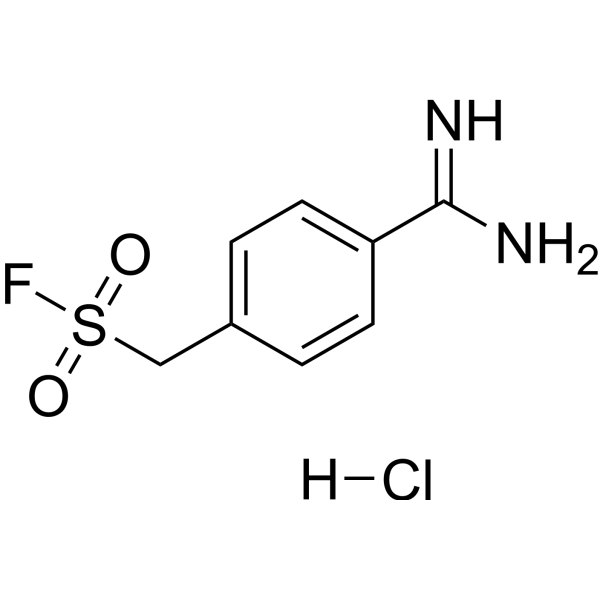
p-APMSF (p-Amidinophenylmethylsulfonylfluoride) hydrochloride is a serine protease and trypsin inhibitor with the characteristic of rapid onset of action. p-APMSF hydrochloride reduces the enzymatic hydrolysis of recombinant human G-CSF in rat pulmonary mucosa. Combined intratracheal treatment with p-APMSF hydrochloride and Laureth-9 significantly enhances its absorption efficiency in rat lungs. Following intranasal administration, p-APMSF hydrochloride does not increase the concentration of recombinant human G-CSF in rat plasma, nor does it alter the effect of G-CSF on inducing an increase in total white blood cell count.
商品は「研究用試薬」です。人や動物の医療用・臨床診断用・食品用の製品ではありません。
研究用途以外に使用した場合、当社は一切の責任を負いかねます。
- 純度 : 95.0%
- CAS 番号: 74938-88-8
- 分子式: C8H10ClFN2O2S
- 分子量:252.69
-
保管条件:
-20°C, sealed storage, away from moisture
* In solvent : -80°C, 6 months; -20°C, 1 month (sealed storage, away from moisture)

To place orders, for customer services and technical support, please contact: MedChemExpress USA
Tel: 609-228-6898 E-mail: [email protected] [email protected]


-
 生物活性
生物活性
-
化学情報
- 純度とドキュメンテーション
- 参考文献
-
 Help & FAQs


-
HY-128133
MMP-8 inhibitor-1MMP-8 Inhibitor -

HY-A0299A
H-Gly-Pro-Hyp-OH acetateDPP-4 Inhibitor -
HY-126034
3,4-DichloroisocoumarinSerine-protease Inhibitor -

HY-N15181
Fluostatin BDPP-3 Inhibitor -

HY-129407
AAF-CMK TFA -

HY-N14989A
Fluostatin A sodiumDipeptidyl PeptidaseIII Inhibitor -

HY-137858
H-Gly-Arg-pNA hydrochlorideFluorescent Dye


生物活性
製品説明
体外実験
p-APMSF (4 mg/mL; 2 h) hydrochloride effectively inhibits trypsin activity in a cell-free system after 2 hours of incubation at room temperature, enabling the isolation of α2M-cytochrome c conjugates[1].
MedChemExpress (MCE) has not independently confirmed the accuracy of these methods. They are for reference only. .
体内実験
p-APMSF hydrochloride (10 mM; intranasal) does not enhance rhG-CSF-induced increases in total leukocyte numbers or plasma rhG-CSF concentrations following intranasal co-administration in healthy rats[3].
MedChemExpress (MCE) has not independently confirmed the accuracy of these methods. They are for reference only.
-
Animal Model:Sprague-Dawley Rat (SD) (male, 8 weeks old, 250-300 g)[2]
-
Dosage:10 mM
-
Administration:intratracheal; single coadministered dose
-
Result:Increased plasma rhG-CSF concentration about 3-fold, from 3.9 to 11.7 ng/mL, at 30 minutes post-administration.
Increased AUC0-8 of rhG-CSF by more than 1.5-fold compared to intratracheal control.
When combined with Laureth-9, increased plasma rhG-CSF concentration at 30 minutes post-administration about 123-fold to 481.5 ng/mL.
Achieved a relative bioavailability of rhG-CSF of 73.6% versus intravenous administration and 172.8% versus subcutaneous administration.
-
Animal Model:Sprague-Dawley Rat (SD) (male, 8 weeks old, 250-300 g)[3]
-
Dosage:10 mM (in combination with rhG-CSF at 100 μg/kg)
-
Administration:intranasal
-
Result:Did not produce a significant increase in the AUC for the increase ratio of total leukocyte numbers compared to rhG-CSF administered alone.
Did not significantly increase plasma rhG-CSF concentrations relative to rhG-CSF administered alone.


化学情報
-
CAS 番号 74938-88-8
-
性状 Solid
-
分子量 252.69
-
分子式 C8H10ClFN2O2S
-
Color White to off-white
-
SMILES
O=S(CC1=CC=C(C(N)=N)C=C1)(F)=O.[H]Cl
-
別名
p-Amidinophenylmethylsulfonylfluoride hydrochloride
-
輸送条件
Room temperature in continental US; may vary elsewhere.
-
保管条件
-20°C, sealed storage, away from moisture
* In solvent : -80°C, 6 months; -20°C, 1 month (sealed storage, away from moisture)


純度とドキュメンテーション
-
データシート (273 KB)
-
SDS (476 KB)
- English - EN (476 KB)
- Français - FR (476 KB)
- Deutsch - DE (476 KB)
- Norwegian - NO (476 KB)
- Español - ES (476 KB)
- Swedish - SV (476 KB)
- Italian - IT (476 KB)
- Korean - KR (476 KB)
- Portuguese - PT (476 KB)
-
取扱説明書 (2659 KB)
参考文献
[2]. Machida M, et al. The effects of absorption enhancers on the pulmonary absorption of recombinant human granulocyte colony-stimulating factor (rhG-CSF) in rats. Biol Pharm Bull. 2000;23(1):84-86. [Content Brief]
[3]. Machida M, et al. Effects of surfactants and protease inhibitors on nasal absorption of recombinant human granulocyte colony-stimulating factor (rhG-CSF) in rats. Biol Pharm Bull. 1994;17(10):1375-1378. [Content Brief]

Calculators
濃度 (開始) × 体積 (開始) = 濃度 (終了) × 体積 (終了)


p-APMSF hydrochloride 関連分類
HY-W014134 関連分類
 Powered by Bioz