



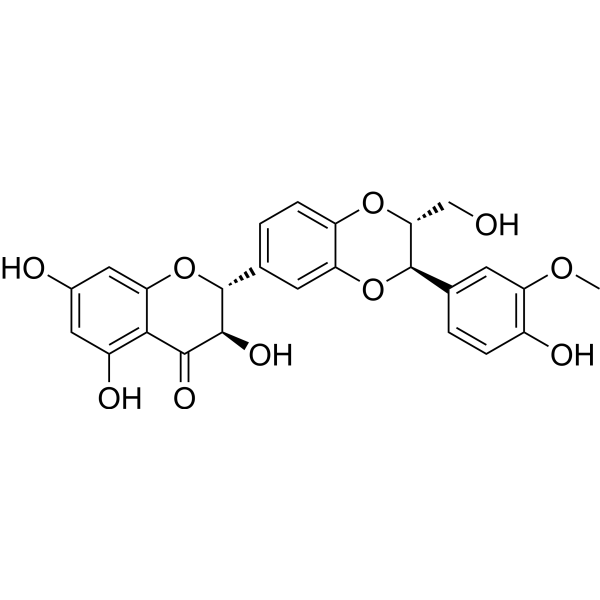
(±)-Silybin

Based on 1 Customer Validation
(±)-Silybin is the racemate of Silybin (HY-N0779A). Silybin induces apoptosis and exhibits hepatoprotective, antioxidant, anti-inflammatory, anti-cancer activity.
For research use only. We do not sell to patients.
- Purity : 99.40%
- CAS No.: 36804-17-8
- Formula: C25H22O10
- Molecular Weight:482.44
-
Storage:
4°C, stored under nitrogen
* In solvent : -80°C, 6 months; -20°C, 1 month (stored under nitrogen)

To place orders, for customer services and technical support, please contact: MedChemExpress USA
Tel: 609-228-6898 E-mail: [email protected] [email protected]


-
 Biological Activity
-
Chemical Information
-
Solvent & Solubility
- Protocols
- Purity & Documentation
- References
-
 Help & FAQs




Biological Activity
Description
Cellular Effect
|
Cell Line

|
Type | Value | Description | References |
|---|---|---|---|---|
| B16-4A5 | IC50 |
>100 μM
Compound: 5
|
Toxicity in mouse B16-4A5 cells assessed as inhibition of cell proliferation in presence of 1 mM theophylline after 72 hrs by WST8 dye reduction assay
Toxicity in mouse B16-4A5 cells assessed as inhibition of cell proliferation in presence of 1 mM theophylline after 72 hrs by WST8 dye reduction assay
|
[PMID: 20189399] |
| B16-4A5 | IC50 |
21 μM
Compound: 5
|
Inhibition of theophylline-stimulated melanogenesis in mouse B16-4A5 cells after 72 hrs
Inhibition of theophylline-stimulated melanogenesis in mouse B16-4A5 cells after 72 hrs
|
[PMID: 20189399] |
| HEK293 | IC50 |
2.7 μM
Compound: Silybin A
|
Inhibition of OATP1B3 (unknown origin) expressed in HEK293 cells assessed as reduction of [3H]estradiol-17beta-glucuronide uptake after 3 mins by beta-counting
Inhibition of OATP1B3 (unknown origin) expressed in HEK293 cells assessed as reduction of [3H]estradiol-17beta-glucuronide uptake after 3 mins by beta-counting
|
[PMID: 23401473] |
| HEK293 | IC50 |
9.7 μM
Compound: Silybin A
|
Inhibition of OATP1B1 (unknown origin) expressed in HEK293 cells assessed as reduction of [3H]estradiol-17beta-glucuronide uptake after 3 mins by beta-counting
Inhibition of OATP1B1 (unknown origin) expressed in HEK293 cells assessed as reduction of [3H]estradiol-17beta-glucuronide uptake after 3 mins by beta-counting
|
[PMID: 23401473] |
| Hepatocyte | IC50 |
29.9 μM
Compound: Silybin
|
Hepatoprotective activity against D-GaIN/TNFalpha-induced cell death in mouse hepatocyte at 100 uM relative to control
Hepatoprotective activity against D-GaIN/TNFalpha-induced cell death in mouse hepatocyte at 100 uM relative to control
|
[PMID: 29353722] |
| Hepatocyte | IC50 |
33.6 μM
Compound: Silybin
|
Hepatoprotective activity against D-GaIN/TNFalpha-induced cell death in mouse hepatocyte at 100 uM
Hepatoprotective activity against D-GaIN/TNFalpha-induced cell death in mouse hepatocyte at 100 uM
|
[PMID: 29353722] |
| Hepatocyte | IC50 |
38.8 μM
Compound: Silybin
|
Hepatoprotective activity against D-GaIN-induced toxicity in mouse hepatocyte relative to control
Hepatoprotective activity against D-GaIN-induced toxicity in mouse hepatocyte relative to control
|
[PMID: 29353722] |
| HepG2 | EC50 |
75.7 μM
Compound: Silybin
|
Cytotoxicity against human HepG2 cells assessed as reduction in cell viability by SRB assay
Cytotoxicity against human HepG2 cells assessed as reduction in cell viability by SRB assay
|
[PMID: 29353722] |
| Huh-7 | IC50 |
80 μM
Compound: 1
|
Cytotoxicity against human Huh7.5.1 cells after 72 hrs
Cytotoxicity against human Huh7.5.1 cells after 72 hrs
|
[PMID: 23673225] |
| Huh7.5.1 | CC50 |
80 μM
Compound: 3
|
Cytotoxicity against human Huh7.5.1 cells after 72 hrs by ATPlite assay
Cytotoxicity against human Huh7.5.1 cells after 72 hrs by ATPlite assay
|
[PMID: 30485098] |
| HUVEC | IC50 |
62.33 μM
Compound: 1a, (2R,3R,10R,11R)
|
Cytotoxicity against HUVEC assessed as cell viability after 16 hrs by MTT assay
Cytotoxicity against HUVEC assessed as cell viability after 16 hrs by MTT assay
|
[PMID: 21928794] |
| HUVEC | IC50 |
8.83 μM
Compound: 1a, (2R,3R,10R,11R)
|
Antiproliferative activity against HUVEC assessed as inhibition of cell growth after 3 days by MTT assay
Antiproliferative activity against HUVEC assessed as inhibition of cell growth after 3 days by MTT assay
|
[PMID: 21928794] |
| LoVo | IC50 |
50 μM
Compound: Silybin A; Silibinin
|
Cytotoxicity against human LoVo cells assessed as reduction in cell growth after 24 hrs by trypan blue exclusion assay
Cytotoxicity against human LoVo cells assessed as reduction in cell growth after 24 hrs by trypan blue exclusion assay
|
[PMID: 27517806] |
| LX-2 | IC50 |
151.1 μM
Compound: Silybin
|
Cytotoxicity against human LX2 cells assessed as reduction in cell viability by MTT assay
Cytotoxicity against human LX2 cells assessed as reduction in cell viability by MTT assay
|
[PMID: 33775837] |
| LX-2 | IC50 |
164.4 μM
Compound: Silybin
|
Inhibition of hyaluronic acid deposition in human LX2 cells
Inhibition of hyaluronic acid deposition in human LX2 cells
|
[PMID: 33775837] |
| LX-2 | IC50 |
51.5 μM
Compound: Silybin
|
Inhibition of collagen type 1 deposition in human LX2 cells
Inhibition of collagen type 1 deposition in human LX2 cells
|
[PMID: 33775837] |
| LX-2 | IC50 |
83.7 μM
Compound: Silybin
|
Inhibition of laminin deposition in human LX2 cells
Inhibition of laminin deposition in human LX2 cells
|
[PMID: 33775837] |
| MCF7 | IC50 |
222.8 μM
Compound: 1
|
Cytotoxicity in human MCF7 cells assessed as reduction in cell viability incubated for 68 hrs by MTT assay
Cytotoxicity in human MCF7 cells assessed as reduction in cell viability incubated for 68 hrs by MTT assay
|
[PMID: 28411546] |
| MDCK-II | IC50 |
4.5 μM
Compound: Silybin A
|
Inhibition of OATP2B1 (unknown origin) expressed in MDCK2 cells assessed as reduction of [3H]estrone-3-sulfate uptake after 3 mins by beta-counting
Inhibition of OATP2B1 (unknown origin) expressed in MDCK2 cells assessed as reduction of [3H]estrone-3-sulfate uptake after 3 mins by beta-counting
|
[PMID: 23401473] |
| T47D | IC50 |
110 μM
Compound: Silybin A; Silibinin
|
Cytotoxicity against human T47D cells assessed as reduction in cell viability after 24 hrs by MTT assay
Cytotoxicity against human T47D cells assessed as reduction in cell viability after 24 hrs by MTT assay
|
[PMID: 27517806] |
| T47D | IC50 |
12 μM
Compound: Silybin A; Silibinin
|
Downregulation of telomerase expression in human T47D cells after 72 hrs in presence of curcumin by SYBR green-dye based RT-PCR analysis
Downregulation of telomerase expression in human T47D cells after 72 hrs in presence of curcumin by SYBR green-dye based RT-PCR analysis
|
[PMID: 27517806] |
| T47D | IC50 |
20 μM
Compound: Silybin A; Silibinin
|
Cytotoxicity against human T47D cells assessed as reduction in cell viability after 24 hrs in presence of curcumin by MTT assay
Cytotoxicity against human T47D cells assessed as reduction in cell viability after 24 hrs in presence of curcumin by MTT assay
|
[PMID: 27517806] |
In Vitro
Racemate: A mixture composed of equal amounts of a pair of enantiomers that are mirror images of each other and possess opposite optical rotations; the mixture as a whole is optically inactive.
MedChemExpress (MCE) has not independently confirmed the accuracy of these methods. They are for reference only. Further protocols information, click here.


Chemical Information
-
CAS No. 36804-17-8
-
Appearance Solid
-
Molecular Weight 482.44
-
Formula C25H22O10
-
Color White to off-white
-
SMILES
OC[C@@H]1[C@@H](C2=CC(OC)=C(C=C2)O)OC3=CC([C@H]4OC5=CC(O)=CC(O)=C5C([C@@H]4O)=O)=CC=C3O1
-
Synonyms
Silibinin (mixture of Silybin A and Silybin B)
-
Structure Classification
-
Shipping
Room temperature in continental US; may vary elsewhere.
-
Storage
4°C, stored under nitrogen
* In solvent : -80°C, 6 months; -20°C, 1 month (stored under nitrogen)


Solvent & Solubility
In Vitro:
DMSO : 50 mg/mL (103.64 mM; Need ultrasonic; Hygroscopic DMSO has a significant impact on the solubility of product, please use newly opened DMSO)
Please refer to the solubility information to select the appropriate solvent. Once prepared, please aliquot and store the solution to prevent product inactivation from repeated freeze-thaw cycles.
Storage method and period of stock solution: -80°C, 6 months; -20°C, 1 month (stored under nitrogen). When stored at -80°C, please use it within 6 months. When stored at -20°C, please use it within 1 month.
Please refer to the solubility information to select the appropriate solvent. Once prepared, please aliquot and store the solution to prevent product inactivation from repeated freeze-thaw cycles.
Storage method and period of stock solution: -80°C, 6 months; -20°C, 1 month (stored under nitrogen). When stored at -80°C, please use it within 6 months. When stored at -20°C, please use it within 1 month.
Concentration (start) × Volume (start) = Concentration (final) × Volume (final)

Protocols
-
Detection of Apoptosis
Apoptosis, also called programmed cell death, is generally characterized by distinct morphological characteristics.
-
TUNEL staining for apoptotic DNA fragmentation
TUNEL staining detects DNA strand breaks by using terminal deoxynucleotidyl transferase to add labeled nucleotides to exposed 3′-OH DNA termini, generating either microscopic staining in fixed cells or tissue sections, or fluorescence/cytometric signal in cell suspensions. TUNEL positivity reflects DNA fragmentation but should not be interpreted alone as definitive apoptosis, because TUNEL can also label necrotic, autolytic, mechanically damaged, or DNA-repair-associated DNA breaks.
-
Annexin V plus membrane-impermeant dye apoptosis staining
Annexin V-based apoptosis assays rely on the detection of phosphatidylserine (PS) externalization from the inner leaflet of the plasma membrane to the outer leaflet, an early biochemical hallmark of apoptosis. Fluorescently labeled Annexin V binds PS in a calcium-dependent manner, enabling identification of early apoptotic cells by flow cytometry or fluorescence microscopy. When combined with a membrane-impermeant DNA-binding dye (e. g. , propidium iodide), this approach allows discrimination between viable (Annexin V−/dye−), early apoptotic (Annexin V+/dye−), and late apoptotic or necrotic (Annexin V+/dye+) cell populations by assessing membrane integrity and PS exposure.
-
Apoptosis Solutions
Apoptosis is a regulated, generally non-lytic cell-death pathway that removes unwanted, damaged, infected, or abnormal cells through coordinated morphological changes, caspase activation, DNA fragmentation, and membrane remodeling. The intrinsic apoptosis pathway is controlled mainly by mitochondrial outer membrane permeabilization, BCL-2 family proteins, cytochrome c release, apoptosome formation, caspase-9 activation, and downstream executioner caspase-3/7 activation. The extrinsic apoptosis pathway is initiated by death receptors such as Fas, TNFR, and TRAIL receptors, which recruit adaptor proteins and activate caspase-8 before engaging executioner caspases or mitochondrial amplification through BID cleavage. Apoptosis is linked to many phenotypes, including cancer cell killing, tissue homeostasis, immune regulation, neurodegeneration, infection response, and treatment-induced cytotoxicity; unresolved questions include how apoptosis interacts with necroptosis, pyroptosis, ferroptos
-
Research Protocol for Inflammation-related Diseases
The NLRP3 inflammasome is a cytosolic innate immune signaling platform that integrates priming signals and danger-signal activation to promote caspase-1 activation, maturation of IL-1β and IL-18, and gasdermin D-mediated pyroptotic cell death. The core experimental logic is to determine whether inflammatory disease phenotypes are driven by increased NLRP3 expression, ASC-containing inflammasome assembly, caspase-1 cleavage, GSDMD cleavage, and extracellular release of IL-1β/IL-18 rather than by nonspecific cell injury alone. The pathway is strongly linked to inflammation-related disease phenotypes because monosodium urate crystals activate NALP3/NLRP3 inflammasome signaling in gout-like crystal inflammation, cholesterol crystals activate NLRP3 inflammasomes in atherogenesis models, and DSS-induced intestinal inflammation has been reported to involve NLRP3 inflammasome activity. However, experimental colitis studies also show context-dependent protective effects of NLRP3 inflammasome co


Purity & Documentation
-
Data Sheet (280 KB)
-
SDS (393 KB)
- English - EN (393 KB)
- Français - FR (393 KB)
- Deutsch - DE (393 KB)
- Norwegian - NO (393 KB)
- Español - ES (393 KB)
- Swedish - SV (393 KB)
- Italian - IT (393 KB)
- Korean - KR (393 KB)
- Portuguese - PT (393 KB)
-
Handling Instructions (2659 KB)
References
[1]. Silvia Zappavigna, et al. Silybin-Induced Apoptosis Occurs in Parallel to the Increase of Ceramides Synthesis and miRNAs Secretion in Human Hepatocarcinoma Cells. Int J Mol Sci. 2019 May 3;20(9):2190. [Content Brief]
[2]. Runbin Sun, et al. Silybin ameliorates hepatic lipid accumulation and modulates global metabolism in an NAFLD mouse model. Biomed Pharmacother. 2020 Mar;123:109721. [Content Brief]


Complete Stock Solution Preparation Table
Please refer to the solubility information to select the appropriate solvent. Once prepared, please aliquot and store the solution to prevent product inactivation from repeated freeze-thaw cycles.
Storage method and period of stock solution: -80°C, 6 months; -20°C, 1 month (stored under nitrogen). When stored at -80°C, please use it within 6 months. When stored at -20°C, please use it within 1 month.
| Optional Solvent | Concentration Solvent Mass | 1 mg | 5 mg | 10 mg | 25 mg |
|---|---|---|---|---|---|
| DMSO | 1 mM | 2.0728 mL | 10.3640 mL | 20.7280 mL | 51.8199 mL |
| 5 mM | 0.4146 mL | 2.0728 mL | 4.1456 mL | 10.3640 mL | |
| 10 mM | 0.2073 mL | 1.0364 mL | 2.0728 mL | 5.1820 mL | |
| 15 mM | 0.1382 mL | 0.6909 mL | 1.3819 mL | 3.4547 mL | |
| 20 mM | 0.1036 mL | 0.5182 mL | 1.0364 mL | 2.5910 mL | |
| 25 mM | 0.0829 mL | 0.4146 mL | 0.8291 mL | 2.0728 mL | |
| 30 mM | 0.0691 mL | 0.3455 mL | 0.6909 mL | 1.7273 mL | |
| 40 mM | 0.0518 mL | 0.2591 mL | 0.5182 mL | 1.2955 mL | |
| 50 mM | 0.0415 mL | 0.2073 mL | 0.4146 mL | 1.0364 mL | |
| 60 mM | 0.0345 mL | 0.1727 mL | 0.3455 mL | 0.8637 mL | |
| 80 mM | 0.0259 mL | 0.1295 mL | 0.2591 mL | 0.6477 mL | |
| 100 mM | 0.0207 mL | 0.1036 mL | 0.2073 mL | 0.5182 mL |


(±)-Silybin Related Classifications
HY-139637 Related Classifications
 Powered by Bioz