



MIP-1 alpha/CCL3 Protein, Rat
Based on 1 Customer Validation
The CCL3 protein is a single factor with inflammatory and chemotactic properties that attracts immune cells such as monocytes, neutrophils, eosinophils, basophils, and lymphocytes. It is critical in pulmonary TNF-α production, neutrophil recruitment, and lung injury and may serve as an autocrine mediator of TNF-α production by macrophages. MIP-1 alpha/CCL3 Protein, Rat is the recombinant rat-derived MIP-1 alpha/CCL3 protein, expressed by E. coli , with tag free.
- Species: Rat
- Source: E. coli
-
Almacenamiento:Stored at -20°C for 2 years from date of receipt. After reconstitution, it is stable at 4°C for 1 week or -20°C for longer (with carrier protein). It is recommended to freeze aliquots at -20°C or -80°C for extended storage.


To place orders, for customer services and technical support, please contact: MedChemExpress USA
Tel: 609-228-6898 E-mail: [email protected] [email protected]


-
 Actividad biológica
-
Technical Parameters
-
Product Properties
- Documentación
- Help & FAQs




Actividad biológica
Descripciòn
The CCL3 protein is a single factor with inflammatory and chemotactic properties that attracts immune cells such as monocytes, neutrophils, eosinophils, basophils, and lymphocytes. It is critical in pulmonary TNF-α production, neutrophil recruitment, and lung injury and may serve as an autocrine mediator of TNF-α production by macrophages. MIP-1 alpha/CCL3 Protein, Rat is the recombinant rat-derived MIP-1 alpha/CCL3 protein, expressed by E. coli , with tag free.
Background
CCL3 protein, a monokine with inflammatory and chemokinetic properties, exhibits chemotactic activity for a variety of immune cells, including monocytes, neutrophils, eosinophils, basophils, and lymphocytes. It plays a crucial role in lung TNF-alpha production, neutrophil recruitment, and subsequent lung injury, potentially serving as an autocrine mediator for macrophage-produced TNF-alpha. This, in turn, up-regulates vascular adhesion molecules essential for neutrophil influx. Additionally, CCL3 protein demonstrates binding affinity for heparin.
Verified Bioactivity
1.Fully biologically active when compared to standard. The biological activity determined by a chemoattract bioassay using human blood monocytes is in a concentration range of 10-100 ng/mL.
2.Measured by its ability to chemoattract BaF3 mouse pro-B cells transfected with human CCR5. The ED50 for this effect is 3.140 ng/mL, corresponding to a specific activity is 3.185×10⁵ U/mg.
MCE Validation Data
-
Purity - SDS-PAGE
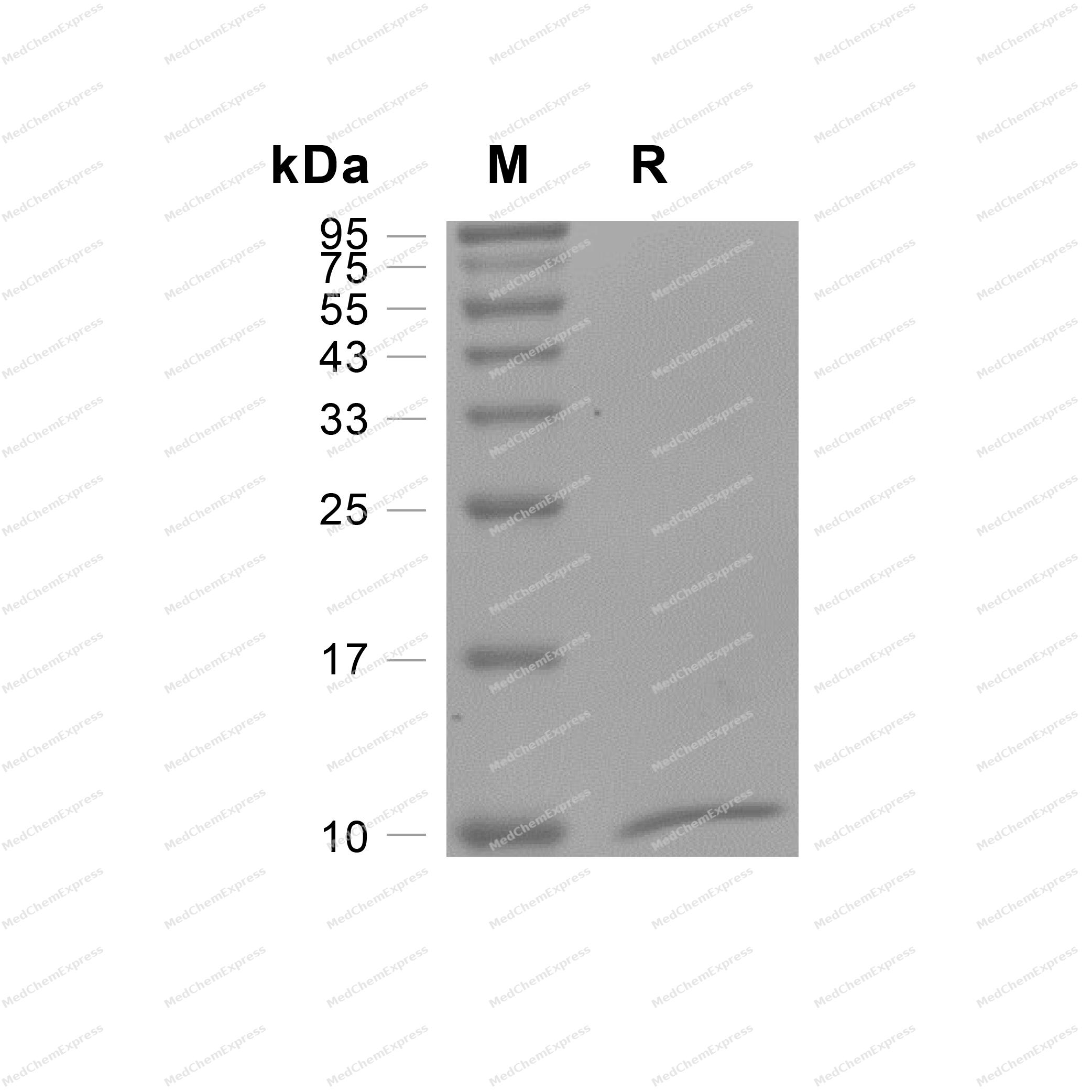
Purity - SDS-PAGE
-
Bioactivity - Cell-Based Assay
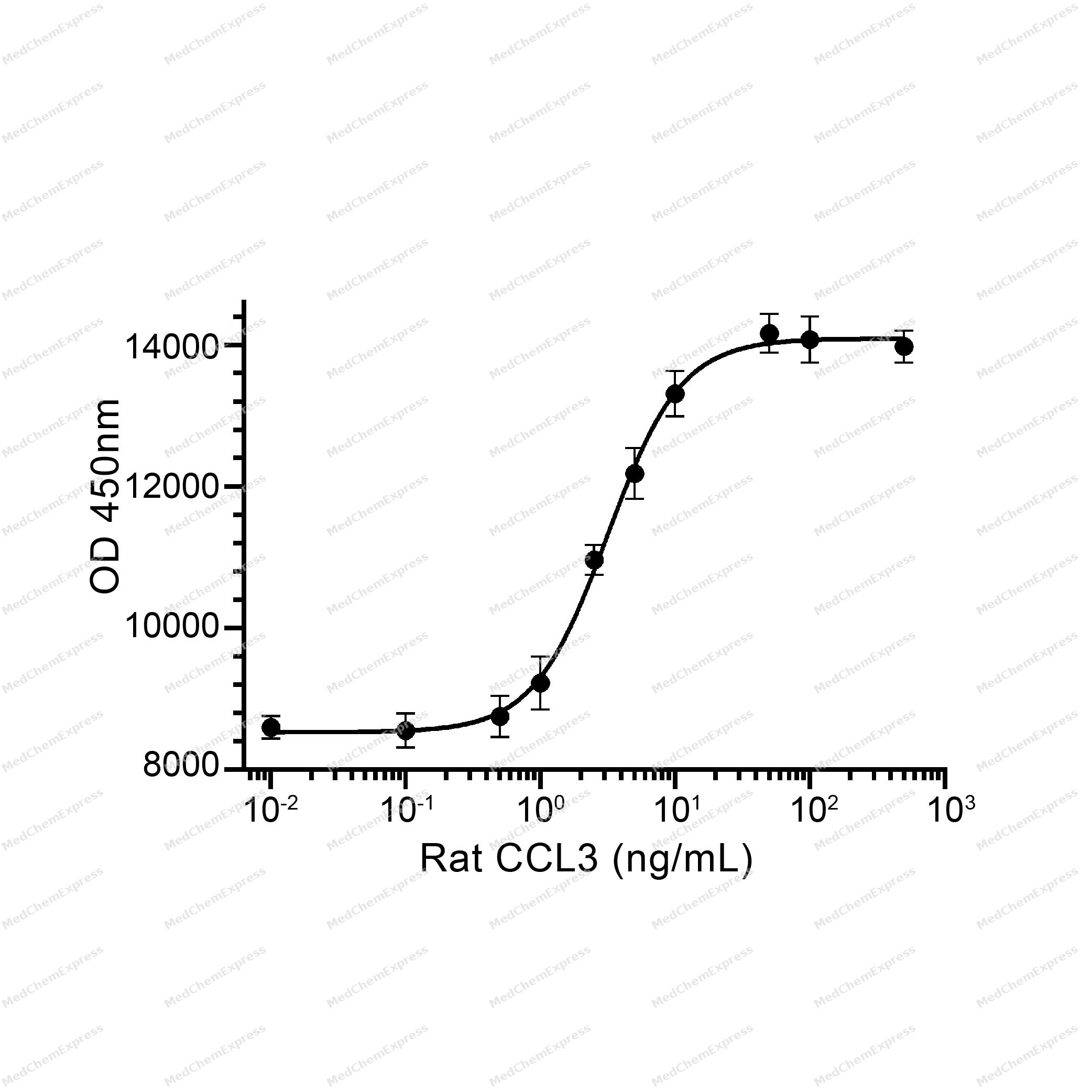
Bioactivity - Cell-Based Assay


Technical Parameters
-
Species Rat
-
Source E. coli
-
Tag Tag Free
-
Accession
P50229 (A24-A92)
-
Molecular Construction
-
N-term
-
CCL3 (A24-A92)
Accession # P50229 -
C-term
-
-
Protein Length
Full Length of Mature Protein
-
Synonyms
CCL3; Tonsillar Lymphocyte LD78 Alpha Protein; Prev. SCYA3; C-C Motif Chemokine 3; MIP-1-Alpha; PAT 464.1; G0S19-1; SIS-Beta; LD78ALPHA; MIP1A; LD78; Macrophage Inflammatory Protein 1 Alpha; SCI; Chemokine (C-C Motif) Ligand 3; Small Inducible Cytokine A3
-
AA Sequence
APYGADTPTACCFSYGRQIPRKFIADYFETSSLCSQPGVIFLTKRNRQICADPKETWVQEYITELELNA
-
Predicted Molecular Mass
7.8 kDa
-
Peso molecular
Approximately 5-10 kDa, based on SDS-PAGE under reducing conditions.
-
Pureza
≥ 95%, as determined by reducing SDS-PAGE.


Product Properties
Lyophilized powder
1.Lyophilized from a 0.22 μm filtered solution of 50 mM Tris-HCl, 300 mM NaCl, pH 8.0.
Note: For SPR assay, please replace the buffer. Primary amine components (e.g., Tris, imidazole) can affect protein-coupled chips.
<1 EU/μg, determined by LAL method.
It is not recommended to reconstitute to a concentration less than 100 μg/mL in sterile distilled water.For long term storage it is recommended to add a carrier protein (0.1% BSA, 5% HSA, 10% FBS or 5% Trehalose).
Stored at -20°C for 2 years from date of receipt. After reconstitution, it is stable at 4°C for 1 week or -20°C for longer (with carrier protein). It is recommended to freeze aliquots at -20°C or -80°C for extended storage.
Room temperature in continental US; may vary elsewhere.


Documentación
-
Ficha de datos (235 KB)
-
SDS (251 KB)
- English - EN (251 KB)
- Français - FR (251 KB)
- Deutsch - DE (251 KB)
- Norwegian - NO (251 KB)
- Español - ES (251 KB)
- Swedish - SV (251 KB)
- Italian - IT (251 KB)
- Korean - KR (251 KB)
- Portuguese - PT (251 KB)
-
Instrucciones de manejo (2659 KB)

Calculators
Concentration (start) × Volume (start) = Concentration (final) × Volume (final)


 Powered by Bioz

