



FSHR Protein, Human (His)

Based on 1 Customer Validation
FSHR, a G protein-coupled receptor, specifically recognizes follitropin (FSH) and activates PI3K-AKT and ERK1/ERK2 pathways by promoting cAMP production. Operating as a homotrimer, FSHR binds the heterodimeric FSH hormone, forming a functional unit for signal transduction. Its regulatory mechanisms involve interaction with ARRB2, and independently of FSH stimulation, it engages with APPL2, demonstrating versatility in diverse cellular contexts. FSHR Protein, Human (His) is the recombinant human-derived FSHR protein, expressed by E. coli , with N-6*His labeled tag.
- Species: Human
- Source: E. coli
-
Almacenamiento:Stored at -20°C for 2 years from date of receipt. After reconstitution, it is stable at 4°C for 1 week or -20°C for longer (with carrier protein). It is recommended to freeze aliquots at -20°C or -80°C for extended storage.


To place orders, for customer services and technical support, please contact: MedChemExpress USA
Tel: 609-228-6898 E-mail: [email protected] [email protected]


-
 Actividad biológica
-
Technical Parameters
-
Product Properties
- Documentación
- Help & FAQs




Actividad biológica
Descripciòn
FSHR, a G protein-coupled receptor, specifically recognizes follitropin (FSH) and activates PI3K-AKT and ERK1/ERK2 pathways by promoting cAMP production. Operating as a homotrimer, FSHR binds the heterodimeric FSH hormone, forming a functional unit for signal transduction. Its regulatory mechanisms involve interaction with ARRB2, and independently of FSH stimulation, it engages with APPL2, demonstrating versatility in diverse cellular contexts. FSHR Protein, Human (His) is the recombinant human-derived FSHR protein, expressed by E. coli , with N-6*His labeled tag.
Background
FSHR is a G protein-coupled receptor specifically designed for the recognition of follitropin, also known as follicle-stimulating hormone. This receptor activates downstream signaling pathways, including the PI3K-AKT and ERK1/ERK2 pathways, by facilitating cAMP production. As a homotrimer, FSHR binds to the heterodimeric FSH hormone, consisting of CGA and FSHB subunits, forming a functional unit for signal transduction. FSHR's interaction with ARRB2 contributes to its regulatory mechanisms, and it also engages with APPL2 independently of follicle-stimulating hormone stimulation, showcasing its versatility in diverse cellular contexts.
Verified Bioactivity
1.Immobilized Human FSH Fc (HY-P74133) at 2 μg/mL (100μL/well) can bind Biotinylated Human FSHR. The ED50 for this effect is 0.265 μg/mL.
2.Immobilized Human FSH (HY-P70237) at 2 μg/mL (100 μL/well) can bind Biotinylated Human FSHR. The ED50 for this effect is 0.5152 μg/mL.
3.Immobilized Human FSHR at 2 μg/mL (100 μL/well) can bind Human FSH Fc (HY-P74133). The ED50 for this effect is 1.099 μg/mL.
MCE Validation Data
-
Purity - SDS-PAGE

Purity - SDS-PAGE
-
Bioactivity - ELISA
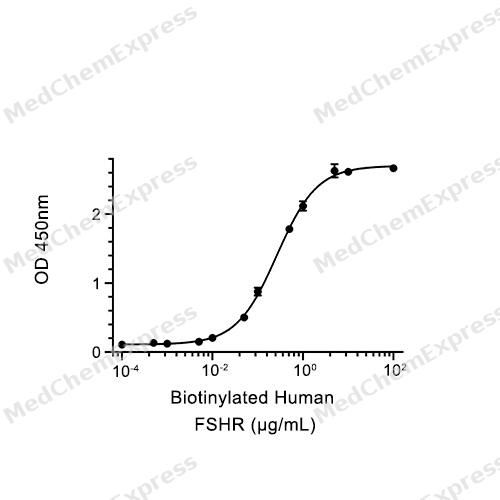
Bioactivity - ELISA
-
Bioactivity - ELISA
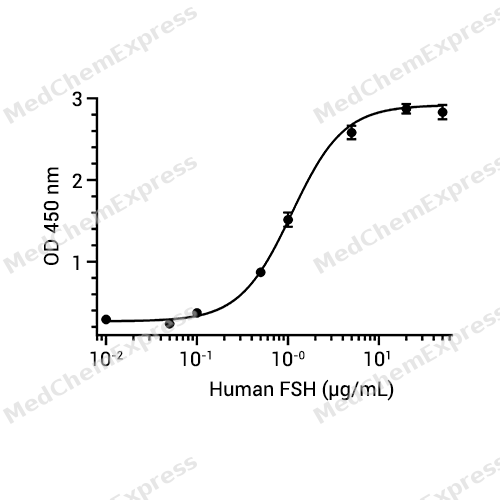
Bioactivity - ELISA


Technical Parameters
-
Species Human
-
Source E. coli
-
Tag N-6*His
-
Accession
P23945-1 (C18-R366)
-
Molecular Construction
-
N-term
-
6*His
-
FSHR (C18-R366)
Accession # P23945-1 -
C-term
-
-
Protein Length
Extracellular Domain
-
Synonyms
FSHR; FSHRO; Prev. ODG1; FSH Receptor; LGR1; FSHR1; Follicle-Stimulating Hormone Receptor; FSH-R; Follitropin Receptor; Follicle Stimulating Hormone Receptor; LRRNT Domain-Containing Protein
-
AA Sequence
CHHRICHCSNRVFLCQESKVTEIPSDLPRNAIELRFVLTKLRVIQKGAFSGFGDLEKIEISQNDVLEVIEADVFSNLPKLHEIRIEKANNLLYINPEAFQNLPNLQYLLISNTGIKHLPDVHKIHSLQKVLLDIQDNINIHTIERNSFVGLSFESVILWLNKNGIQEIHNCAFNGTQLDELNLSDNNNLEELPNDVFHGASGPVILDISRTRIHSLPSYGLENLKKLRARSTYNLKKLPTLEKLVALMEASLTYPSHCCAFANWRRQISELHPICNKSILRQEVDYMTQARGQRSSLAEDNESSYSRGFDMTYTEFDYDLCNEVVDVTCSPKPDAFNPCEDIMGYNILR
-
Peso molecular
Approximately 45 kDa, based on SDS-PAGE under reducing conditions.
-
Pureza
≥ 90%, as determined by reducing SDS-PAGE.


Product Properties
Lyophilized powder
1.Lyophilized from a 0.22 μm filtered solution of PBS, 6% Trehalose, pH 7.4 or
2.Lyophilized from a 0.22 μm filtered solution of 10 mM Tris-HCl, 1 mM EDTA, 6% Trehalose, pH 8.0.
Please refer to the lot-specific COA for specific buffer information.
Note: For SPR assay, please replace the buffer. Primary amine components (e.g., Tris, imidazole) can affect protein-coupled chips.
<1 EU/μg, determined by LAL method.
It is not recommended to reconstitute to a concentration less than 100 μg/mL in ddH2O.
Stored at -20°C for 2 years from date of receipt. After reconstitution, it is stable at 4°C for 1 week or -20°C for longer (with carrier protein). It is recommended to freeze aliquots at -20°C or -80°C for extended storage.
Room temperature in continental US; may vary elsewhere.


Documentación
-
Ficha de datos (237 KB)
-
SDS (251 KB)
- English - EN (251 KB)
- Français - FR (251 KB)
- Deutsch - DE (251 KB)
- Norwegian - NO (251 KB)
- Español - ES (251 KB)
- Swedish - SV (251 KB)
- Italian - IT (251 KB)
- Korean - KR (251 KB)
- Portuguese - PT (251 KB)
-
Instrucciones de manejo (2659 KB)

Calculators
Concentration (start) × Volume (start) = Concentration (final) × Volume (final)


 Powered by Bioz

