



Retatrutide acetate
Based on 5 publication(s) in Google Scholar
Retatrutide (LY3437943) acetate is a triple agonist peptide of the glucagon receptor (GCGR), glucosedependent insulinotropic polypeptide receptor (GIPR), and glucagon-like peptide-1 receptor (GLP-1R). Retatrutide acetate inhibits human GCGR, GIPR, and GLP-1R with EC50 values of 5.79, 0.0643 and 0.775 nM, respectively. Retatrutide acetate can be used for the research of obesity.
For research use only. We do not sell to patients.
- Purity : 99.69%
- Formula: C221H342N46O68.xC2H4O2
- Molecular Weight:4731.33 (free base)
-
Storage:
Sealed storage, away from moisture.
Powder -80°C, 2 years , -20°C, 1 year* In solvent : -80°C, 6 months; -20°C, 1 month (sealed storage, away from moisture)

To place orders, for customer services and technical support, please contact: MedChemExpress USA
Tel: 609-228-6898 E-mail: [email protected] [email protected]


-
 Biological Activity
-
Chemical Information
-
Solvent & Solubility
- Protocols
- Purity & Documentation
- References
-
 Help & FAQs


Publications Citing Use of MedChemExpress (MCE) Retatrutide acetate
More Customer Validation & Images

-
In Vivo Efficacy Study
-
Histological Imaging/Staining
-
IHC
-
In Vivo Efficacy Study
-
In Vivo Efficacy Study


Biological Activity
Description
IC50 & Target
EC50 (for human): 5.79 (GCGR), 0.0643 (GIPR), 0.775 nM (GLP-1R) [1].
EC50 (for mouse): 2.32 (GCGR), 0.191 (GIPR), 0.794 nM (GLP-1R) [1].
Ki (for human): 5.6 (GCGR), 0.057 (GIPR), 7.2 nM (GLP-1R) [1].
Ki (for mouse): 73 (GCGR), 2.8 (GIPR), 1.3 nM (GLP-1R)[1].
In Vitro
Retatrutide (LY3437943) acetate has efficacy for human GCGR, GIPR, and GLP-1R with EC50 values of 5.79, 0.0643 and 0.775 nM, respectively[1].
Retatrutide acetate has efficacy for mouse GCGR, GIPR, and GLP-1R with EC50 values of 2.32, 0.191 and 0.794 nM, respectively[1].
Retatrutide acetate has binding affinity for human GCGR, GIPR, and GLP-1R with Ki values of 5.6, 0.057 and 7.2 nM, respectively[1].
Retatrutide acetate has binding affinity for mouse GCGR, GIPR, and GLP-1R with Ki values of 73, 2.8 and 1.3 nM, respectively[1].
MedChemExpress (MCE) has not independently confirmed the accuracy of these methods. They are for reference only.
In Vivo
Retatrutide acetate (s.c.; 10 mL/kg; cycle every 3 days; for 21 days) causes great body weight loss and increases energy expenditure through glucagon receptor activatio[1].
Retatrutide acetate has safety and tolerability[1].
MedChemExpress (MCE) has not independently confirmed the accuracy of these methods. They are for reference only.
Clinical Trial
| NCT Number | Sponsor | Condition | Start Date |
Phase

|
|---|---|---|---|---|
| NCT01329991 | Plexxikon| | 2011-05 | PHASE1 |


Chemical Information
-
Appearance Solid
-
Molecular Weight 4731.33 (free base)
-
Formula C221H342N46O68.xC2H4O2
-
Color White to off-white
-
Synonyms
LY3437943 acetate
-
Sequence
Tyr-{Aib}-Gln-Gly-Thr-Phe-Thr-Ser-Asp-Tyr-Ser-Ile-{a-Me-Leu}-Leu-Asp-Lys-Lys(AEEA-γGlu-C20 diacid)Ala-Gln-{Aib}-Ala-Phe-Ile-Glu-Tyr-Leu-Leu-Glu-Gly-Gly-Pro-Ser-Ser-Gly-Ala-Pro-Pro-Pro-Ser-NH2
-
Sequence Shortening
Y-{Aib}-QGTFTSDYSI-{α-Me-Leu}-LDK-Lys(AEEA-γGlu-C20 diacid)-AQ-{Aib}-AFIEYLLEGGPSSGAPPPS-NH2
-
Shipping
Room temperature in continental US; may vary elsewhere.
-
Storage
Sealed storage, away from moisture
Powder -80°C 2 years -20°C 1 year * In solvent : -80°C, 6 months; -20°C, 1 month (sealed storage, away from moisture)


Publications (5)
-
Journal Impact Factor
-
Most Recent
-
-
Int J Obes
Efficacy of GLP-1 analog peptides, semaglutide, tirzepatide, and retatrutide on MC4R deficient obesity and their comparison. [Abstract]2026 Feb 21. PMID: 41723268 -
-
Endocrine
Comparison of the effects of Liraglutide, Tirzepatide, and Retatrutide on diabetic kidney disease in db/db mice. [Abstract]2025 Jan;87(1):159-169. PMID: 39212900
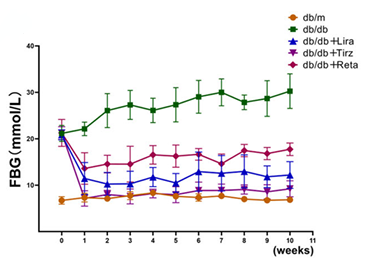
Retatrutide acetate purchased from MedChemExpress. Usage Cited in: Endocrine. 2025 Jan;87(1):159-169. [Abstract]
The mice received daily subcutaneous injections of 10 nmol/kg of Retatrutide for 10 weeks. Changes in fasting blood glucose (FBG) of mice in each group were recorded.
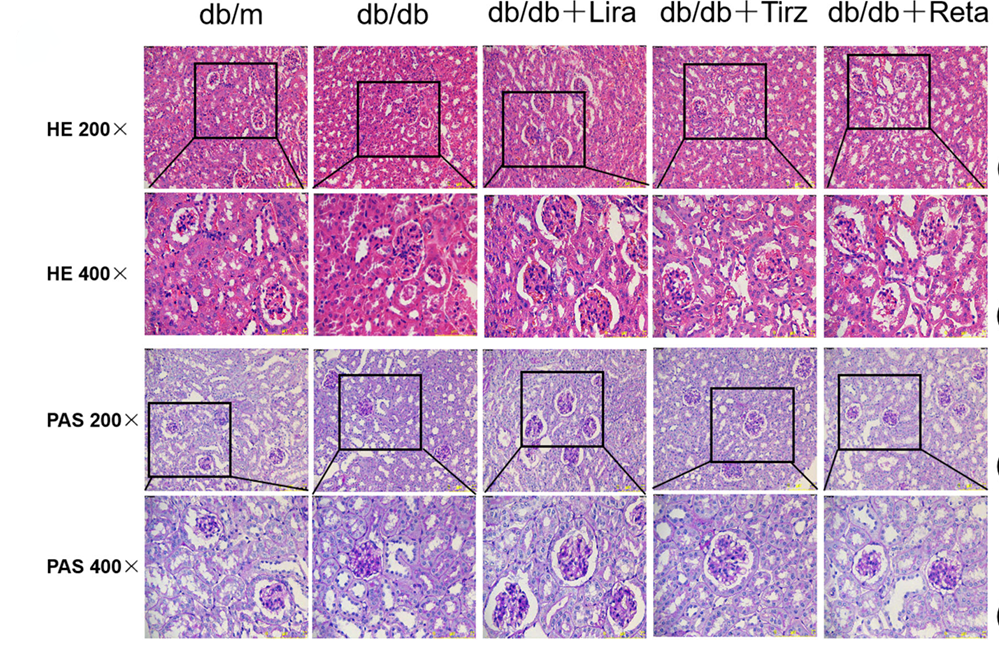
Retatrutide acetate purchased from MedChemExpress. Usage Cited in: Endocrine. 2025 Jan;87(1):159-169. [Abstract]
The mice received daily subcutaneous injections of 10 nmol/kg of Retatrutide for 10 weeks. Representative HE and PAS stained images of the kidneys of mice in each group were obtained.
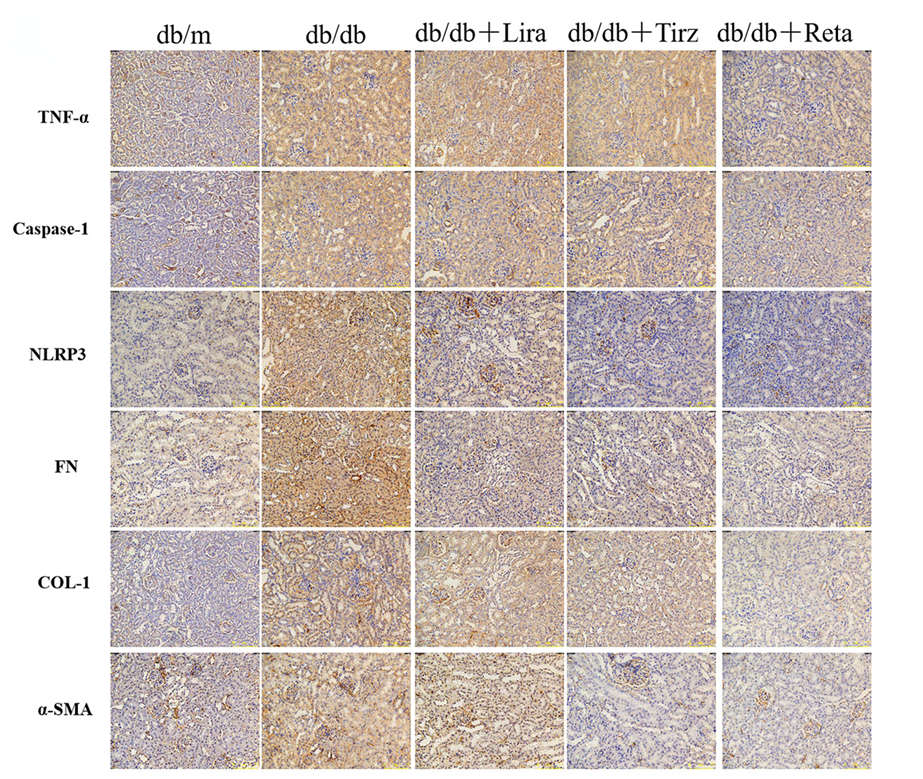
Retatrutide acetate purchased from MedChemExpress. Usage Cited in: Endocrine. 2025 Jan;87(1):159-169. [Abstract]
The mice received daily subcutaneous injections of 10 nmol/kg of Retatrutide for 10 weeks. Representative immunohistochemical staining of TNF-α, Caspase-1, NLRP3, fibronectin, collagen I, and α-SMA in renal tissue of mice in each group was performed.
-
NPJ Metab Health Dis
Incretin triple agonist retatrutide (LY3437943) alleviates obesity-associated cancer progression. [Abstract]2025;3(1):10. PMID: 40094000
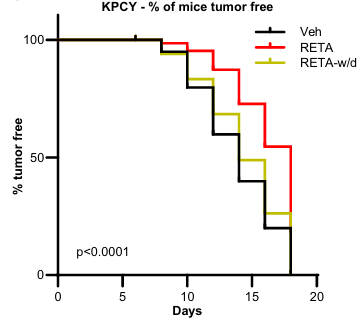
Retatrutide acetate purchased from MedChemExpress. Usage Cited in: NPJ Metab Health Dis. 2025;3(1):10. [Abstract]
Mice were subcutaneously administered either Veh, 30 nmol/kg Retatrutide, or 30 nmol/kg SEMA every other day before the initiation of the dark cycle at 5 pm. Survival curves were plotted as % of mice tumor-free for each group.
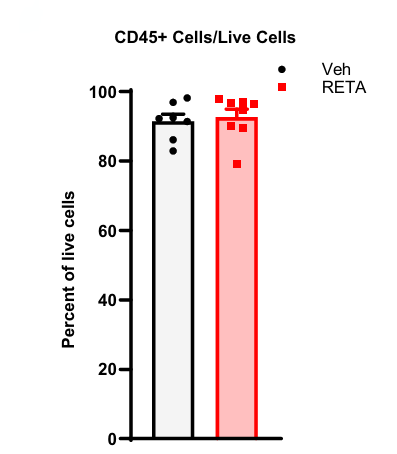
Retatrutide acetate purchased from MedChemExpress. Usage Cited in: NPJ Metab Health Dis. 2025;3(1):10. [Abstract]
Mice were subcutaneously administered either Veh, 30 nmol/kg Retatrutide, or 30 nmol/kg SEMA every other day before the initiation of the dark cycle at 5 pm. Frequencies of CD45+ cells/live cells were shown.


Solvent & Solubility
In Vitro:
DMSO : 100 mg/mL (Need ultrasonic; Hygroscopic DMSO has a significant impact on the solubility of product, please use newly opened DMSO)


Purity & Documentation
-
Data Sheet (291 KB)
-
SDS (254 KB)
- English - EN (254 KB)
- Français - FR (254 KB)
- Deutsch - DE (254 KB)
- Norwegian - NO (254 KB)
- Español - ES (254 KB)
- Swedish - SV (254 KB)
- Italian - IT (254 KB)
- Korean - KR (254 KB)
- Portuguese - PT (254 KB)
-
Handling Instructions (2659 KB)
References

Calculators
Concentration (start) × Volume (start) = Concentration (final) × Volume (final)


Retatrutide acetate Related Classifications
HY-P3506B Related Classifications
 Powered by Bioz