



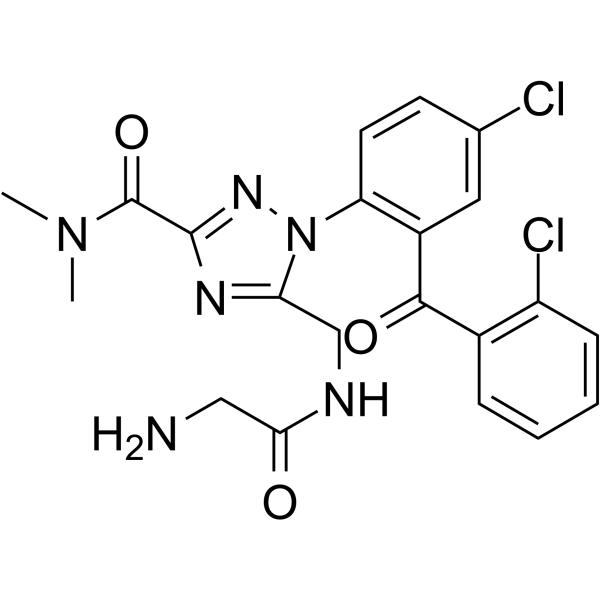
Rilmazafone
Rilmazafone (450191S) is an orally active sleep inducer. Rilmazafone targets cytochrome P-450b and cytochrome P-450e. Rilmazafone induces hepatic drug-metabolizing enzyme activity in rats, mice and dogs. Rilmazafone is applicable for insomnia-related research.
For research use only. We do not sell to patients.
- CAS No.: 99593-25-6
- Formula: C21H20Cl2N6O3
- Molecular Weight:475.33
-
Storage:
Please store the product under the recommended conditions in the Certificate of Analysis.

To place orders, for customer services and technical support, please contact: MedChemExpress USA
Tel: 609-228-6898 E-mail: [email protected] [email protected]


-
 Biological Activity
-
Chemical Information
- Purity & Documentation
- References
-
 Help & FAQs




Biological Activity
Description
In Vivo
Rilmazafone (450191S) (0.3-3 mg/kg; p.o.; single dose) exerts dose-dependent hypnotic effects in sleep-disturbed male Wistar rats, with significant sleep latency reduction at 1 and 3 mg/kg, significant awake time reduction and non-REM sleep time increase at 3 mg/kg, and significant reductions in non-REM sleep delta activity at 1 and 3 mg/kg, while leaving REM sleep time unchanged at all tested doses[2].
MedChemExpress (MCE) has not independently confirmed the accuracy of these methods. They are for reference only.
-
Animal Model:Jcl Sprague-Dawley (adult male, 7-8 weeks old)[1]
-
Dosage:200 mg/kg (5-day pretreatment + single dose); 600 mg/kg (3-day pretreatment + 200 mg/kg single dose); 200 mg/kg (single dose, liver collection); 600 mg/kg (3-day pretreatment)
-
Administration:p.o.; daily for 3 days; daily for 5 days; single dose
-
Result:Showed plasma levels of metabolite M-1 similar to controls at peak but undetectable by 4 hours post-dose, M-2 plus M-D peaked at 2 hours then decreased rapidly, and M-3 plus M-A peaked between 2-4 hours then decreased rapidly in rats pretreated with 200 mg/kg daily for 5 days followed by 200 mg/kg single dose.
Showed peak plasma levels of all measured metabolites (M-1, M-2 plus M-D, M-3 plus M-A) significantly lower than controls, with M-1 peaking at 15-60 minutes, M-2 plus M-D peaking at 1 hour, and M-3 plus M-A peaking at 2 hours, all declining rapidly thereafter in rats pretreated with 600 mg/kg daily for 3 days followed by 200 mg/kg single dose.
Suppressed hepatic 7-methoxycoumarin O-demethylase activity to 45.1 nmol/min/g liver, a statistically significant reduction compared to controls in rats given a single 200 mg/kg dose with liver collection at 6 hours.
Increased hepatic 7-methoxycoumarin O-demethylase activity to 130.7 nmol/min/g liver, 7-ethoxycoumarin O-deethylase activity to 220.8 nmol/min/g liver, and 7-propoxycoumarin O-depropylase activity to 175.7 nmol/min/g liver, all statistically significant increases compared to controls in rats given 600 mg/kg daily for 3 days.
-
Animal Model:Wistar rats (male, 240-320 g, sleep disturbance model)[2]
-
Dosage:0.3, 1, 3 mg/kg
-
Administration:p.o.; single dose
-
Result:Shortened sleep latency to 51.6 min (1 mg/kg) and 48.0 min (3 mg/kg), respectively, compared to control.
Decreased awake time to 198.0 min and increased non-REM sleep time to 139.0 min at 3 mg/kg compared to control.
Showed no significant effects on sleep latency, awake time, or non-REM sleep time at 0.3 mg/kg compared to control.
Caused no significant effects on total REM sleep time at all tested doses compared to control.


Chemical Information
-
CAS No. 99593-25-6
-
Molecular Weight 475.33
-
Formula C21H20Cl2N6O3
-
SMILES
NCC(NCC1=NC(C(N(C)C)=O)=NN1C2=C(C=C(Cl)C=C2)C(C3=C(C=CC=C3)Cl)=O)=O
-
Shipping
Room temperature in continental US; may vary elsewhere.
-
Storage
Please store the product under the recommended conditions in the Certificate of Analysis.


Purity & Documentation
References

Calculators
Concentration (start) × Volume (start) = Concentration (final) × Volume (final)


Rilmazafone Related Classifications
HY-106547 Related Classifications
 Powered by Bioz