



Saviprazole

Based on 1 Customer Validation
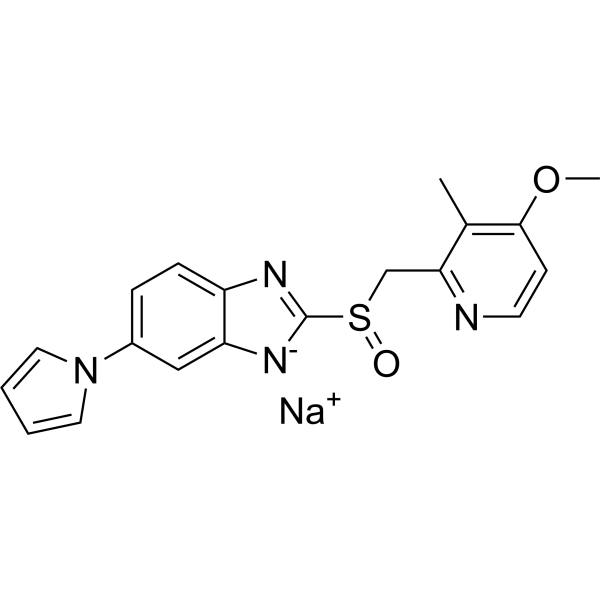
Saviprazole (HOE-731) is a H+,K+-ATPase inhibitor. Saviprazole inhibits gastric acid secretion. Saviprazole inhibits histamine- and dbcAMP-stimulated [14C]aminopyrine uptake, dbcAMP-induced oxygen consumption. Saviprazole can be used in research related to gastrointestinal diseases, such as gastric ulcers and acid reflux.
For research use only. We do not sell to patients.
- Purity : 96.05%
- CAS No.: 121617-11-6
- Formula: C15H10F7N3O2S2
- Molecular Weight:461.38
-
Storage:Powder -20°C, 3 years ; In solvent -80°C, 6 months , -20°C, 1 month


To place orders, for customer services and technical support, please contact: MedChemExpress USA
Tel: 609-228-6898 E-mail: [email protected] [email protected]


-
 Biological Activity
-
Chemical Information
-
Solvent & Solubility
- Purity & Documentation
- References
-
 Help & FAQs




Biological Activity
Description
In Vitro
Saviprazole (0.1-30 μM; 20 min pre-stimulation) non-competitively inhibits histamine- and dbcAMP-stimulated [14C] aminopyrine uptake in isolated rabbit gastric glands with IC50 values of 0.8 μM and 1.3 μM, respectively, and this inhibition is reversible with Dithioerythritol (HY-15916)[1].
Saviprazole (100 μM; 45 min) inhibits dbcAMP-stimulated oxygen consumption in isolated rabbit gastric glands down to basal levels, and this effect is dependent on an acidic parietal cell compartment, as it is fully prevented by 10 mM Imidazole (HY-114481)[1].
Saviprazole potently inhibits gastric H+,K+-ATPase and proton transport in gastric vesicles[2].
MedChemExpress (MCE) has not independently confirmed the accuracy of these methods. They are for reference only.
In Vivo
Saviprazole (0.1-30 mg/kg; i.d.; single dose) causes dose-dependent inhibition of basal and secretagogue-stimulated gastric acid secretion in pylorus-ligated rats, with ID50 values ranging from 0.9 to 2.5 mg/kg[2].
Saviprazole (0.1-1 mg/kg; i.v.; single dose) causes dose-dependent inhibition of receptor- and postreceptor-stimulated gastric acid secretion in anesthetized stomach-lumen-perfused rats, with 0.5 mg/kg reducing IBMX (HY-12318) + Forskolin (HY-15371)-stimulated secretion by ~70%[2].
MedChemExpress (MCE) has not independently confirmed the accuracy of these methods. They are for reference only.
-
Animal Model:Heidenhain pouch dogs[2]
-
Dosage:0.03 mg/kg; 0.1 mg/kg; 0.3 mg/kg; 1.0 mg/kg
-
Administration:i.v.; single dose; i.d.; single dose
-
Result:Caused dose-dependent inhibition of histamine-stimulated gastric acid secretion, with ID50 values of 0.16 mg/kg (i.v.) and 0.31 mg/kg (i.d.).
Caused an immediate 80% drop in acid output after administration of 0.3 mg/kg i.v. during stimulated secretion; acid output was about half maximal on day 2 and approached control values on day 3.
Showed no inhibitory effect when 0.3 mg/kg i.v. was administered 3 hours prior to histamine stimulation.
Caused immediate complete inhibition of acid output at 1 mg/kg i.v., which lasted only 30 minutes, after which acid output rose to ~10% of maximally stimulated levels.


Chemical Information
-
CAS No. 121617-11-6
-
Appearance Solid
-
Molecular Weight 461.38
-
Formula C15H10F7N3O2S2
-
Color Brown to black
-
SMILES
O=S(CC1=NC=CC(OCC(F)(C(F)(C(F)(F)F)F)F)=C1)C2=NC3=CSC=C3N2
-
Synonyms
HOE-731
-
Shipping
Room temperature in continental US; may vary elsewhere.
-
Storage
Powder -20°C 3 years In solvent -80°C 6 months -20°C 1 month


Solvent & Solubility
In Vitro:
DMSO : 100 mg/mL (216.74 mM; Need ultrasonic; Hygroscopic DMSO has a significant impact on the solubility of product, please use newly opened DMSO)
Please refer to the solubility information to select the appropriate solvent. Once prepared, please aliquot and store the solution to prevent product inactivation from repeated freeze-thaw cycles.
Storage method and period of stock solution: -80°C, 6 months; -20°C, 1 month. When stored at -80°C, please use it within 6 months. When stored at -20°C, please use it within 1 month.
Please refer to the solubility information to select the appropriate solvent. Once prepared, please aliquot and store the solution to prevent product inactivation from repeated freeze-thaw cycles.
Storage method and period of stock solution: -80°C, 6 months; -20°C, 1 month. When stored at -80°C, please use it within 6 months. When stored at -20°C, please use it within 1 month.
Concentration (start) × Volume (start) = Concentration (final) × Volume (final)


Purity & Documentation
-
Data Sheet (273 KB)
-
SDS (252 KB)
- English - EN (252 KB)
- Français - FR (252 KB)
- Deutsch - DE (252 KB)
- Norwegian - NO (252 KB)
- Español - ES (252 KB)
- Swedish - SV (252 KB)
- Italian - IT (252 KB)
- Korean - KR (252 KB)
- Portuguese - PT (252 KB)
-
Handling Instructions (2659 KB)
References
[1]. Herling AW, et al. The inhibitory effect of HOE 731 in isolated rabbit gastric glands. Biochem Pharmacol. 1990;40(8):1809-1814. [Content Brief]
[2]. Herling AW, et al. Gastric acid inhibitory profile of saviprazole (HOE 731) compared to omeprazole. Pharmacology. 1991;43(6):293-303. [Content Brief]


Complete Stock Solution Preparation Table
Please refer to the solubility information to select the appropriate solvent. Once prepared, please aliquot and store the solution to prevent product inactivation from repeated freeze-thaw cycles.
Storage method and period of stock solution: -80°C, 6 months; -20°C, 1 month. When stored at -80°C, please use it within 6 months. When stored at -20°C, please use it within 1 month.
| Optional Solvent | Concentration Solvent Mass | 1 mg | 5 mg | 10 mg | 25 mg |
|---|---|---|---|---|---|
| DMSO | 1 mM | 2.1674 mL | 10.8371 mL | 21.6741 mL | 54.1853 mL |
| 5 mM | 0.4335 mL | 2.1674 mL | 4.3348 mL | 10.8371 mL | |
| 10 mM | 0.2167 mL | 1.0837 mL | 2.1674 mL | 5.4185 mL | |
| 15 mM | 0.1445 mL | 0.7225 mL | 1.4449 mL | 3.6124 mL | |
| 20 mM | 0.1084 mL | 0.5419 mL | 1.0837 mL | 2.7093 mL | |
| 25 mM | 0.0867 mL | 0.4335 mL | 0.8670 mL | 2.1674 mL | |
| 30 mM | 0.0722 mL | 0.3612 mL | 0.7225 mL | 1.8062 mL | |
| 40 mM | 0.0542 mL | 0.2709 mL | 0.5419 mL | 1.3546 mL | |
| 50 mM | 0.0433 mL | 0.2167 mL | 0.4335 mL | 1.0837 mL | |
| 60 mM | 0.0361 mL | 0.1806 mL | 0.3612 mL | 0.9031 mL | |
| 80 mM | 0.0271 mL | 0.1355 mL | 0.2709 mL | 0.6773 mL | |
| 100 mM | 0.0217 mL | 0.1084 mL | 0.2167 mL | 0.5419 mL |


Saviprazole Related Classifications
HY-101646 Related Classifications
 Powered by Bioz