7 Results for "

3xTg-AD

" in MedChemExpress (MCE) Product Catalog:
Products (7)

7 Results for "3xTg-AD" in MCE Product Catalog:

12
12 Cited Publications
Cat. No.: HY-12723
CAS No.: 58-00-4
Purity:  98.05%
Synonyms: (-)-Apomorphine
Apomorphine ((-)-Apomorphine) is a potent dopamine receptor agonist. Apomorphine also inhibit MAO-A and MAO-B. Apomorphine exerts neuroprotective effect and can relax rat corpus cavernosum. Apomorphine can inhibit ROS production, DNA fragmentation and inibit JNK and ERK1/2 phosphorylation. Apomorphine can enhance degradation of intracellular Aβ40 and Aβ42, reduces tau protein levels and inhibit MMP-9 expression. Apomorphine is a highly potent radical scavenger and iron chelator. Apomorphine can be used for the researches of dementia, parkinson's disease, alzheimer disease, breast carcinoma, and erectile dysfunction [3] .
loading...
    loading...
Cat. No.: HY-138669
CAS No.: 2417159-57-8
Purity:  99.37%
Target:  

PROTACs Tau Protein

Research Areas:  

Neurological Disease

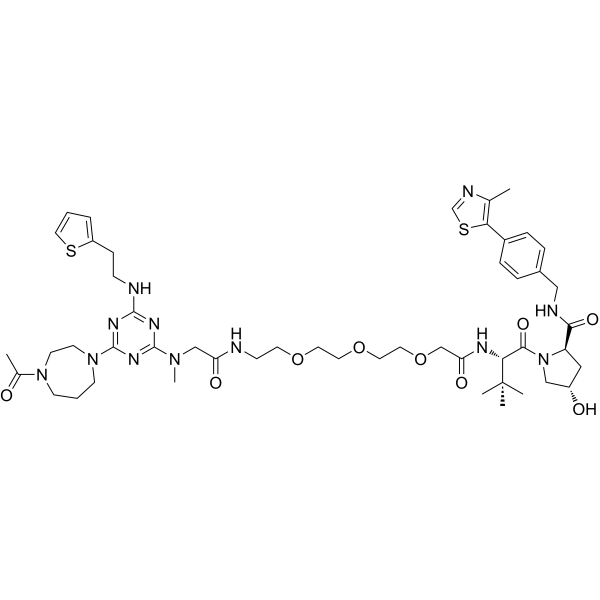
C004019 is a BBB-penetrable and small-molecule PROTAC that targets tau. C004019 can simultaneously recruit tau and E3 ligase, and effectively clear tau proteins by promoting the ubiquitination and proteasome-dependent degradation of tau, thereby improving synaptic and cognitive functions in Alzheimer's disease (AD) mice. C004019 can be used in the research of AD and tau protein-related diseases .
loading...
    loading...
Cat. No.: HY-176438
CAS No.: 3077900-08-1
Target:  

Tau Protein

Research Areas:  

Neurological Disease

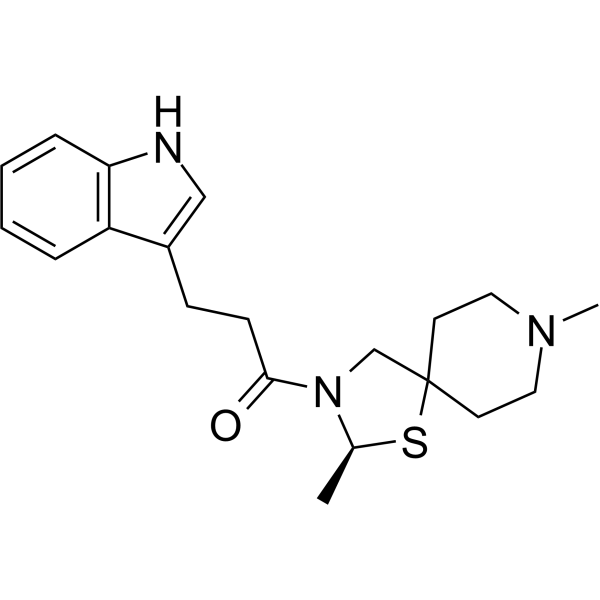
DDL-357 is a potent secreted clusterin enhancer. DDL-357 reduces phospho-tau in brain and improves memory in the murine 3xTg-AD model .
loading...
    loading...
Cat. No.: HY-116586
AF710B is an orally effective allosteric agonist for the M1 muscarinic receptor and σ1 receptor. AF710B activates the downstream phosphorylated ERK1/2 and phosphorylated CREB signaling pathways. AF710B simultaneously improves cognitive function and alleviates the core pathological features of Alzheimer's disease, including deposition, excessive Tau phosphorylation and neuroinflammation. AF710B is applicable to the research of Alzheimer's disease .
loading...
    loading...
Cat. No.: HY-184474
Target:  

LXR PPAR

Research Areas:  

Neurological Disease

AU403 is a potent, brain-penetrant, isoform-selective LXRβ/PPARδ dual agonist (EC50 ≈ 45 nM for LXRβ and EC50 ≈ 40 nM for PPARδ). AU403 is designed to bypass LXRα-driven hepatotoxicity. AU403 significantly improves cognitive functions and reduces amyloid-β plaque burden in 3xTg-AD mice. AU403 is a promising dual-acting agonist for the research of Alzheimer’s disease .
loading...
    loading...
Cat. No.: HY-184832
CAS No.: 1246751-68-7
Synonyms: Peptide 021
Target:  

Amyloid-β Tau Protein

Research Areas:  

Neurological Disease

P021 (Peptide 021) is an orally active, blood-brain barrier penetrant neurotrophic/neurogenic pentapeptide derived from the most active region of ciliary neurotrophic factor (CNTF). P021 competitively inhibits leukemia inhibitory factor (LIF) and promotes BDNF transcription. P021 targets neurogenesis and synaptic plasticity. P021 prevents neurodegeneration, Amyloid-β pathology, tau protein pathology and cognitive deficits, rescues episodic memory impairment and reduces mortality in 3xTg-AD mice. P021 is applicable to the research of Alzheimer's disease .
loading...
    loading...
Cat. No.: HY-183660
CAS No.: 1620896-55-0
Research Areas:  

Neurological Disease

F-SLOH is a brain-penerant and orally active TFEB activator and amyloid-β inhibitor with an IC50 of 3.4 μM against amyloid-β. F-SLOH promotes nuclear translocation of TFEB, driving autophagy and lysosomal biogenesis. F-SLOH reduces amyloid-β oligomers and Tau aggregates via autophagy lysosomal degradation pathway. F-SLOH can be used for the research of Alzheimer’s disease .
loading...
    loading...

