



AF710B
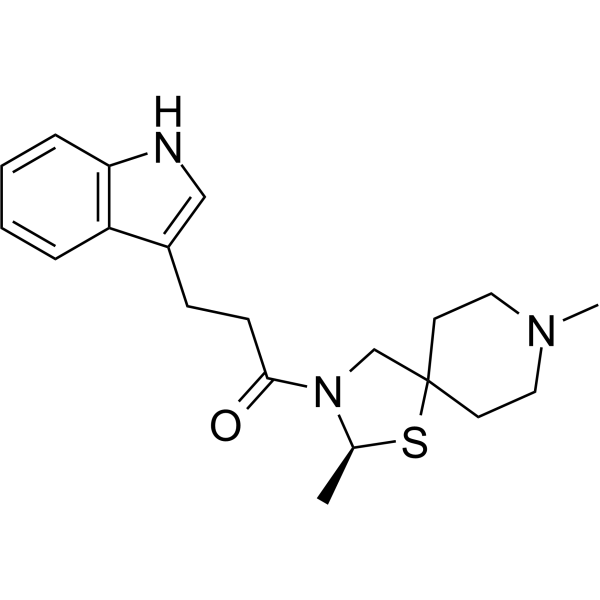
AF710B is an orally effective allosteric agonist for the M1 muscarinic receptor and σ1 receptor. AF710B activates the downstream phosphorylated ERK1/2 and phosphorylated CREB signaling pathways. AF710B simultaneously improves cognitive function and alleviates the core pathological features of Alzheimer's disease, including Aβ deposition, excessive Tau phosphorylation and neuroinflammation. AF710B is applicable to the research of Alzheimer's disease.
For research use only. We do not sell to patients.
- Formula: C20H27N3OS
- Molecular Weight:357.51
-
Storage:
Please store the product under the recommended conditions in the Certificate of Analysis.

To place orders, for customer services and technical support, please contact: MedChemExpress USA
Tel: 609-228-6898 E-mail: [email protected] [email protected]


-
 Biological Activity
-
Chemical Information
- Protocols
- Purity & Documentation
- References
-
 Help & FAQs


All Sigma Receptor Isoforms
More

Biological Activity
Description
In Vitro
AF710B (0.1-10 nM; 3 h) potentiates carbachol-induced ERK1/2 and CREB phosphorylation in starved PC12M1 cells without inducing these responses independently[1].
AF710B (30 nM; 16 h) rescues mushroom spine loss in PS1-KI and APP-KI primary hippocampal neuronal cultures via a mechanism requiring functional M1 mAChRs and intact σ1R expression, with no effect on nTg cultures[1].
MedChemExpress (MCE) has not independently confirmed the accuracy of these methods. They are for reference only.
-
Cell Line:rat pheochromocytoma PC12 cells stably transfected with rat M1 mAChR (PC12M1 cells)
-
Concentration:0.1, 1 and 10 nM
-
Incubation Time:3 h (pretreatment); 10 min (carbachol treatment)
-
Result:Did not increase phospho-ERK1/2 or phospho-CREB levels independently.
Significantly potentiated carbachol-induced phosphorylation of ERK1/2 and CREB at all tested concentrations.
In Vivo
AF710B (10 µg/kg; i.p.; once daily for 2 months) improves cognitive function in mice, and reduces Aβ pathology, excessive tau phosphorylation, and neuroinflammation[1].
MedChemExpress (MCE) has not independently confirmed the accuracy of these methods. They are for reference only.
-
Animal Model:Wistar (male and female, 3 months old, 225-250 gr, trihexyphenidyl-induced cognitive impairment)[1]
-
Dosage:1 µg/kg; 3 µg/kg; 10 µg/kg; 30 µg/kg; 100 µg/kg
-
Administration:p.o.; single dose
-
Result:Significantly increased retention latency in trihexyphenidyl-treated rats compared to vehicle-treated trihexyphenidyl rats at 1, 3, 10, and 30 µg/kg doses.
Showed no significant effect at 100 µg/kg dose.
Demonstrated higher potency at 10 µg/kg dose than 100 µg/kg dose.
Lost anti-amnesic effect at 10 µg/kg dose when coadministered with σ1R antagonist NE-100.
-
Animal Model:129/C57BL/6 (female, 10-12 months old, 3xTg-AD Alzheimer's disease model)[1]
-
Dosage:10 µg/kg
-
Administration:i.p.; daily; 2 months
-
Result:Improved cognitive function, as shown by decreased escape latency during Morris water maze training and increased time spent in the target quadrant during the probe trial.
Significantly reduced levels of soluble and insoluble Aβ40 and Aβ42, and decreased Thioflavin S-positive amyloid plaques.
Lowered BACE1 expression and levels of the β-secretase-derived APP C-terminal fragment C99, while leaving full-length APP and α-secretase (ADAM10, ADAM17) levels unchanged.
Reduced total phosphorylated tau (AT-100 epitope) and specific phospho-tau epitopes (AT180, AT270, PHF-1), while total tau levels remained unchanged.
Increased inhibitory Ser9 phosphorylation of GSK3β and reduced levels of the CDK5 activator p25.
Decreased neuroinflammation, as shown by reduced GFAP-positive astrocytes and Iba-1-positive microglia in the vicinity of Aβ plaques.


Chemical Information
-
Molecular Weight 357.51
-
Formula C20H27N3OS
-
SMILES
C[C@@H]1SC2(CN1C(CCC3=CNC4=C3C=CC=C4)=O)CCN(CC2)C
-
Shipping
Room temperature in continental US; may vary elsewhere.
-
Storage
Please store the product under the recommended conditions in the Certificate of Analysis.


Purity & Documentation
References

Calculators
Concentration (start) × Volume (start) = Concentration (final) × Volume (final)


AF710B Related Classifications
HY-116586 Related Classifications
 Powered by Bioz